
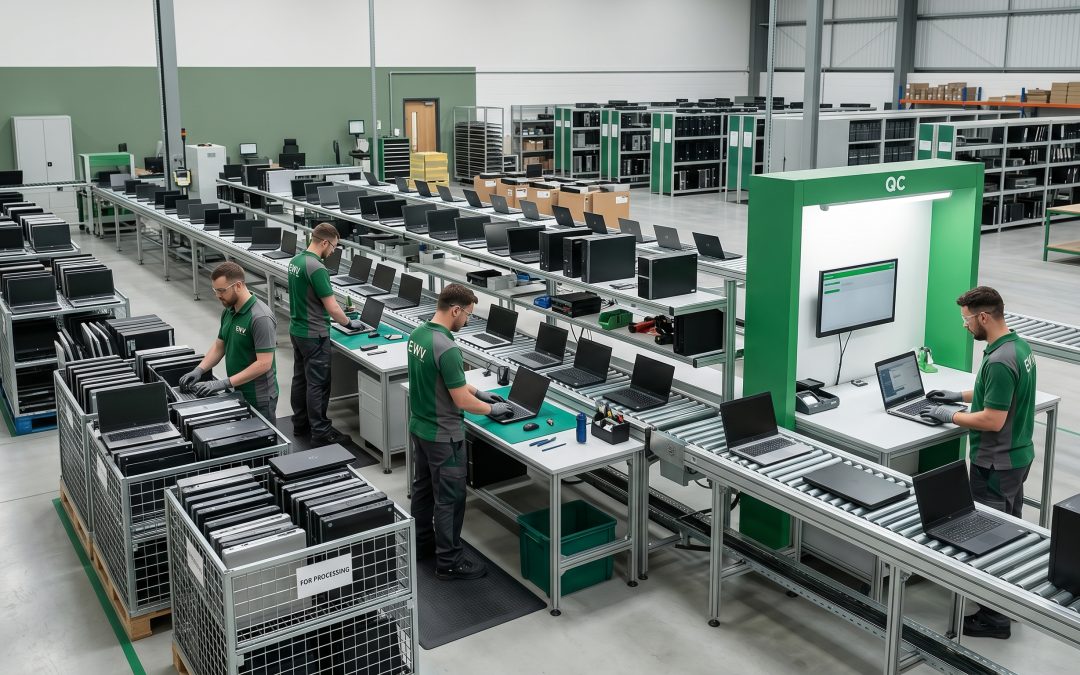
When organisations dispose of IT equipment, they rarely deal with one device at a time. Office refreshes, data centre decommissions, and end-of-lease returns typically involve dozens, hundreds, or even thousands of devices. Bulk device processing is the ITAD workflow designed to handle these volumes efficiently while maintaining the security, compliance, and environmental standards required for each individual device.
The Bulk Processing Workflow
A typical bulk processing engagement follows a structured sequence. It begins with collection, where equipment is picked up from one or more client sites. Devices are packed into secure containers, sealed, and transported to the processing facility. On arrival, every container is checked against the collection manifest to confirm nothing was lost or added during transit.
The next phase is intake and receiving. Each device is unpacked, scanned (by serial number or asset tag), and logged into the processing system. This creates the record that will follow the device through every subsequent step. Condition notes are made at this stage, and any immediate issues (such as missing devices or unexpected items) are flagged.
After intake, devices enter triage, where they are sorted into processing streams based on their type, condition, and the client’s instructions. Functional devices destined for remarketing go one way, devices requiring data destruction before recycling go another, and devices needing physical destruction go to yet another stream.
Data Destruction at Scale
Processing large volumes of devices through data destruction requires both the right technology and tight process controls. For software-based sanitisation, multiple devices are typically connected to wiping stations simultaneously. Professional ITAD facilities use rack-mounted systems that can wipe dozens of hard drives or SSDs in parallel, following standards like NIST 800-88.
Each device’s wipe result (pass or fail) is recorded individually against its serial number. Devices that fail software sanitisation are escalated to physical destruction. This two-tier approach maximises the number of devices that can be reused while ensuring that every device with unrecoverable data issues is still properly handled.
For physical destruction at volume, industrial shredders can process hundreds of hard drives per hour, reducing them to fragments small enough that data recovery is impossible. The shredded material is then sorted for metals recovery and recycling.
Testing and Grading
Devices in the remarketing stream undergo functional testing to determine their condition and resale value. Automated testing tools check hardware components (processor, memory, storage, display, battery, ports), run diagnostic benchmarks, verify that all data has been successfully removed, and assign a cosmetic grade based on the device’s physical appearance.
Grading systems vary by provider, but typically use categories like Grade A (excellent condition, minimal signs of use), Grade B (good condition, minor cosmetic wear), and Grade C (functional but with noticeable cosmetic issues). The grade directly affects the resale value and the remarketing channel used.
Environmental Processing
Devices that are not suitable for reuse enter the recycling stream. At a well-run facility, this involves manual disassembly to separate different material types, removal of hazardous components (batteries, mercury-containing backlights, certain capacitors), sorting of materials into categories (ferrous metals, non-ferrous metals, plastics, glass, circuit boards), and sending each material stream to appropriate specialist recyclers.
Circuit boards are particularly valuable in the recycling stream because they contain gold, silver, palladium, and copper. Proper processing of circuit boards recovers these valuable materials while preventing the release of hazardous substances that would occur if they were landfilled or improperly processed.
All of this must comply with environmental regulations, including Victoria’s e-waste landfill ban.
Quality Control
Maintaining quality at volume is the central challenge of bulk processing. Good ITAD providers implement quality controls at every stage: intake reconciliation to catch discrepancies immediately, spot checks during data destruction to verify wipe effectiveness, functional testing validation to ensure grading consistency, environmental processing audits to confirm proper material handling, and final reconciliation to verify that every incoming device has a documented outcome.
Reporting and Certification
At the conclusion of bulk processing, you should receive comprehensive documentation. This includes a reconciliation report matching every incoming device to its final disposition, individual certificates of destruction for all data-bearing devices, an environmental report detailing weights of materials recycled and diverted from landfill, and a financial summary if value recovery was part of the engagement.
This documentation package serves as your compliance record and should be stored according to your organisation’s retention policies.
Planning for Bulk Processing
To ensure smooth bulk processing, give your ITAD provider as much advance notice as possible about volumes and timing. Provide a detailed inventory list before collection so they can plan staffing and resources. Agree on processing priorities, especially if some devices need urgent data destruction while others can wait. And establish clear communication channels for questions or issues that arise during processing.
EWV handles IT asset disposition (ITAD) end-to-end for Victorian businesses — from collection and data destruction through to certified recycling or refurbishment for resale. Get in touch for a tailored ITAD quote.