
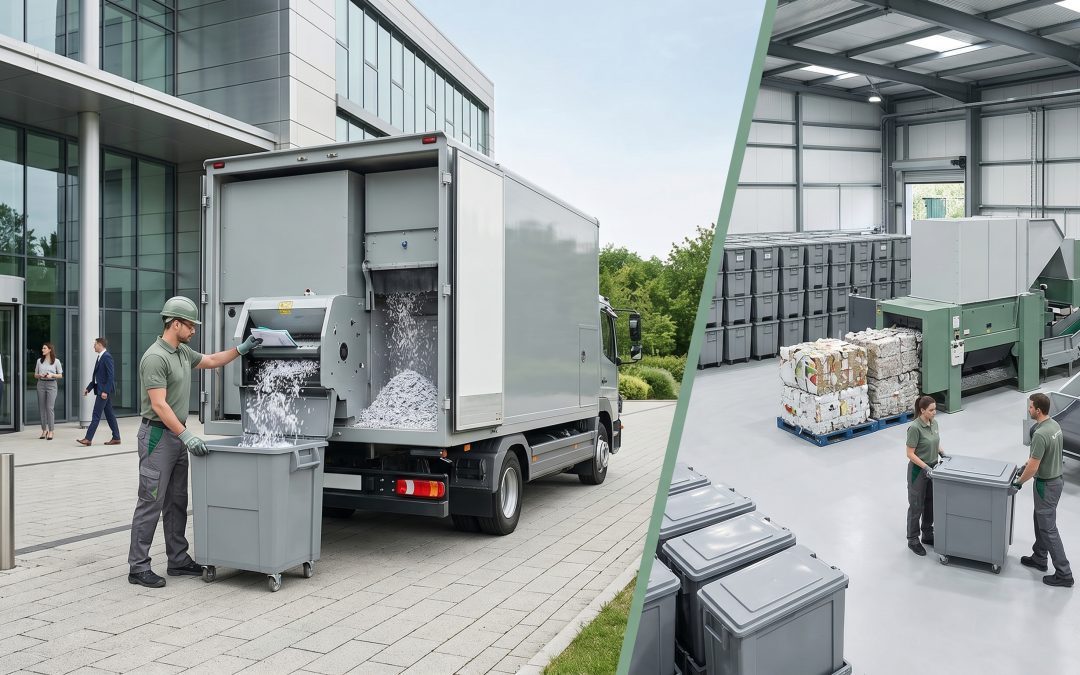
One of the first decisions organisations face when planning IT asset disposal is whether to have data destroyed on their own premises or at the ITAD provider’s facility. Both approaches have legitimate advantages, and the right choice depends on your security requirements, budget, volume, and operational constraints. Understanding the trade-offs helps you make an informed decision rather than defaulting to whichever option your provider prefers.
How On-Site Destruction Works
With on-site destruction, your ITAD provider brings equipment and personnel to your location. For software-based sanitisation, this typically involves portable wiping stations that connect to devices in your server room or staging area. For physical destruction, mobile shredding trucks or portable hard drive crushers are brought to your premises.
The key advantage is that data-bearing devices never leave your physical control until after the data has been destroyed. Your staff can witness the destruction process firsthand, and you eliminate the security risks associated with transporting equipment containing live data. The entire process, from disconnection to certified destruction, happens within your perimeter.
How Off-Site Destruction Works
With off-site destruction, equipment is collected from your premises and transported to the ITAD provider’s processing facility. Data destruction occurs at the facility using their permanently installed equipment, which is typically more capable and efficient than portable alternatives.
Off-site processing offers several practical advantages. The provider’s facility has industrial-grade equipment that can process higher volumes more quickly. Their controlled environment is purpose-built for data destruction, with proper dust extraction, safety systems, and quality controls. And the cost per device is usually lower because the provider does not need to mobilise trucks and technicians to your location.
Security Considerations
The security argument generally favours on-site destruction for the most sensitive assets. When devices containing highly classified, regulated, or particularly sensitive data need to be destroyed, eliminating the transport phase removes a significant risk variable. Government agencies, defence contractors, and financial institutions often mandate on-site destruction for their highest-security equipment.
However, the security advantage of on-site destruction depends entirely on how well the process is executed. A rushed on-site wipe performed in a busy office corridor may actually be less secure than a carefully controlled off-site process at a certified facility with CCTV, access controls, and dedicated staff. The quality of the provider and their processes matters more than the location.
For most organisations, a hybrid approach works well. Use on-site destruction for devices containing your most sensitive data (servers, executive laptops, devices with financial or health records), and off-site processing for standard workstations and peripherals where the security requirements are lower. This balances security with cost-effectiveness.
Cost Comparison
On-site destruction typically costs more per device than off-site processing. The provider needs to transport equipment and personnel to your location, set up temporary processing stations, and work within the constraints of your environment. For physical destruction, mobile shredding trucks have lower throughput than stationary industrial shredders, which means it takes longer to process the same volume.
Off-site processing benefits from economies of scale. The provider’s facility is optimised for throughput, their equipment is permanently installed and maintained, and they can batch your devices with other clients’ equipment for efficient processing. These efficiencies translate to lower per-unit costs.
The cost differential varies by provider and volume, but on-site destruction typically carries a premium of 30-50% over equivalent off-site services. For small volumes, the premium can be even higher due to minimum call-out charges.
Practical and Logistical Factors
On-site destruction requires suitable space at your premises. A mobile shredding truck needs vehicle access, and software wiping stations need power, network access (sometimes), and a secure area where work can proceed undisturbed. Not every site can easily accommodate these requirements, particularly in urban offices with limited parking or strict building management rules.
Timing is another factor. On-site destruction ties up space and may create noise (shredding is not quiet). You need to coordinate schedules between your team and the provider, which can be challenging if your site has limited windows for this type of work. Off-site processing happens on the provider’s schedule at their facility, requiring only that you coordinate the collection itself.
For organisations with multiple sites, logistics become more complex. On-site destruction at each location multiplies the mobilisation costs, while consolidating equipment at a central point for off-site processing may be more efficient for the overall ITAD program.
Verification and Witnessing
On-site destruction allows your staff to physically witness the process, which provides strong assurance and can simplify compliance documentation. Some organisations require witnessed destruction as a matter of policy for certain data classification levels.
Off-site destruction can still provide verification through video recording of the destruction process, CCTV footage of device handling at the facility, detailed certificates of destruction with individual device records, and the option for your staff to visit the facility and witness processing. When choosing an ITAD provider for off-site processing, their willingness to provide verification evidence and accommodate facility visits is an important selection criterion.
Making the Decision
Choose on-site when your devices contain highly classified or regulated data where transport risk is unacceptable, your organisation’s policy mandates witnessed destruction, you need immediate destruction with no gap between decommissioning and data removal, or regulatory requirements specify on-site processing.
Choose off-site when you are processing large volumes where cost efficiency matters, your devices contain standard business data without heightened security requirements, your premises cannot practically accommodate destruction equipment, or you need value recovery through remarketing (which can only be done at a processing facility).
Many organisations find that a thoughtful combination of both approaches, matched to the sensitivity level of different equipment categories, delivers the best balance of security and value.
EWV provides NIST 800-88 certified data destruction for Victorian businesses, covering software-based erasure and physical destruction with full chain-of-custody documentation. Request a quote to discuss your requirements.