
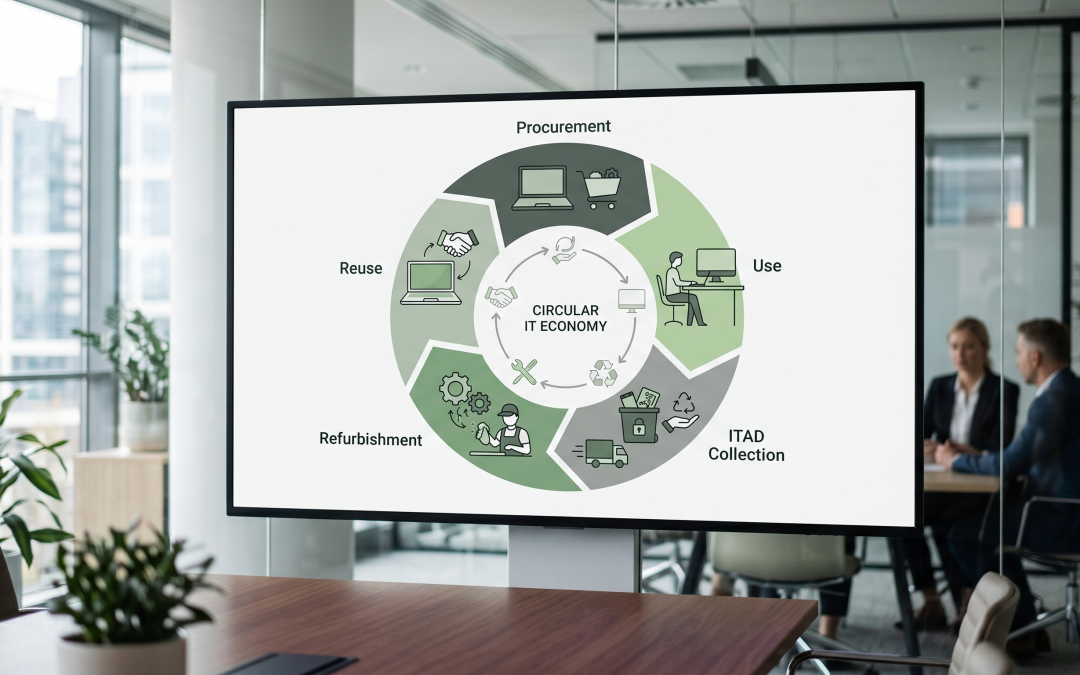
The circular economy reimagines how we think about products and materials, moving away from the traditional “take, make, dispose” model toward one where resources are kept in use for as long as possible. IT asset disposition sits at a critical junction in this model. Done well, ITAD is one of the most practical ways organisations can contribute to circular economy principles while also meeting their data security and compliance obligations.
What the Circular Economy Means for IT
In a circular economy, the goal is to extract maximum value from products and materials at every stage of their life. For IT equipment, this translates to several strategies applied in order of environmental preference: first, extend the useful life of equipment through maintenance, upgrades, and repair. Second, when the original user no longer needs the device, reuse it by remarketing it to a new owner. Third, when the device is no longer functional as a complete unit, recover components and parts for use in repairing other devices. And finally, when no further reuse is possible, recycle the materials back into the manufacturing supply chain.
Each of these strategies keeps materials in productive use longer and reduces the demand for virgin resources. The further up this hierarchy you can keep equipment, the greater the environmental benefit.
How ITAD Enables Circularity
A well-structured ITAD program is the practical mechanism for applying circular economy principles to IT equipment. The assessment and triage phase sorts equipment into the appropriate circularity stream, distinguishing between devices suitable for reuse, those better suited for parts recovery, and those that should go directly to materials recycling.
Data destruction enables reuse by making it safe to place equipment into secondary markets. Without certified data sanitisation, organisations cannot responsibly allow their retired devices to enter new hands. The ability to securely remove data while preserving device functionality is what makes IT equipment refurbishment and remarketing possible at scale.
Material recovery through recycling captures the raw materials in devices that cannot be reused. Circuit boards yield gold, silver, palladium, and copper. Steel and aluminium casings can be melted and reformed. Plastics can be recycled into new products. These recovered materials reduce the need for mining and manufacturing from scratch.
The Environmental Impact
The environmental case for circular IT is compelling. Manufacturing a new laptop generates roughly 300-400 kg of CO2 equivalent, consumes significant quantities of water, and requires mining of rare earth elements and other finite resources. Extending the life of an existing laptop through refurbishment and remarketing avoids all of that manufacturing impact.
Even when equipment reaches the end of its useful life as a product, recycling its materials captures substantial environmental savings compared to landfilling the device and manufacturing replacement materials from virgin sources. Understanding the true environmental cost of electronic waste makes the case for circular approaches clear.
Business Benefits of Circular ITAD
Beyond environmental responsibility, circular ITAD practices deliver tangible business benefits. Value recovery from remarketing offsets disposal costs and can generate net revenue, turning a cost centre into a partial revenue source. Extended equipment life through internal redeployment reduces procurement costs. Reduced waste generation lowers disposal fees and demonstrates responsible resource management.
For organisations with sustainability commitments or ESG reporting obligations, circular ITAD provides quantifiable metrics: devices reused, materials recovered, CO2 avoided, and landfill diverted. These metrics strengthen sustainability disclosures and demonstrate genuine progress toward stated environmental goals.
Challenges and Considerations
Implementing circular ITAD is not without challenges. Data security requirements sometimes conflict with reuse goals. Devices containing the most sensitive data may need to be physically destroyed rather than wiped and remarketed, even when they are in perfect working condition. This is a necessary trade-off where security must take priority.
The economics of refurbishment do not always work out. Very old equipment may cost more to refurbish than it is worth on the secondary market. Part of effective circular ITAD is recognising when recycling is the most appropriate option rather than forcing reuse where it does not make sense.
Supply chain transparency is another challenge. Once equipment leaves your possession for recycling, knowing exactly where materials end up requires robust tracking and auditing of downstream processors. Choosing certified providers who maintain visibility of their recycling supply chain helps ensure materials genuinely re-enter productive use.
Getting Started
If your current ITAD approach defaults to recycling everything, shifting toward a more circular model starts with better triage. Before any device is sent for recycling, ask whether it could be reused. Before components are shredded, assess whether they could be harvested for parts. These simple questions at the point of disposition can significantly increase the circularity of your IT program.
Work with your ITAD provider to understand their reuse capabilities and secondary market channels. A provider focused solely on recycling will naturally default to that outcome. A provider with strong remarketing capabilities will actively look for reuse opportunities, which benefits both the environment and your financial returns.
EWV provides e-waste collection and recycling for Victorian businesses, responsibly processing electronic equipment through certified downstream partners. Book a collection to keep your e-waste out of landfill.