
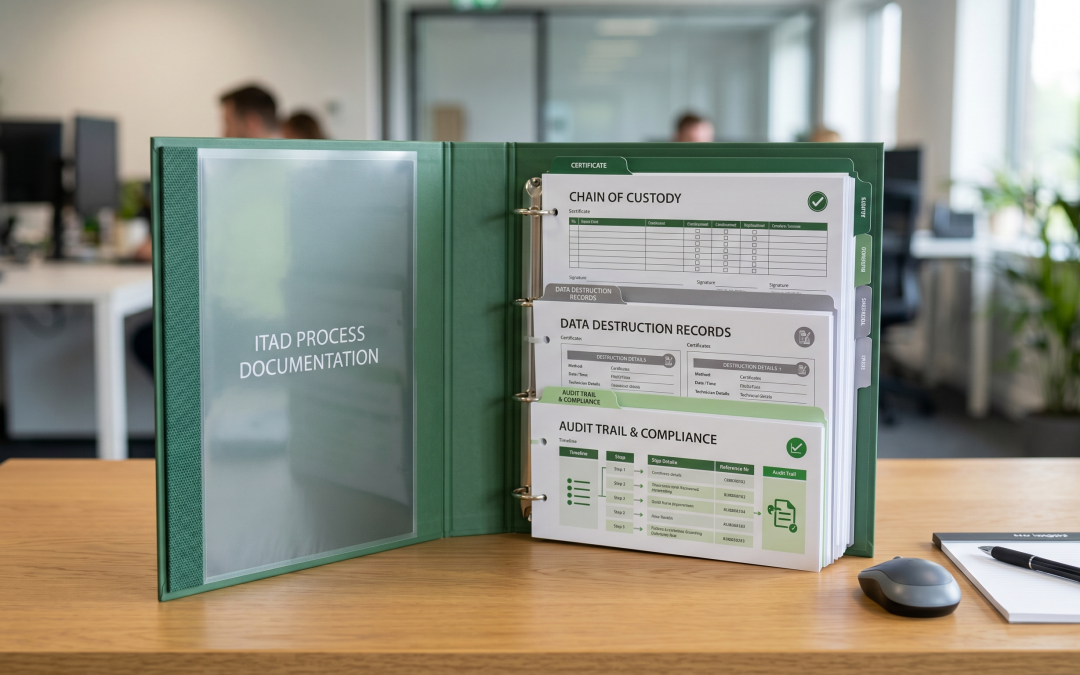
Documentation is the thread that ties your entire ITAD program together. Without proper records, you cannot prove compliance, track performance, resolve disputes, or learn from experience. Yet many organisations treat ITAD documentation as an afterthought, keeping some records haphazardly while letting others slip through the cracks. A systematic approach to process documentation protects your organisation and strengthens your program.
Why Documentation Matters
ITAD documentation serves multiple purposes across your organisation. For compliance, it provides evidence that you met your obligations under the Privacy Act, industry regulations, and environmental legislation. For risk management, it demonstrates due diligence in selecting providers and managing the disposal process. For financial accountability, it supports asset write-offs, value recovery reconciliation, and cost tracking. For continuous improvement, it provides the data needed to analyse program performance and identify opportunities for enhancement.
If a data breach is ever traced to disposed equipment, your documentation is the first thing investigators will examine. If an auditor asks how you disposed of specific assets, your documentation provides the answer. If a dispute arises with your ITAD provider, your documentation establishes the facts.
Essential Documents to Retain
Several categories of documentation should be systematically created and retained for every disposal project or cycle.
The asset disposal inventory is the list of all equipment identified for disposal, with serial numbers, asset tags, data classification, and intended disposition. This is your starting point and the document against which everything else is reconciled.
Collection manifests record exactly what equipment was collected, when, by whom, and under what conditions. These should be signed by both your representative and the collection team, with seal numbers and container identifiers noted.
Certificates of destruction confirm that data destruction was completed for each data-bearing device. Each certificate should reference individual serial numbers, the destruction method used, the standard followed, and the outcome.
Processing reports from your ITAD provider detail what happened to each device after collection: whether it was wiped and remarketed, physically destroyed, or recycled. These reports should reconcile back to your collection manifests.
Environmental reports document the environmental outcomes: weight of materials recycled, landfill diversion rate, CO2e avoided, and any hazardous materials handled. These feed into your sustainability reporting.
Financial records include invoices, value recovery statements, and any buy-back payments. These support your financial accounting and help track the net cost of your ITAD program.
Provider Documentation
Maintain a file for each ITAD provider you engage, containing their current certifications and accreditations, your service agreement or contract, their insurance certificates, results of any facility audits or inspections, SLA performance records, and any incident reports or corrective actions.
This provider file supports your due diligence obligations and provides evidence that you selected and monitored your providers appropriately.
Retention Periods
How long you need to retain ITAD documentation depends on your industry and the types of data involved. As a general guideline, destruction certificates should be retained for at least seven years, which aligns with common regulatory retention requirements in Australia. Some industries require longer retention, up to 10 or even 25 years in certain healthcare and government contexts.
Provider agreements, audit reports, and financial records should be retained according to your organisation’s standard records management policy. When in doubt, retain longer rather than shorter, as the cost of storage is minimal compared to the risk of not having records when needed.
Review your retention requirements with your legal and compliance teams, particularly if you operate in regulated industries. The regulatory landscape may impose specific retention obligations that override general guidelines.
Storage and Organisation
Organise your ITAD documentation so it can be retrieved quickly when needed. A logical structure might organise records by disposal project or cycle, with each project folder containing the inventory, collection manifests, processing reports, destruction certificates, environmental reports, and financial records.
Digital storage is preferred over paper for searchability, durability, and access control. Ensure digital records are backed up and that access is restricted to authorised personnel. Some ITAD providers offer online portals where documentation is stored and can be accessed on demand, which provides convenient access but should not be your only copy.
Using Documentation for Improvement
Beyond compliance, ITAD documentation is a rich source of operational insights. Analyse destruction certificate data to track first-pass wipe success rates across device types. Review environmental reports to identify trends in material recovery. Compare financial records across disposal cycles to assess cost efficiency. And examine processing timelines to evaluate whether SLAs are being met consistently.
This analysis transforms documentation from a compliance requirement into a management tool that drives continuous improvement in your ITAD program.
EWV handles IT asset disposition (ITAD) end-to-end for Victorian businesses — from collection and data destruction through to certified recycling or refurbishment for resale. Get in touch for a tailored ITAD quote.