
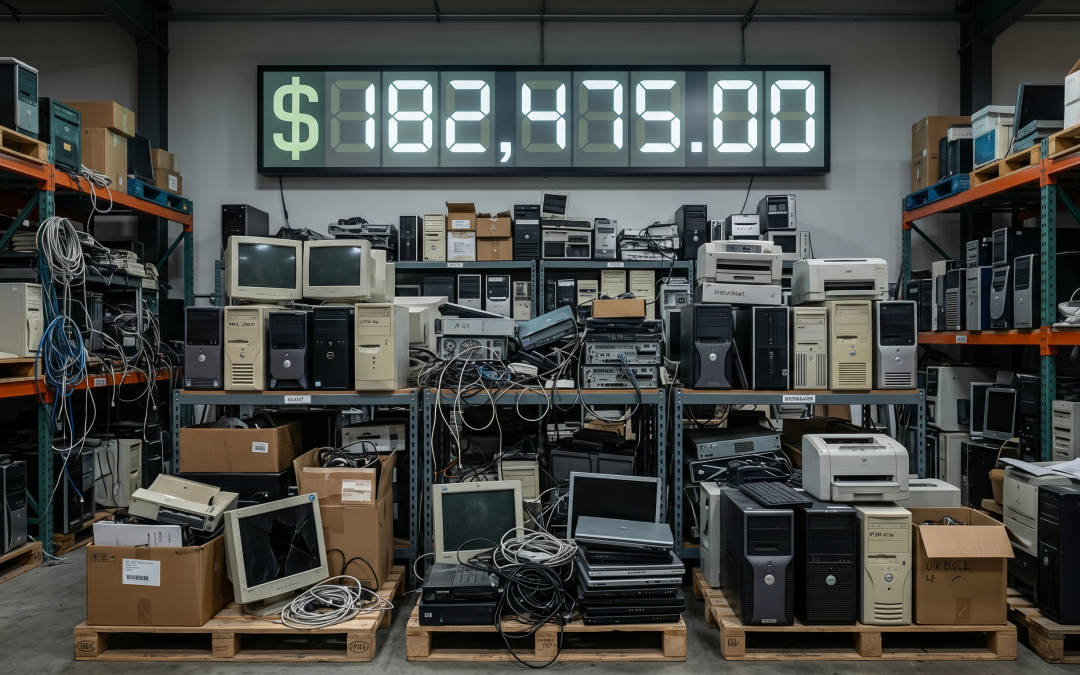
Almost every organisation has a cupboard, storage room, or corner of the server room filled with old IT equipment that nobody has gotten around to disposing of. It seems harmless, even prudent, to keep old devices “just in case.” But hoarding retired IT equipment comes with real costs that accumulate quietly and are easy to underestimate until you add them up.
The Space Cost
Office space is expensive. In Melbourne’s CBD, commercial rent can easily exceed $500 per square metre per year. Even in suburban locations, the cost is substantial. Every square metre occupied by old equipment sitting in storage is space that could be used productively or eliminated from your lease entirely.
A server room rack full of decommissioned equipment is not just using floor space. It may also be consuming power (some equipment gets left plugged in), generating heat that your cooling system needs to handle, and occupying rack space that could accommodate current infrastructure. In co-located facilities where you pay per rack unit, this cost is immediately quantifiable.
Storage rooms full of old laptops, desktops, and monitors take up space that facilities teams could use for other purposes. In organisations where meeting rooms and collaborative spaces are in demand, repurposing storage areas has real operational value.
The Security Risk Cost
Old IT equipment sitting in storage still contains all the data it held when it was last used. Customer records, financial data, employee information, intellectual property, and authentication credentials may all be sitting on devices in your storeroom, often with minimal security.
The longer equipment sits in storage, the greater the risk that security controls erode. Storage rooms get repurposed, access controls lapse, and equipment gets moved around without documentation. A data breach from a stolen or improperly handled device in storage can cost millions in remediation, notification, and reputational damage.
Under the Notifiable Data Breaches scheme, organisations must report breaches that are likely to result in serious harm. A breach from a stockpiled device that should have been properly disposed of months or years earlier is a particularly uncomfortable situation to explain to regulators and affected individuals.
The Depreciation Cost
IT equipment loses value rapidly. A business laptop that could have been remarketed for $400 immediately after retirement might be worth $200 a year later and almost nothing after two years. Every month you hold onto equipment that could be resold, you are losing money.
The depreciation curve for IT equipment is steep and predictable. New product releases, changing specifications, and evolving market preferences all drive secondary market prices downward over time. The optimal time to remarketing equipment for maximum value recovery is as soon as possible after it is no longer needed.
Multiply the per-device value loss by hundreds or thousands of stockpiled devices and the financial impact becomes significant. For organisations that regularly refresh technology, the cumulative value lost through delayed disposal can easily reach tens of thousands of dollars annually.
The Compliance Cost
Stockpiled equipment creates ongoing compliance obligations that are easy to overlook. Under the Australian Privacy Principles, you must take reasonable steps to protect personal information for as long as you hold it. Equipment in storage that contains personal data requires the same level of protection as equipment in active use.
If your organisation is subject to industry-specific regulations (financial services, healthcare, government), the compliance requirements may be even more stringent. Auditors who discover stockpiled equipment containing sensitive data will ask pointed questions about your data lifecycle management and disposal practices.
The Insurance and Liability Cost
Equipment in storage may or may not be covered by your insurance policies. Check whether your business insurance covers theft of or damage to IT equipment in storage, whether there are specific requirements for how stored equipment must be secured, and whether there are reporting obligations if stored equipment is lost or stolen.
If a data breach occurs from stockpiled equipment, your cyber insurance coverage may be affected if you cannot demonstrate reasonable care in managing the stored data.
The Opportunity Cost
Beyond the direct costs, hoarding old equipment has opportunity costs. Staff time spent managing, moving, and tracking stored equipment could be spent on more productive activities. Capital tied up in equipment that could be remarketed is capital not available for other investments. And the mental clutter of knowing there is a stockpiling problem that needs to be dealt with “eventually” is a real, if hard to quantify, drag on organisational energy.
Breaking the Hoarding Cycle
The solution is straightforward: implement a regular disposal schedule and stick to it. Build ITAD into your IT asset lifecycle management so that equipment moves promptly from active use to disposal when it is no longer needed. Set maximum storage periods for decommissioned equipment and treat those deadlines as firm. And when doing a disposal project, do not just process the obvious items. Clear out the cupboards, the drawers, and the forgotten corners too.
The costs of hoarding old IT equipment are real, ongoing, and entirely avoidable. The only thing more expensive than proper disposal is not doing it.
EWV helps Victorian businesses manage e-waste and IT asset disposal compliantly and sustainably — including collection, certified data destruction, and recycling. Contact us for a free quote.