
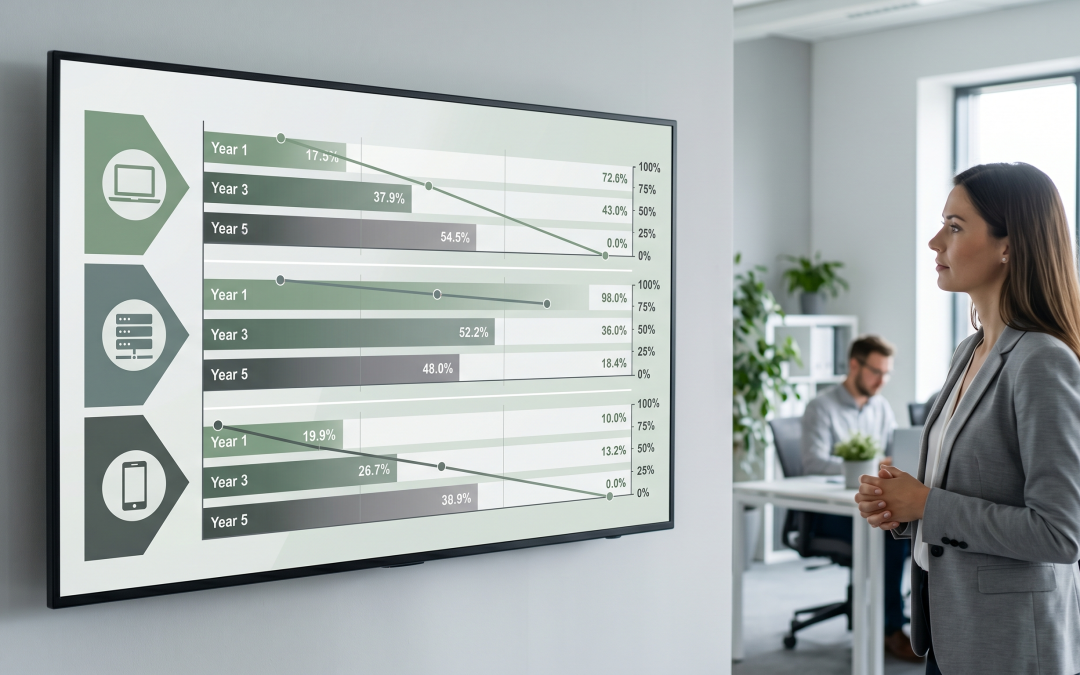
Understanding the residual value patterns of different IT equipment categories helps organisations budget for disposal, plan refresh cycles, and maximise financial returns from retired assets. While specific values change with market conditions and technology cycles, the relative patterns between categories remain fairly consistent.
Business Laptops
Business laptops consistently offer the best value recovery opportunity in most disposal projects. The strong secondary market is driven by broad demand from individuals, small businesses, schools, and refurbishment operations. Premium business models from Dell (Latitude), Lenovo (ThinkPad), and HP (EliteBook) tend to hold value best due to their reputation for durability and the availability of parts and support.
At one year old, expect to recover roughly 40-55% of the original purchase price for a well-maintained, current-specification business laptop. At two years, this drops to approximately 25-40%. By three years, residual values typically sit between 15-25%, and by four years, values drop to 5-15% depending on specification and condition. Laptops with higher RAM, faster processors, and larger SSDs retain value better than base configurations.
Apple Products
Apple equipment forms a special category due to its consistently strong residual value. MacBooks routinely retain 50-65% of their purchase price at one year and 30-45% at two years. iPhones are even stronger, often holding 55-70% at one year. iPads fall between the two, typically retaining 40-55% at one year.
The premium residual value of Apple products means organisations with Apple fleets often have disposal economics that are significantly better than those with Windows-based equipment. This differential is worth factoring into TCO calculations during procurement.
Desktop Computers
Desktops typically return 50-70% of the equivalent laptop value at the same age. The lower secondary market demand reflects the broader shift toward portable computing. Standard business desktops in the sub-$1,500 original price range may return only $50-150 after three years.
The exception is high-performance workstations used for design, engineering, video production, or scientific computing. These specialised machines can retain stronger value if their GPU, RAM, and processor configurations remain relevant to demanding applications.
Servers and Enterprise Equipment
Enterprise server residual values are highly variable and depend heavily on processor generation, configuration, and the manufacturer’s support lifecycle. Current-generation servers from Dell (PowerEdge), HP (ProLiant), and Lenovo (ThinkSystem) in popular configurations can retain 30-50% of their value at two years.
However, server values can drop sharply when a new processor generation launches, as buyers in the secondary market shift their preferences. Storage arrays, particularly from EMC, NetApp, and Pure Storage, follow similar patterns but can hold value longer if their firmware remains supported.
The enterprise secondary market is more specialised than the consumer market, with fewer but larger transactions. Working with an ITAD provider who has strong enterprise remarketing channels is important for achieving the best returns on server and storage equipment.
Networking Equipment
Enterprise networking equipment from Cisco, Juniper, and HPE (Aruba) can retain surprising value. Cisco equipment in particular has a well-established secondary market, with some models holding 20-40% of their value even at four to five years old, provided they remain within the manufacturer’s support window.
The key factor for networking equipment value is whether the model is still receiving software updates and security patches from the manufacturer. Equipment that has reached end-of-software-support loses value more rapidly than equipment still within its support lifecycle.
Mobile Devices
Corporate mobile devices, particularly smartphones, can generate meaningful value recovery if disposed of promptly. Business-issued iPhones in good condition typically return the strongest values. Android devices vary more widely, with flagship models from Samsung holding value reasonably well while mid-range and budget devices depreciate faster.
Mobile device values are particularly sensitive to timing around new model launches. Values drop noticeably in the weeks following a major new release as the secondary market adjusts.
Monitors and Peripherals
Standard business monitors have limited resale value, particularly older models with lower resolutions or TN panels. However, high-resolution displays (4K and above), ultrawide monitors, and professional-grade colour-accurate displays can hold meaningful value. Docking stations, particularly universal USB-C docks from established brands, also retain some secondary market value.
Printers, scanners, and most other peripherals have minimal resale value in secondary markets. These are typically better directed to recycling rather than remarketing efforts.
Using This Information
Understanding residual value patterns by category helps with budget planning for ITAD projects, optimising refresh cycle timing for different equipment types, setting realistic expectations for value recovery from your ITAD provider, and building a stronger business case for timely equipment disposal rather than stockpiling. Track your actual value recovery results over time and compare them against these benchmarks to evaluate your ITAD program’s financial performance.
EWV helps Victorian businesses manage e-waste and IT asset disposal compliantly and sustainably — including collection, certified data destruction, and recycling. Contact us for a free quote.