
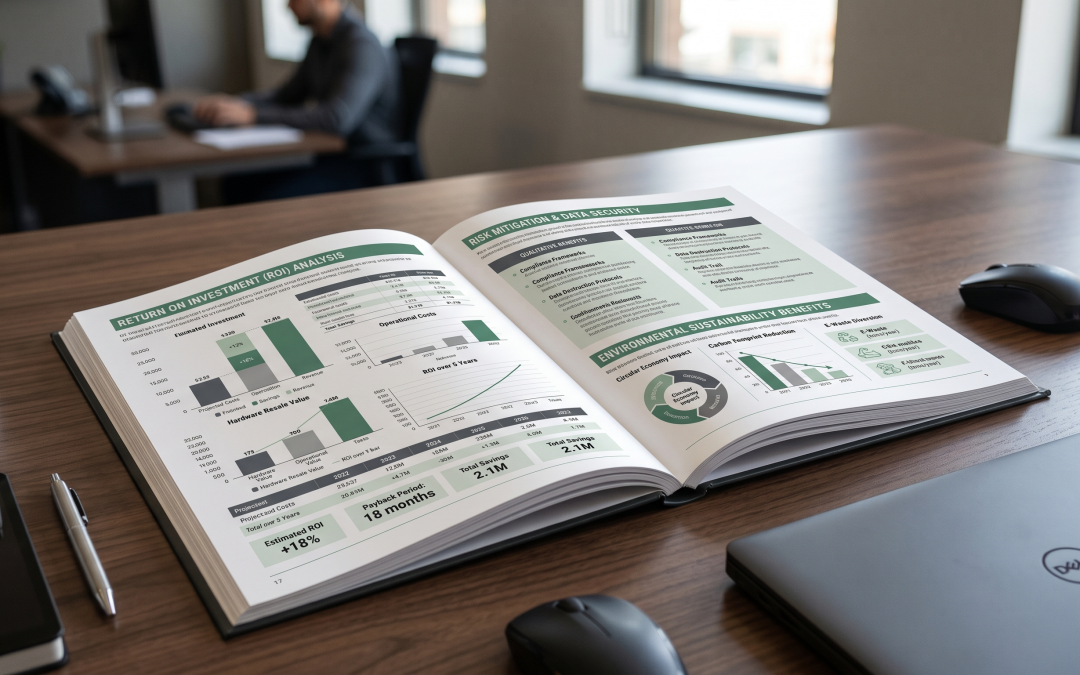
Getting budget approval for an IT asset disposition program requires speaking the language of business value, not just technical necessity. Decision-makers need to understand not just what ITAD is, but why it deserves funding alongside competing priorities. A well-structured business case addresses financial returns, risk reduction, compliance requirements, and strategic alignment in terms that resonate with executive audiences.
Framing the Problem
Start your business case by clearly defining the problem that ITAD solves. Avoid technical jargon and focus on business impact. Frame it around four key risks your organisation faces without a structured ITAD program.
Data breach risk: retired equipment containing customer, employee, and business data sits in storage rooms or is disposed of through uncontrolled channels. A single incident could cost millions in breach response, regulatory penalties, and reputational damage.
Compliance risk: without documented disposal processes and certified destruction, the organisation cannot demonstrate compliance with the Privacy Act, environmental regulations, or industry-specific requirements. Audit findings and regulatory actions become a matter of when, not if.
Financial waste: equipment with resale value depreciates in storage rooms instead of generating revenue. The longer it sits, the less it is worth. Stockpiling costs the organisation money in lost value, occupied space, and management overhead.
Environmental liability: improper disposal of electronic equipment breaches Victorian e-waste regulations and undermines any corporate sustainability commitments.
Quantifying the Costs
Translate these risks into financial terms that decision-makers can evaluate. For the current state (doing nothing or continuing ad hoc practices), estimate the annual value lost from depreciating stockpiled equipment, the probability-adjusted cost of a data breach, the cost of occupied space used for equipment storage, staff time spent on ad hoc disposal arrangements, and any penalties or audit costs from non-compliance.
For the proposed ITAD program, estimate annual processing and provider costs, internal programme management costs, any one-off costs for clearing existing stockpiles, and expected value recovery from remarketing.
Present the net comparison clearly. In most cases, the annual cost of a structured program is a fraction of the risks and waste from the current state.
Value Recovery Projections
Value recovery is often the most attention-grabbing element of an ITAD business case because it represents tangible revenue rather than cost avoidance. Work with potential ITAD providers to get indicative valuations of your current stockpile and projected disposal volumes.
Present value recovery projections conservatively, using a range rather than a single optimistic number. Show the value recovery potential at current market conditions and note that acting sooner captures more value than waiting. If the projections show the program could be revenue-neutral or revenue-positive after value recovery, highlight this prominently.
Risk Reduction
Quantify risk reduction using a simple expected value framework. Estimate the probability of a disposal-related data breach under current practices (even a conservative 1-2% annual probability is defensible). Multiply by the estimated impact (industry average breach costs). Compare to the near-zero probability under a structured program with certified data destruction.
The expected value of risk reduction alone often exceeds the entire cost of the ITAD program. Present this as insurance, an investment that eliminates a specific, quantifiable risk.
Compliance Benefits
For organisations in regulated industries, the compliance dimension can be the strongest argument. Frame ITAD as a compliance requirement rather than an optional programme. Reference the specific regulations that apply: Privacy Act and Australian Privacy Principles, industry-specific requirements (APRA CPS 234, health records legislation), environmental regulations including e-waste landfill bans, and any contractual obligations to clients regarding data handling.
If your organisation has upcoming audits, regulatory reviews, or compliance certifications, position the ITAD program as preparation that demonstrates proactive compliance management.
Strategic Alignment
Connect ITAD to broader organisational strategies. If your organisation has sustainability commitments, ITAD delivers measurable environmental outcomes. If digital transformation is underway, ITAD is a necessary component of retiring old infrastructure. If cost optimisation is a priority, value recovery and space savings contribute directly. And if reputation management matters, responsible disposal protects against the reputational damage of a preventable incident.
Implementation Plan
Include a practical implementation plan in your business case. Decision-makers want to know not just why, but how and when. Outline the steps: provider selection, initial stockpile clearance, establishment of ongoing program, and reporting cadence. Define the timeline, typically three to six months from approval to operational program. Identify the resources required, both financial and personnel.
Presenting to Different Audiences
Tailor your emphasis based on your audience. For the CFO, lead with financial returns and cost avoidance. For the CIO or CISO, emphasise data security and compliance. For the CEO, focus on risk management and strategic alignment. For the board, lead with governance and fiduciary responsibility. The core content is the same, but the framing and emphasis should match what each audience values most.
EWV handles IT asset disposition (ITAD) end-to-end for Victorian businesses — from collection and data destruction through to certified recycling or refurbishment for resale. Get in touch for a tailored ITAD quote.