
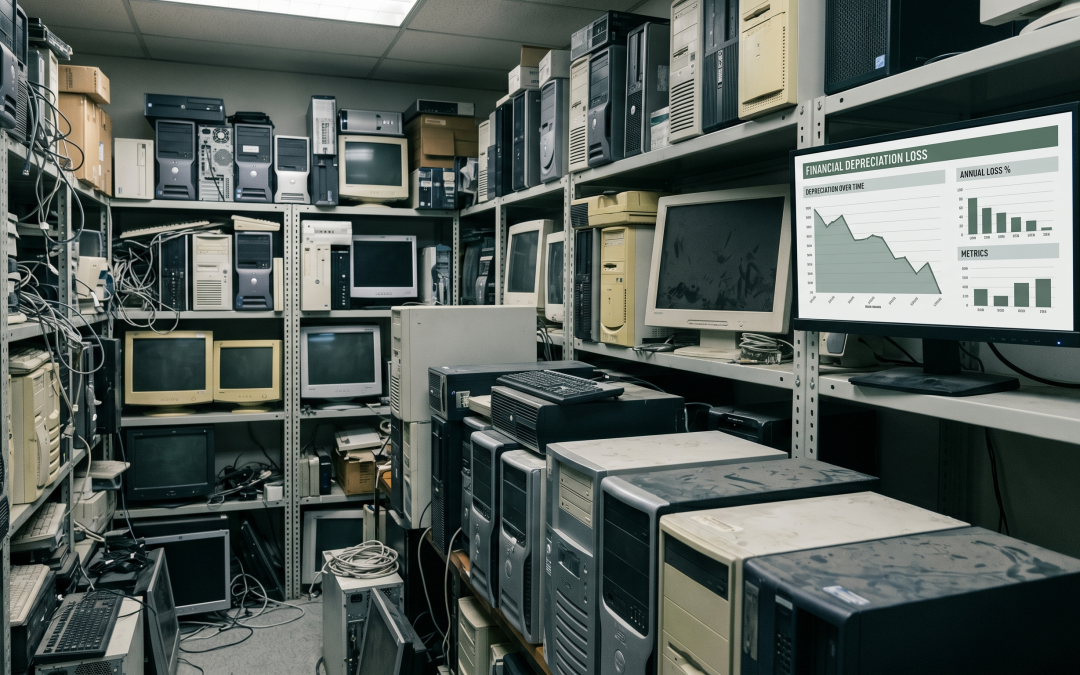
IT equipment stockpiling is one of the most common and costly bad habits in technology management. Nearly every organisation has a collection of old devices somewhere, accumulating dust and losing value while occupying space that could be used for something productive. The financial impact is larger than most people realise, and it compounds over time.
The Depreciation Clock Never Stops
The most significant financial cost of stockpiling is value depreciation. IT equipment loses value whether it is being used or sitting in a closet. A laptop that was worth $500 on the secondary market when it was first retired might be worth $300 six months later, $150 after a year, and $50 after two years. Multiply this depreciation by every device in your stockpile and the lost revenue adds up fast.
For a mid-sized organisation with 200 devices in storage, the value loss can easily exceed $50,000 per year. That is money that could have been recovered through remarketing if the equipment had been disposed of promptly.
The depreciation is not linear. IT equipment values drop sharply around new product launches, when the next generation of a processor or platform is released, and at the end of a manufacturer’s support lifecycle. Each of these events can cause a step-change decline in value for stockpiled equipment.
Space Has a Price
Every square metre occupied by old IT equipment has a direct cost. In a CBD office paying $600 per square metre per year, a 10-square-metre storage area filled with retired equipment costs $6,000 annually in rent alone, not including fit-out, power, insurance, and maintenance for the space.
In many organisations, the stockpile has grown to fill multiple rooms, cages, or storage areas. The cumulative space cost can be significant, particularly in locations where office space is constrained and additional space would enable productive use.
Even if you own your building, the space has an opportunity cost. It could be used for productive purposes: additional workstations, meeting rooms, or break areas. Or it could reduce the total building footprint your facilities team needs to maintain.
Security Costs
Stockpiled equipment containing data represents an ongoing security liability. To manage this liability properly, you need secure storage (locked rooms, access controls), inventory tracking (knowing what is in storage and where), regular auditing (verifying nothing has gone missing), and incident response readiness (in case equipment is stolen or improperly accessed).
These security measures have both direct costs (physical security infrastructure, staff time for audits) and indirect costs (organisational attention, compliance documentation). If you are not investing in these controls for your stockpile, you are accepting unmanaged risk. If you are investing in them, you are paying ongoing costs to protect equipment that generates no value.
The alternative, prompt data destruction and disposal, eliminates the security obligation entirely.
Management Overhead
Stockpiled equipment creates ongoing management overhead even when nobody is actively dealing with it. Asset registers need to be maintained. Questions arise about what is in storage and whether any of it can be used. Internal requests to “check if we have a spare” generate time-consuming searches through disorganised stockpiles. And eventually, someone needs to deal with the accumulated mess, usually at the worst possible time (office move, lease expiration, audit preparation).
The management overhead tends to grow as the stockpile grows. More equipment means more inventory to track, more space to manage, and more effort required when disposal is finally undertaken.
Environmental Liability
Under Victoria’s e-waste regulations, electronic equipment cannot be sent to landfill. Stockpiled equipment does not avoid this obligation; it merely defers it. The environmental disposal costs will eventually need to be incurred regardless of how long equipment sits in storage.
In some cases, stockpiling can actually increase environmental costs. Equipment that degrades in poor storage conditions may lose remarketing potential and need to go directly to recycling, which generates less environmental benefit than reuse.
Why Organisations Stockpile
Understanding why stockpiling happens helps prevent it. Common reasons include lack of a formal disposal process (nobody knows how to arrange proper disposal), hope that equipment might be needed again (it almost never is), perceived cost of disposal (which is almost always less than the cost of continued stockpiling), nobody owning the responsibility for disposal, and the “out of sight, out of mind” effect (equipment in storage does not feel urgent).
Addressing these root causes through a clear ITAD policy, assigned responsibilities, and regular disposal schedules prevents stockpiling from recurring after any initial clearance.
Breaking the Cycle
If your organisation has a stockpiling problem, the financial case for action is clear. Arrange an assessment of your current stockpile with an ITAD provider. Get a valuation of what can be remarketed. Calculate the total cost of continued stockpiling versus the net cost of immediate disposal. And present the comparison to decision-makers. The numbers almost always make the decision obvious.
EWV helps Victorian businesses manage e-waste and IT asset disposal compliantly and sustainably — including collection, certified data destruction, and recycling. Contact us for a free quote.