
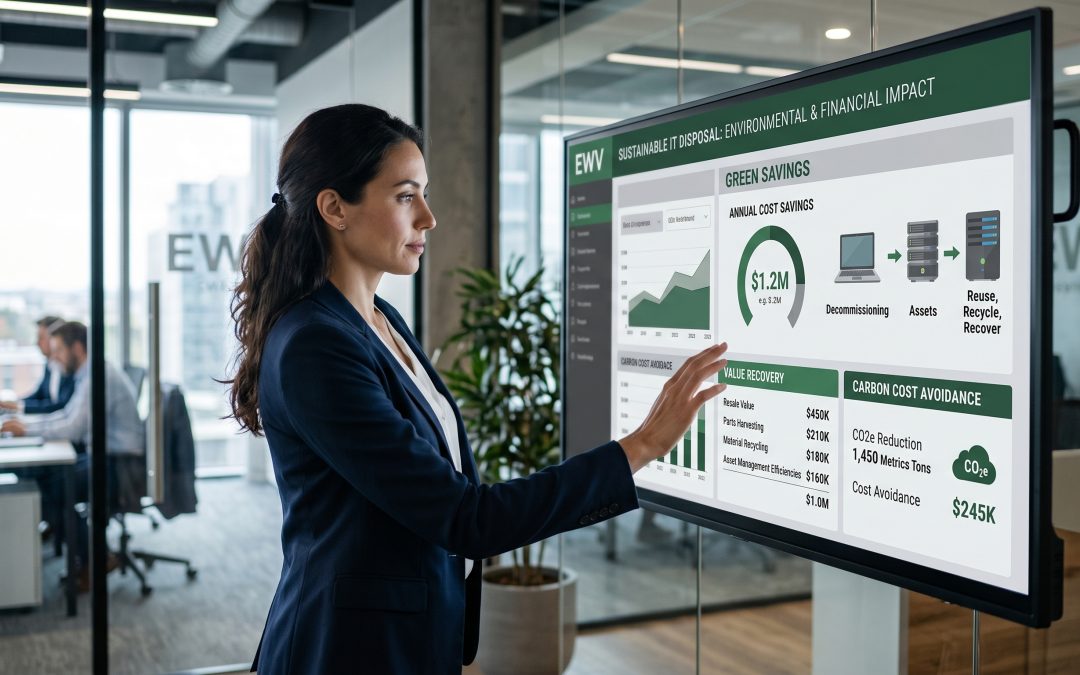
Sustainable IT disposal is often framed as a cost, something organisations do because they should rather than because it makes financial sense. In reality, sustainable disposal practices frequently deliver better financial outcomes than their less responsible alternatives. The alignment between environmental responsibility and financial benefit in ITAD is one of the strongest cases for “doing well by doing good” in corporate operations.
How Sustainability Saves Money
The financial benefits of sustainable IT disposal flow from several sources. Reuse generates more revenue than recycling. A refurbished laptop sold to a new user generates far more revenue than the same laptop shredded for materials recovery. Prioritising reuse, which is the most environmentally beneficial disposal option, also happens to be the most financially beneficial option. This alignment means that doing the right thing environmentally is also the best financial decision.
Recycling reduces waste disposal costs. Proper recycling diverts materials from landfill, which in Victoria is not just an environmental best practice but a legal requirement under the e-waste landfill ban. Recycling fees are typically less expensive per kilogram than general waste disposal, and the recovered materials have value that offsets processing costs.
Extended product life through internal redeployment delays the need for new purchases. A laptop retired by an executive might serve another two years in a less demanding role, saving the cost of a new device for that user while keeping the existing device productive.
Value Recovery Through the Circular Economy
The circular economy is not just an environmental concept; it is a financial model. Each tier of the circular hierarchy delivers both environmental and financial returns.
Reuse through remarketing returns the highest financial value per device while delivering the greatest environmental benefit. Refurbishment extends product life, generating returns from devices that might otherwise go directly to recycling. Parts harvesting recovers value from devices that are not viable as complete units. And materials recycling captures the commodity value of metals, plastics, and other materials.
A sustainable ITAD program works through each of these tiers, extracting maximum value at every level before materials enter the final recycling stream.
Reduced Compliance Costs
Sustainable disposal practices naturally align with regulatory requirements, reducing compliance costs and risk. Organisations that dispose of IT equipment through certified, environmentally responsible channels are less likely to face enforcement actions, less likely to incur penalties, better positioned to pass environmental audits, and more easily able to demonstrate compliance to regulators.
The cost of a compliance failure, including penalties, remediation, legal fees, and management time, typically dwarfs the incremental cost of doing disposal sustainably in the first place.
ESG-Related Financial Benefits
The growing emphasis on ESG performance creates additional financial incentives for sustainable IT disposal. Organisations with strong ESG credentials may benefit from lower borrowing costs through sustainability-linked financing. Access to ESG-conscious investors expands the capital base. Competitive advantage in tenders and procurement processes where sustainability is evaluated. Customer retention and acquisition from sustainability-minded buyers. And employee attraction and retention in a market where many professionals prefer employers with genuine sustainability commitments.
Your ITAD program’s environmental metrics, including CO2e avoided, materials recovered, and landfill diverted, contribute directly to your ESG reporting and strengthen these financial benefits.
Marketing and Brand Value
Sustainable disposal practices create positive stories that strengthen your brand. Quantified environmental outcomes make for compelling content in sustainability reports, customer communications, social media, and employee engagement. “We recycled 50 tonnes of e-waste and avoided 120 tonnes of CO2 last year” is a concrete, credible claim that resonates with stakeholders.
For B2B organisations, demonstrable sustainability performance is increasingly a factor in winning and retaining contracts. Enterprise buyers and government procurement teams frequently evaluate supplier sustainability as part of their vendor assessment processes.
Calculating Your Green Savings
To quantify the financial benefits of sustainable IT disposal for your organisation, compare the net cost of your current program (processing costs minus value recovery) to the theoretical cost of simply discarding equipment. Factor in avoided compliance costs, value recovery that would not occur under a less structured approach, and any ESG-related benefits that can be quantified.
For most organisations, the analysis reveals that sustainable disposal is not just the responsible choice but the financially rational one. The question is not whether you can afford to dispose of IT sustainably; it is whether you can afford not to.
EWV helps Victorian businesses manage e-waste and IT asset disposal compliantly and sustainably — including collection, certified data destruction, and recycling. Contact us for a free quote.