
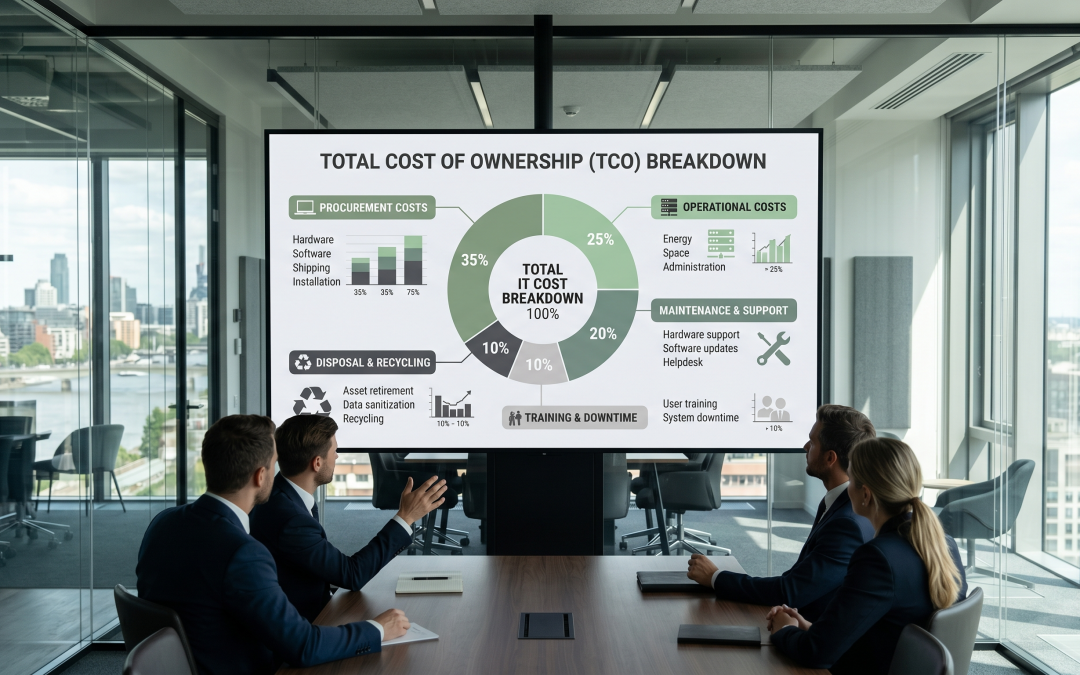
The price tag on a piece of IT equipment tells you remarkably little about what it will actually cost your organisation over its lifetime. The true cost includes everything from deployment and support to the eventual disposal, and the total can be two to three times the purchase price. Understanding and tracking these costs leads to smarter purchasing decisions and better lifecycle management.
The Full Cost Picture
The true cost of IT equipment ownership spans five phases, each with its own cost components. Acquisition includes the purchase price, any volume discounts or rebates, procurement team time for evaluation and ordering, vendor management overhead, and financing costs if equipment is leased or purchased on terms.
Deployment covers unboxing, asset tagging, and physical setup, imaging and software installation, user configuration and data migration, training and onboarding for new devices, and any accessories or peripherals needed (docking stations, monitors, bags).
Operation and support includes power consumption over the device’s life, software licensing (operating system, security, productivity), helpdesk support and troubleshooting time, hardware repairs and warranty management, and productivity impact from device performance and reliability.
Maintenance and refresh includes battery replacements, component upgrades (RAM, storage), software updates and patches, interim repairs to extend useful life, and productivity loss from device downtime.
End of life covers decommissioning and data preparation, data destruction processing, transport and ITAD provider fees, internal coordination and documentation time, and environmental recycling costs, offset by any value recovery from remarketing.
Typical Cost Breakdown
For a standard business laptop with a three-year lifecycle, the cost breakdown might look something like this. The purchase price represents roughly 40-50% of the total cost of ownership. Deployment represents 5-10%. Operation and support represents 25-35%. Maintenance represents 5-10%. And end-of-life costs (net of value recovery) represent 2-8%.
These proportions vary by organisation, equipment type, and how well each phase is managed. Organisations with efficient deployment processes and strong helpdesk operations will have lower proportional costs in those areas. Those with poor lifecycle management will spend more on maintenance and support as equipment ages.
Hidden Costs Most Organisations Miss
Several cost categories are commonly overlooked in ownership calculations. Productivity loss from older or slower equipment is real but rarely quantified. If a laptop that is four years old takes 15 minutes longer to boot and load applications each day compared to a new device, that is roughly 60 hours of lost productivity per year per device at a loaded labour cost of $50-80 per hour, that is $3,000-4,800 of hidden cost.
Support escalation costs increase with equipment age. Older devices generate more helpdesk tickets, require more complex troubleshooting, and consume more IT team time per incident. Security costs increase as older equipment receives less frequent security updates or cannot run the latest security software.
Stockpiling costs are another commonly missed category. Equipment that sits in storage after decommissioning continues to generate costs through space consumption, value depreciation, and security management, as discussed in detail in the context of IT asset lifecycle management.
Using True Cost for Better Decisions
When you understand the true cost of ownership, several decisions become clearer. Refresh timing can be optimised based on the total cost per year of use rather than just the depreciation schedule. The optimal point is where total annual cost (including increasing support costs and decreasing productivity) begins to rise. Equipment selection can factor in total lifecycle costs rather than just purchase price. A more expensive device with lower support costs, longer useful life, and better resale value may have a lower true cost than a cheaper alternative.
Lifecycle strategies can be tailored by equipment category. The optimal lifecycle for laptops (where productivity impact is personal and direct) differs from servers (where performance requirements are workload-dependent) and mobile devices (where battery degradation is a limiting factor).
Building a Cost Tracking Framework
To calculate true costs for your organisation, you need to track costs by device or device category across all lifecycle phases. This does not require complex systems. A well-structured spreadsheet can serve a mid-sized organisation. Capture procurement costs from purchase orders, support costs from helpdesk ticket data, maintenance costs from repair records, and disposal costs and value recovery from your ITAD program reports.
Over time, this data builds a picture of true ownership costs that is specific to your organisation, your equipment, and your operating environment, far more useful than generic industry benchmarks.
EWV helps Victorian businesses manage e-waste and IT asset disposal compliantly and sustainably — including collection, certified data destruction, and recycling. Contact us for a free quote.