
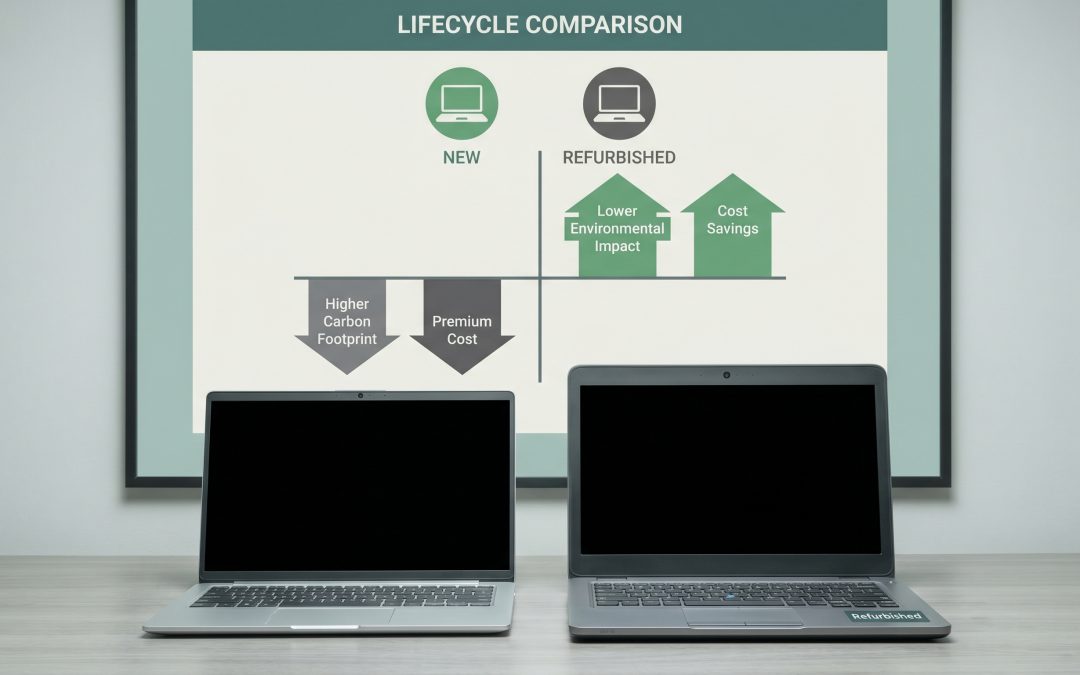
The choice between purchasing new IT equipment and buying refurbished is increasingly relevant for organisations seeking to balance performance, cost, and sustainability. A lifecycle comparison that considers acquisition cost, useful life, total cost of ownership, and environmental impact reveals that refurbished equipment can be a compelling option for many use cases.
Acquisition Cost
Refurbished equipment typically costs 40 to 70 percent less than equivalent new equipment. A new enterprise laptop that costs $1,800 might be available refurbished for $600 to $1,100, depending on its age, specification, and condition. Servers, networking equipment, and monitors show similar discounts.
The savings are most significant for equipment categories where technology advancement has slowed. A three-year-old business laptop with an 11th-generation Intel processor performs adequately for most office tasks, and the performance difference compared to a current-generation model is modest for everyday use. The cost saving, however, is substantial.
Useful Life and Performance
Refurbished equipment has a shorter remaining useful life than new equipment, but the difference is often less than people assume. A professionally refurbished three-year-old laptop with a new battery and fresh SSD can deliver three to four more years of productive use. A refurbished server with verified components can operate reliably for several additional years.
Performance depends on the use case. For standard office productivity, web browsing, and communication, refurbished equipment from the past three to five years performs well. For resource-intensive tasks like software development, data analysis, or design work, newer equipment with the latest specifications may be justified.
Warranty coverage is an important consideration. Reputable refurbishment providers offer warranties on their equipment, typically 12 to 24 months. While shorter than new equipment warranties, this coverage provides adequate protection for the initial deployment period.
Total Cost of Ownership
Total cost of ownership (TCO) includes acquisition, operation, support, and end-of-life costs. Refurbished equipment has lower acquisition costs but may have slightly higher support costs due to older components and shorter warranty periods. Energy costs may be marginally higher for older equipment, though the difference is usually minimal for current-generation devices.
End-of-life costs are similar for both new and refurbished equipment, as both require the same data destruction and environmental compliance. However, refurbished equipment will have lower residual value at end of life because it is older when it reaches disposition.
For most use cases, the significantly lower acquisition cost of refurbished equipment more than compensates for any increase in support costs, resulting in a lower TCO per year of use.
Environmental Comparison
The environmental case for refurbished equipment is compelling. Manufacturing a new laptop generates approximately 300 to 400 kg of CO2 equivalent, primarily from mining raw materials, component manufacturing, assembly, and shipping. Refurbishing an existing laptop generates a fraction of that amount, primarily from the energy used in testing, cleaning, and any replacement parts.
By extending the useful life of existing equipment, refurbishment avoids the environmental cost of manufacturing a replacement and delays the equipment’s entry into the waste stream. This aligns directly with circular economy principles and contributes to organisational sustainability goals.
When to Choose New
New equipment is the better choice when you need the latest specifications for performance-intensive workloads, long warranty coverage is essential for your operational model, standardisation across a large fleet requires identical hardware, or the equipment type does not refurbish well, such as batteries in mobile devices.
When to Choose Refurbished
Refurbished equipment is the better choice when the use case does not require the latest specifications, budget constraints make new equipment difficult to justify, sustainability goals favour extending equipment life, the equipment is for temporary use such as project work or seasonal staff, or you want to maximise the number of devices you can deploy within a fixed budget.
EWV handles IT asset disposition (ITAD) end-to-end for Victorian businesses — from collection and data destruction through to certified recycling or refurbishment for resale. Get in touch for a tailored ITAD quote.