
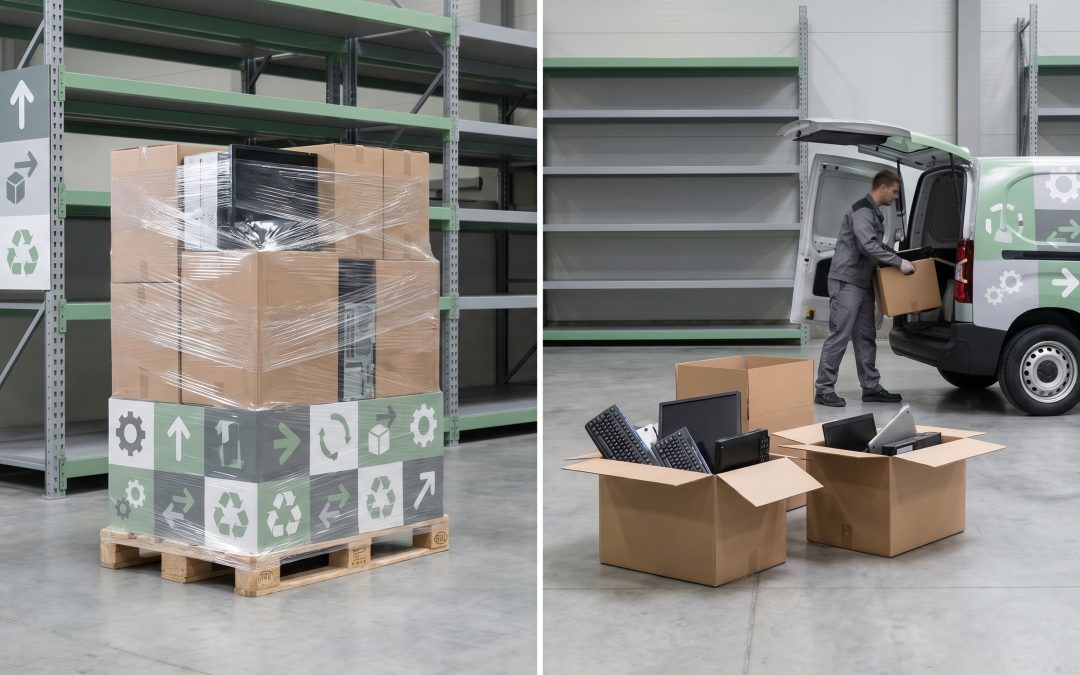
The physical logistics of getting retired IT equipment from your premises to an ITAD facility might seem like a minor detail, but the choice between pallet collection and individual item pickup affects cost, efficiency, security, and how much internal effort is required from your team. Getting this right is particularly important for organisations managing regular equipment refreshes or multi-site operations.
How Pallet Collection Works
Pallet collection involves consolidating your retired IT assets onto pallets, typically standard 1165 x 1165mm Australian pallets, wrapping them securely, and having the ITAD provider collect the palletised load using a truck with a tail lift or forklift access. This model works best when you have enough volume to fill at least one pallet, you have a loading dock or ground-level access suitable for pallet handling, your team can consolidate and palletise equipment in advance, and you have somewhere to stage pallets before collection.
A single pallet can typically hold 15 to 25 desktop computers, 30 to 50 laptops (properly stacked), or a mix of monitors, peripherals, and small form factor devices. Servers and networking equipment are often palletised separately due to weight considerations.
How Individual Item Pickup Works
Individual item pickup means the ITAD provider sends a team to your site to collect equipment item by item. They might walk through offices collecting laptops from desks, pull servers from racks, or gather equipment from multiple rooms and floors. The provider handles all the packing, carrying, and loading.
This model is more hands-off for your team but requires more time on-site from the collection crew, which typically translates to higher costs per item.
Cost Comparison
Pallet collection is almost always cheaper per unit because the logistics are more efficient. The truck arrives, the driver loads pre-prepared pallets, and the collection is complete in minutes. You are essentially paying for transport time and minimal handling.
Individual item pickup involves labour costs for the collection team, who may spend hours on-site gathering, inventorying, packing, and loading equipment. For large collections, providers may send a team of two to four people. This labour cost is passed through to you either as a flat collection fee or per-item charge.
Security Considerations
From a chain of custody perspective, pallet collection offers some advantages. You control the consolidation process, which means you can verify and document every item before it leaves your hands. The pallets can be wrapped and sealed, with tamper-evident seals providing assurance that nothing has been added or removed during transport.
Individual item pickup introduces more handling touchpoints. Equipment is picked up from various locations, potentially by multiple people, and consolidated into the collection vehicle on-site. While reputable providers have strong handling procedures, the more touchpoints in the process, the more opportunities for items to go missing or be mishandled.
That said, individual pickup can be more secure in situations where decommissioned equipment is currently scattered across an office with no central staging area. In those cases, having the collection team systematically go through the site may actually result in better asset capture than asking internal staff to consolidate equipment they may not easily identify.
Facility Requirements
Pallet collection requires adequate physical infrastructure. You need a loading dock, ground-level roller door, or at minimum an area accessible by a truck with a tail lift. The staging area needs to be large enough to hold pallets of equipment, and the path from the staging area to the loading point needs to accommodate pallet jacks or forklifts.
Many modern office buildings, particularly multi-tenant commercial spaces, do not have loading docks or easy freight access. In these cases, individual item pickup may be the only practical option. The collection team can use standard lifts, trolleys, and hand-carry methods that do not require specialised loading facilities.
Volume Thresholds
As a general guide, pallet collection becomes the more efficient option when you have more than about 20 items per collection. Below that threshold, the effort of palletising and staging often is not justified, and individual pickup is simpler for everyone involved.
For very large decommissions, hundreds or thousands of items from a floor or building closure, pallet collection is essential. The alternative, having a team individually carry hundreds of items through a building, would take days and cost significantly more than a forklift loading pallets onto a truck.
Multi-Site Considerations
Organisations with multiple offices face additional logistics decisions. Options include having each site consolidate and palletise for individual collection, using individual pickup at smaller sites and pallet collection at larger ones, consolidating equipment from multiple small sites to a central location for a single pallet collection, and scheduling a routed collection where the truck visits multiple sites in sequence.
The most cost-effective approach depends on the geographic spread of your sites, the volume at each location, and the facility capabilities at each address. Your ITAD provider should be able to model different scenarios and recommend the most efficient logistics plan.
Preparation Requirements
Pallet collection requires more preparation from your team. Assets need to be disconnected, wiped of external labels if required, consolidated to the staging area, documented on a manifest, stacked on pallets with appropriate protection between layers, and wrapped and sealed.
Individual pickup shifts most of this effort to the collection provider. Your main responsibilities are ensuring access, having someone available to supervise, and providing asset information for the manifest.
For organisations with busy IT teams, the reduced preparation requirement of individual pickup may be worth the higher per-item cost. For organisations with available resources and regular collection volumes, investing the time to palletise delivers better value over time.
Getting your logistics model right is one piece of a broader IT asset lifecycle strategy. The right approach depends on your specific volumes, facilities, and internal capabilities.
]]>EWV helps Victorian businesses manage e-waste and IT asset disposal compliantly and sustainably — including collection, certified data destruction, and recycling. Contact us for a free quote.