
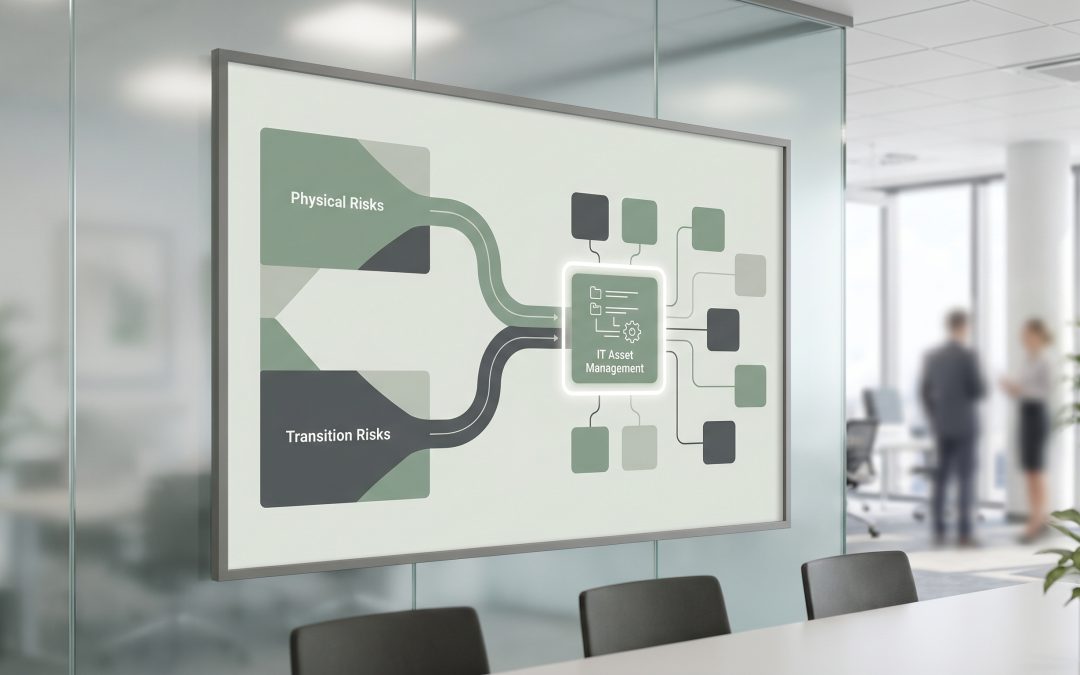
The Task Force on Climate-related Financial Disclosures (TCFD) framework has become the foundation for climate reporting globally, and it underpins Australia’s mandatory climate disclosure regime. While TCFD recommendations are often discussed in terms of energy, transport, or industrial processes, they have direct relevance to IT asset management. Understanding how to apply the four TCFD pillars to your IT lifecycle helps you meet reporting requirements while also improving how you manage technology assets.
The Four TCFD Pillars and IT
TCFD organises disclosures around governance, strategy, risk management, and metrics and targets. Each pillar has specific implications for how organisations manage, report on, and make decisions about IT equipment.
Governance: Who Oversees IT Sustainability?
The governance pillar asks organisations to disclose how their board and management oversee climate-related risks and opportunities. For IT asset management, this means identifying who has responsibility for IT sustainability decisions at the board and management level, documenting how IT disposal and procurement policies are reviewed and approved, showing how climate considerations are integrated into IT budget decisions, and demonstrating that IT-related climate risks are escalated to appropriate governance bodies.
In many organisations, IT sustainability falls between the responsibilities of the CIO, the sustainability team, and procurement. TCFD reporting requires clarity about who owns these decisions and how they connect to the organisation’s broader climate governance structure. If nobody has explicit responsibility for the environmental impact of IT equipment decisions, that gap will become visible in your disclosures.
Strategy: IT in Your Climate Transition Plan
The strategy pillar asks how climate-related risks and opportunities influence your business strategy and financial planning. For IT asset management, relevant strategic considerations include transitioning from linear IT procurement (buy, use, dispose) to circular models that extend asset life, the financial impact of refurbishment and remarketing programmes that generate returns while reducing emissions, how changing regulations around e-waste disposal affect your operating costs and compliance requirements, and the role of IT equipment choices in achieving organisational net zero targets.
A credible transition plan should include specific actions related to IT equipment. Extending the average laptop lifecycle from three years to five years, for example, measurably reduces both purchasing costs and embodied carbon emissions. Choosing to refurbish and remarket equipment rather than shred it generates revenue while avoiding the emissions associated with manufacturing replacement units.
Risk Management: IT-Related Climate Risks
The risk management pillar asks organisations to describe how they identify, assess, and manage climate-related risks. IT asset management creates several categories of climate risk.
Regulatory risk is a key concern. E-waste regulations are tightening globally. Victoria’s landfill ban on e-waste, effective since 1 July 2019, is an example of regulatory action that directly affects IT disposal costs and processes. Similar regulations in other jurisdictions, or the expansion of existing rules, could increase compliance costs for organisations that have not prepared.
Supply chain risk also matters. Climate-related disruptions to electronics manufacturing, whether from extreme weather events affecting factories or resource scarcity driving up raw material costs, can affect IT procurement timelines and budgets. Organisations with refurbishment and reuse programmes are partially insulated from these risks because they reduce dependence on new equipment purchases.
Reputational risk is relevant for organisations whose stakeholders, including customers, investors, and employees, increasingly expect responsible management of technology waste. Improper disposal practices or a lack of transparency about IT-related environmental impacts can damage reputation and affect business relationships.
Transition risk arises from the potential for carbon pricing, extended producer responsibility schemes, or mandatory take-back requirements that could change the economics of IT procurement and disposal.
Metrics and Targets: Measuring IT Impact
The metrics and targets pillar asks for specific, quantifiable data on climate performance. For IT asset management, relevant metrics include total weight of IT equipment disposed of annually, percentage of retired IT equipment refurbished and reused versus recycled or destroyed, CO2e avoided through refurbishment and remarketing compared to purchasing new equipment, Scope 3 emissions from purchased IT equipment (embodied carbon), emissions from IT asset transportation and processing, and e-waste diversion rate (percentage diverted from landfill).
Setting targets against these metrics demonstrates commitment and creates accountability. A target to increase the refurbishment rate from 40 percent to 60 percent over three years, for example, is specific, measurable, and directly linked to emissions reduction.
Scenario Analysis and IT
TCFD recommends scenario analysis to understand how different climate futures might affect your organisation. For IT asset management, consider how a 1.5 degree scenario with aggressive carbon pricing would affect the cost of purchasing new electronics, whether increased frequency of extreme weather events could disrupt your IT supply chain, how a rapid transition to renewable energy might change the embodied carbon calculations for new equipment, and whether stricter e-waste regulations could affect the viability of current disposal methods.
These scenarios do not need to be complex models. Even qualitative assessments of how IT procurement and disposal would be affected under different climate pathways add value to your disclosures and help inform strategic planning.
Connecting IT Data to TCFD Reporting
The practical challenge for most organisations is collecting the data needed to populate TCFD disclosures for IT assets. This requires an accurate, up-to-date IT asset register that tracks equipment from procurement through to end of life, relationships with IT suppliers who can provide embodied carbon data for purchased equipment, an ITAD provider that supplies detailed environmental reporting including CO2e avoidance figures, and internal processes for aggregating IT environmental data into your broader sustainability reporting.
For guidance on measuring your IT disposal impact, see our guide on how to measure the environmental impact of IT disposal. For a broader overview of how ESG reporting and e-waste management intersect for Australian businesses, our ESG reporting guide covers the full picture.
]]>