
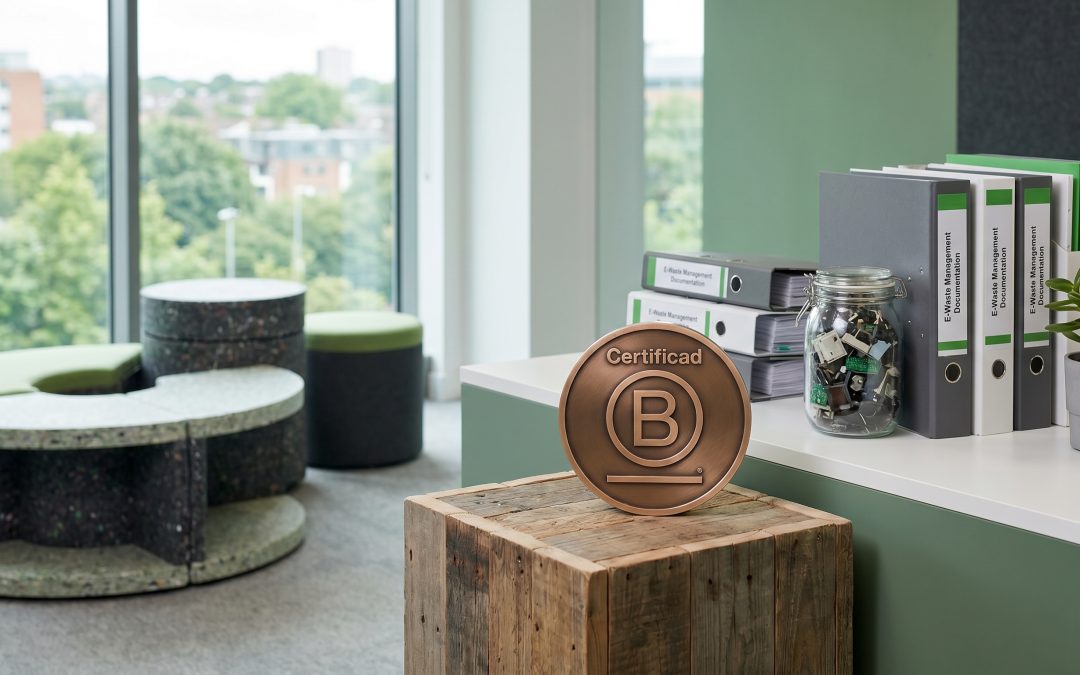
B Corp certification has become one of the most recognised markers of a business that balances purpose with profit. Certified B Corporations meet verified standards of social and environmental performance, transparency, and accountability. For organisations pursuing or maintaining B Corp status, e-waste management is a relevant area that contributes to your B Impact Assessment score and demonstrates your commitment to environmental stewardship.
What B Corp Certification Involves
B Corp certification is administered by B Lab, a non-profit organisation. To become certified, a company must score at least 80 out of 200 on the B Impact Assessment (BIA), which evaluates performance across five impact areas: governance, workers, community, environment, and customers. The assessment is verified by B Lab, and certified companies must recertify every three years.
The environment section of the BIA is where e-waste management is most directly relevant, though responsible IT practices can also contribute to the governance and community sections depending on how your programme is structured.
E-Waste in the B Impact Assessment
The BIA’s environment section asks about several areas where e-waste management can contribute points. Waste management questions ask about your organisation’s approach to reducing, reusing, and recycling waste, including electronic waste. Demonstrating a formal e-waste programme with measurable outcomes, such as diversion rates and recycling volumes, directly supports your score in this area.
Environmental management system questions ask whether you have formalised environmental policies and management systems. An e-waste policy that is documented, implemented, and monitored shows systematic environmental management. Supply chain questions evaluate how you assess and manage the environmental impact of your suppliers. This includes your ITAD provider and any downstream recyclers or refurbishers involved in processing your retired IT equipment.
Resource conservation questions look at efforts to reduce resource consumption. Extending IT equipment lifecycles through refurbishment and reuse, and recovering materials through recycling, directly contributes to resource conservation metrics.
How E-Waste Programmes Support B Corp Scores
A well-structured e-waste management programme can contribute to your BIA score in several specific ways. Tracking and reporting e-waste volumes demonstrates environmental monitoring and measurement. Choosing certified ITAD providers shows supply chain due diligence. Refurbishing equipment for reuse demonstrates circular economy practices. Measuring CO2e avoidance from refurbishment provides quantified environmental impact data. Donating refurbished equipment to community organisations contributes to the community impact area.
The combination of these activities can meaningfully lift your environment score, particularly if you can show improvement over time. The BIA looks favourably on organisations that track their environmental performance and set targets for improvement.
Aligning ITAD with B Corp Values
B Corp certification is about more than checking boxes on an assessment. The underlying philosophy is that business should serve all stakeholders, not just shareholders. For IT asset management, this translates to considering the environmental impact of your procurement choices, not just the purchase price, ensuring your e-waste is processed in ways that protect workers and communities (not exported to countries with poor labour and environmental protections), maximising the useful life of equipment before recycling to reduce demand on natural resources, and being transparent about your IT lifecycle practices and their outcomes.
This stakeholder-oriented approach to IT management aligns naturally with choosing ITAD providers who hold certifications like R2, e-Stewards, or ISO 14001, which demonstrate third-party verification of environmental and social responsibility practices.
E-Waste and the B Corp Community
The B Corp community in Australia includes over 700 certified companies across various industries. Many of these organisations are office-based businesses with significant IT equipment needs. Sharing best practices around e-waste management within the B Corp community can help raise the standard of IT lifecycle management across the network.
Some B Corps have found value in collective approaches to e-waste, such as coordinating group collections to reduce per-unit costs, sharing information about ITAD providers and their performance, and establishing common standards for IT equipment disposition among B Corp suppliers.
Practical Steps for B Corp Applicants
If your organisation is preparing for B Corp certification and wants to strengthen its e-waste performance, practical steps include formalising your e-waste policy if you do not already have one, engaging a certified ITAD provider and documenting your provider selection criteria, starting to track e-waste volumes and disposition methods if you are not currently doing so, setting measurable targets for improvement, collecting data on CO2e avoidance and materials recovery from your ITAD provider, and considering how refurbished IT equipment could be donated to community organisations as part of your community impact strategy.
For guidance on measuring the environmental impact of your IT disposal programme, see our guide on how to measure the environmental impact of IT disposal. For a broader look at how sustainability and e-waste management connect to corporate strategy, our guide on corporate sustainability and responsible e-waste management provides a comprehensive framework.
]]>