
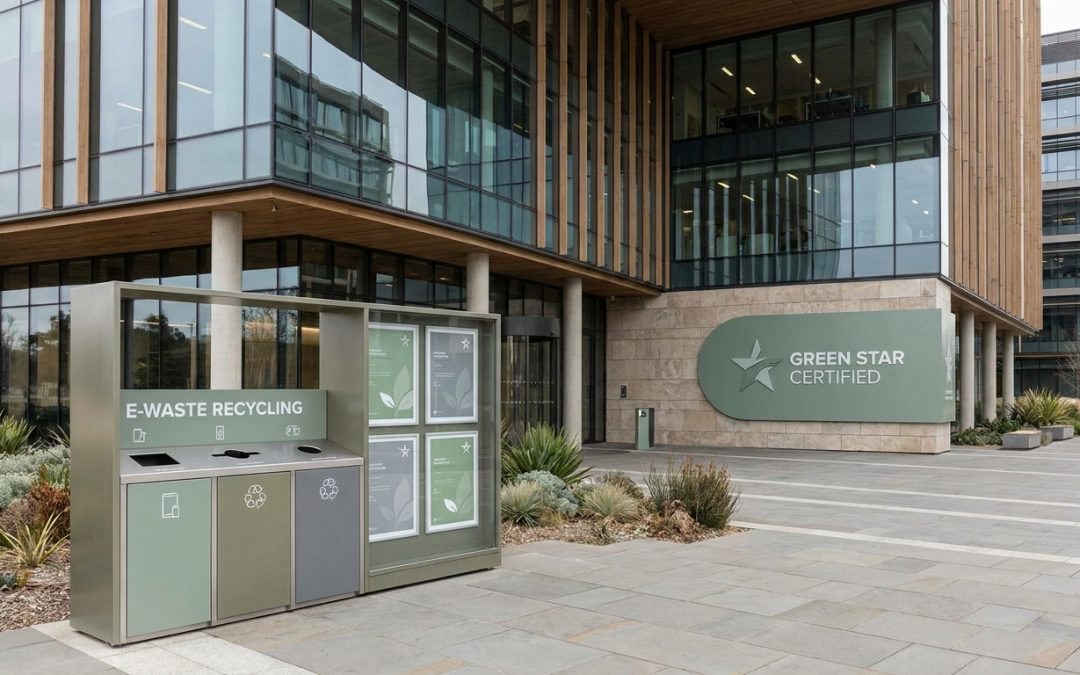
Green Star is Australia’s leading sustainability rating system for buildings and communities, administered by the Green Building Council of Australia (GBCA). For organisations occupying or developing Green Star-rated buildings, e-waste management is a relevant consideration that can contribute to achieving and maintaining certification. Understanding how e-waste fits into Green Star requirements helps you integrate IT lifecycle management with your broader building sustainability strategy.
What Green Star Covers
Green Star provides ratings for building design and construction, building operations, and community-scale developments. The system evaluates performance across multiple categories including energy, water, materials, indoor environment quality, land use and ecology, and management. E-waste management is most directly relevant to the materials and waste categories, though it can also contribute to management credits through environmental management systems and procurement policies.
Green Star ratings range from 1 Star (minimum practice) to 6 Stars (world leadership). Most new commercial developments aim for 4 or 5 Stars, and many building owners pursue operational ratings to demonstrate ongoing performance.
E-Waste in Green Star Design and As Built
For new buildings or major refurbishments pursuing Green Star Design and As Built certification, e-waste considerations include providing dedicated, accessible space for e-waste collection and storage, designing waste management systems that allow for segregation of electronic waste from general waste, specifying IT infrastructure with end-of-life management in mind, and incorporating waste management plans that address electronic waste streams.
The materials category credits reward the use of recycled and reused materials, which connects to the circular economy outcomes of e-waste recycling. Materials recovered from processed e-waste, including metals, plastics, and glass, re-enter manufacturing supply chains and contribute to the availability of recycled content materials.
E-Waste in Green Star Performance
Green Star Performance rates the operational sustainability of existing buildings. This is where e-waste management has the most direct impact, as it measures actual waste management performance rather than design intent.
Key metrics for e-waste in Green Star Performance include waste diversion rates (the percentage of total waste diverted from landfill, with e-waste included in the calculation), waste stream segregation (whether e-waste is separated from other waste types for appropriate processing), waste management planning (whether there is a documented approach to managing all waste streams including electronics), and monitoring and reporting (whether e-waste volumes and disposition methods are tracked and reported).
Responsible Products Credits
Green Star’s Responsible Products framework evaluates the environmental and social credentials of products used in buildings. While this primarily applies to building materials, organisations can extend the principle to IT equipment procurement. Choosing IT equipment from manufacturers with strong environmental product declarations, responsible sourcing programmes, and take-back or recycling schemes aligns with the spirit of Green Star’s responsible products approach.
Some organisations pursuing Green Star certification go further by specifying that IT equipment must meet specific environmental standards such as EPEAT or ENERGY STAR, requiring IT suppliers to provide lifecycle assessment data, and giving preference to equipment with higher recycled content or more recyclable designs.
Operational Waste Management Plans
Green Star Performance requires buildings to have operational waste management plans. A comprehensive plan should address all waste streams, including e-waste. The e-waste component of your waste management plan should cover collection arrangements (where e-waste is collected and how often), storage requirements (secure, designated areas for e-waste awaiting collection), processing partners (who handles the e-waste and what certifications they hold), reporting requirements (what data is collected and how it feeds into building performance reporting), and tenant communication (how building occupants are informed about e-waste disposal procedures).
For multi-tenant buildings, the building owner or manager typically coordinates the overall waste management plan, but individual tenants are responsible for their own e-waste management within the framework. Clear communication about available e-waste collection services and any building-specific requirements ensures consistent performance across all tenancies.
Green Star Communities
Green Star Communities rates the sustainability performance of community-scale developments. E-waste management can contribute to community ratings through the provision of accessible e-waste collection facilities within the community, integration with council e-waste collection services, community education about responsible e-waste disposal, and partnerships with e-waste recyclers serving the community.
Connecting IT Management to Green Star
For organisations occupying Green Star-rated buildings, integrating IT lifecycle management with building sustainability performance creates a more cohesive approach. Your IT procurement policies can align with the building’s sustainability targets. Your e-waste management programme can contribute to the building’s waste diversion metrics. Your energy-efficient IT equipment choices can support the building’s energy performance.
This integration works best when there is communication between your IT team, your facilities management team, and the building’s sustainability coordinator. Each group holds part of the picture, and connecting them ensures that IT decisions support rather than undermine building sustainability performance.
For broader guidance on measuring the environmental impact of your IT equipment decisions, see our guide on measuring the environmental impact of IT disposal. For information on how ESG reporting connects to your e-waste management practices, our ESG reporting guide provides a comprehensive overview.
]]>