
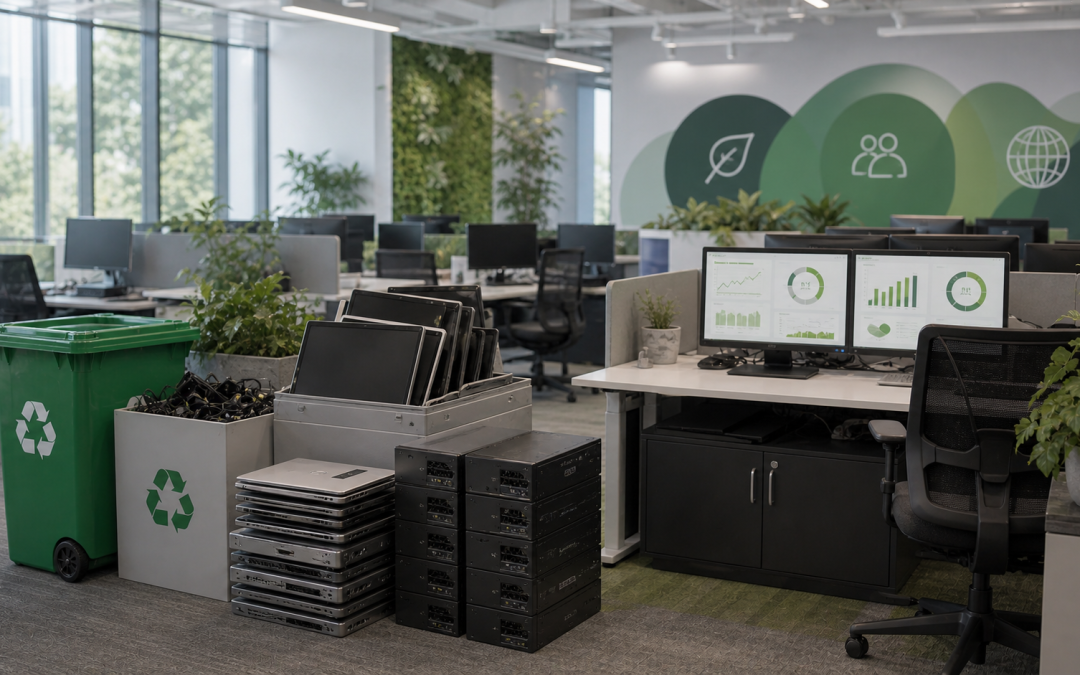
Retail organisations operate extensive technology networks that span head offices, distribution centres, and store floors. Point-of-sale terminals, inventory management systems, digital signage, security cameras, and back-office computers all form part of a retail technology estate that generates significant e-waste when refreshed or decommissioned. For retailers building ESG programs, this technology footprint offers measurable environmental metrics that strengthen sustainability reporting.
The Retail Technology Footprint
A national retailer with hundreds of stores operates thousands of technology devices. Each store might have multiple POS terminals, self-checkout systems, price-check kiosks, digital signage displays, security and surveillance equipment, back-office computers, and networking equipment. Distribution centres add warehouse management systems, handheld scanners, and logistics technology. Head office contributes corporate IT infrastructure.
When any of these systems are upgraded, the old equipment needs responsible disposal. The scale and geographic distribution of retail operations makes this a logistically complex challenge, but it also means the environmental impact of getting it right is substantial.
ESG in Retail
Consumer-facing retailers are under growing pressure to demonstrate environmental responsibility. Customers make purchasing decisions based partly on brand values. Institutional investors evaluate retail companies against ESG criteria. And supply chain partners increasingly require environmental standards from their retail customers.
E-waste management provides concrete data for retail ESG reporting. Unlike some sustainability metrics that require estimation, the volume of equipment recycled, materials recovered, and emissions avoided from responsible technology disposal can be tracked with precision.
Store-Level Challenges
Managing e-waste across a distributed store network presents unique challenges. Individual stores typically lack the space and expertise to manage e-waste locally. Equipment from multiple stores needs to be consolidated for efficient processing. And the logistics of collecting old equipment during or after a technology refresh need to be coordinated with the rollout schedule.
The most effective approach is building e-waste collection into technology refresh project plans from the outset. When new equipment is delivered, old equipment is collected simultaneously. This reverse logistics model minimises store disruption and ensures nothing gets left behind or disposed of improperly.
Data Security Across the Network
Retail technology handles sensitive data including customer payment information, loyalty program data, employee records, and commercial transaction data. PCI DSS compliance requires secure handling of payment card data throughout its lifecycle, including at disposal. POS terminals and payment processing equipment need certified data destruction before leaving any retail location.
Ensure your disposal procedures address the specific data security requirements of each equipment type. A POS terminal that has processed millions of card transactions requires different attention than a digital signage display that only stored marketing content.
Supply Chain Integration
Forward-thinking retailers are integrating e-waste management into their broader supply chain sustainability programs. This means evaluating technology suppliers on their environmental credentials, including take-back programs and product recyclability. It means using the same sustainability lens on technology procurement that many retailers already apply to product sourcing.
Some retailers are also exploring circular procurement models where technology providers offer equipment-as-a-service arrangements that include end-of-life management. These models shift responsibility for disposal to the manufacturer and can simplify the retailer’s environmental obligations.
Seasonal and Campaign Technology
Retail generates unique e-waste from seasonal and campaign-specific technology. Pop-up displays with embedded screens, temporary kiosk installations, and campaign-specific digital signage all have short operational lives and need disposal planning. Include end-of-life management in the planning for any temporary technology deployment so that disposal is budgeted and arranged before the equipment is installed.
Reporting and Benchmarking
Report your retail e-waste performance as part of your broader sustainability disclosures. Key metrics include total equipment recycled by weight, landfill diversion rate, material recovery rate, data destruction compliance, and CO2e avoided. Benchmark against retail industry peers to provide context and demonstrate where your performance sits relative to the sector.
Victoria’s e-waste landfill ban since July 2019 provides the regulatory baseline. Exceeding compliance through comprehensive tracking and high recovery rates positions your retail brand as an environmental leader.
For more on connecting e-waste data to ESG frameworks, see our guide on ESG reporting and e-waste for Australian businesses.