
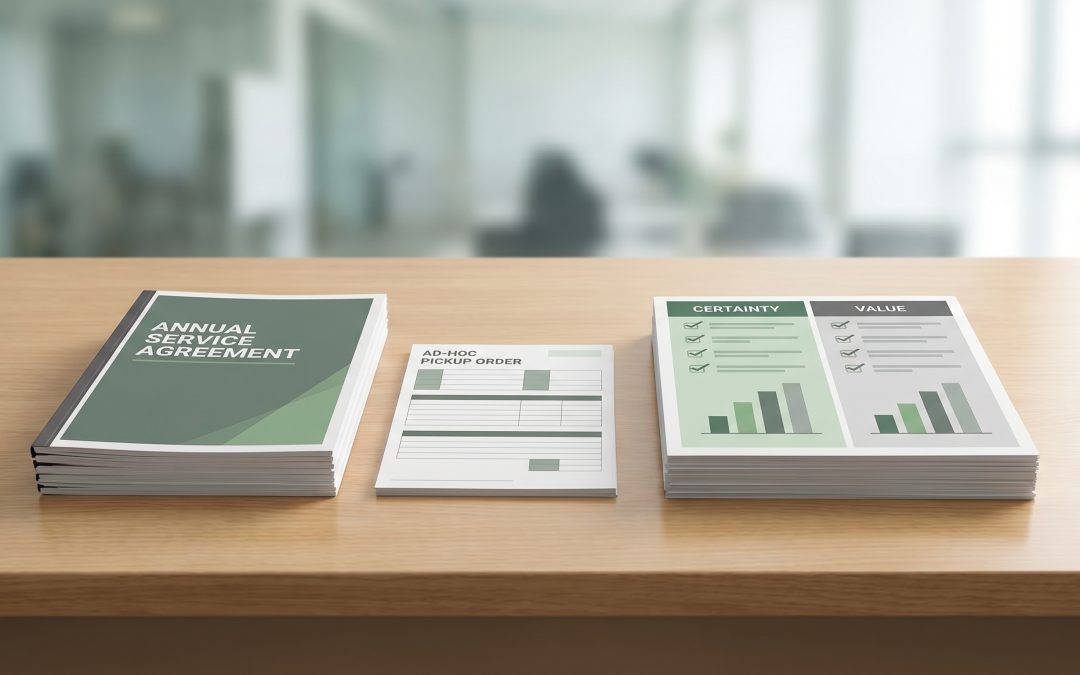
Should you lock in an annual ITAD contract or handle disposal on an ad-hoc basis as needs arise? The answer depends on your disposal volumes, budget preferences, and how much management attention you want to dedicate to IT asset disposition.
Annual Contracts
An annual contract establishes an ongoing relationship with your ITAD provider, with agreed pricing, service levels, and processes that cover all disposals throughout the year. Collections can be scheduled regularly or called in as needed under the contract terms.
Advantages: Pre-negotiated pricing, typically better than ad-hoc rates. Defined SLAs for response times, processing, and reporting. No need to source and evaluate a provider each time you need a disposal. Consistent processes and documentation across all events. Priority service from a provider who values the ongoing relationship. And streamlined administration with a single contract covering all activity.
Disadvantages: May include minimum volume commitments that you need to meet. Less flexibility to switch providers if a better option emerges. The pricing may not reflect current market conditions if equipment values change significantly during the term. And you may be paying for a service level you do not always need.
Ad-Hoc Services
Ad-hoc ITAD means engaging a provider each time you need equipment disposed of, without a standing contract. You request a quote, agree to terms, and arrange the one-off service.
Advantages: Complete flexibility to choose a different provider for each event. No minimum volume commitments. Pricing reflects current market conditions at the time of each transaction. And you only engage (and pay for) the service when you actually need it.
Disadvantages: Higher per-unit pricing because you lack volume leverage. Time and effort required to source and evaluate providers for each event. Inconsistent processes and documentation across different providers. No guaranteed response times or service levels. And the provider has less incentive to invest in understanding your specific requirements.
Contract Structure Options
Annual contracts do not have to be rigid. Flexible structures include framework agreements that set pricing and terms but do not commit to minimum volumes, call-off arrangements where you can request services as needed under pre-agreed terms, and tiered pricing that adjusts based on actual volumes processed during the year.
These flexible structures give you the benefits of pre-negotiated terms and an established provider relationship without locking you into commitments that may not match your actual disposal patterns.
Deciding What Is Right
Consider your disposal patterns over the past two to three years. If disposals are regular and predictable, a contract makes sense. If they are sporadic and unpredictable, a flexible framework agreement gives you the best of both worlds. If you only dispose of equipment once a year in small volumes, ad-hoc may be the simplest option.
Also consider the administrative burden. Each ad-hoc engagement requires sourcing, quoting, contracting, and managing. For busy IT or procurement teams, the time cost of repeated ad-hoc arrangements often exceeds the management overhead of a standing contract.