
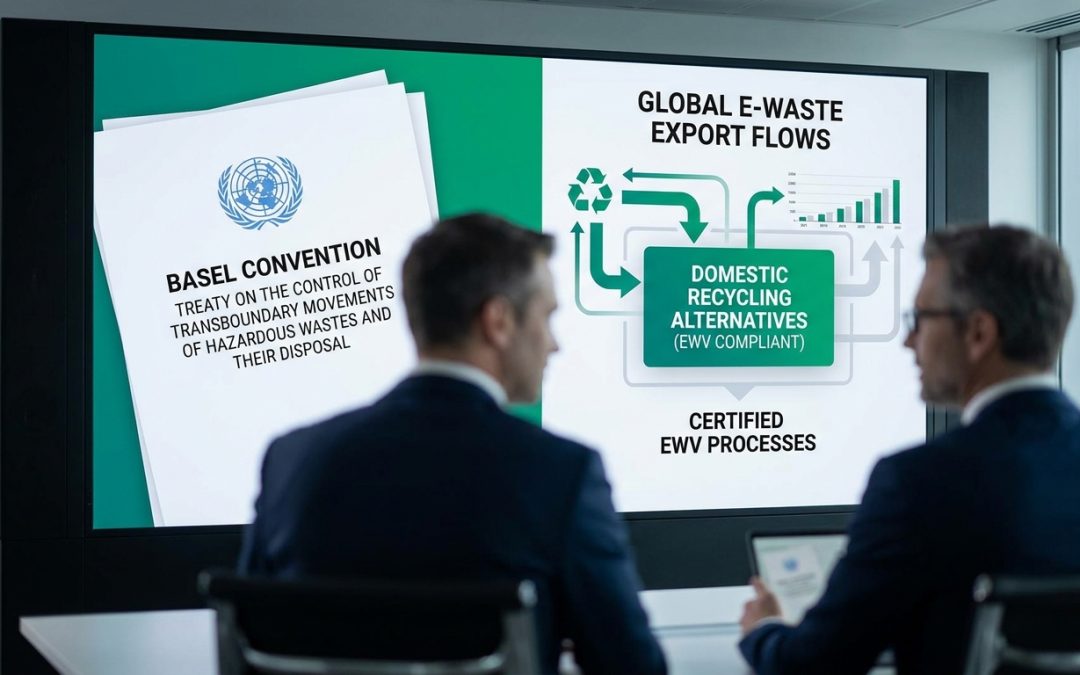
What Is the Basel Convention?
The Basel Convention on the Control of Transboundary Movements of Hazardous Wastes and their Disposal is an international treaty designed to prevent the dumping of hazardous waste by wealthy nations onto developing countries. Adopted in 1989 and entering into force in 1992, the Convention has become one of the most important international frameworks governing how electronic waste moves between countries.
Australia ratified the Basel Convention and implements it through domestic legislation, primarily the Hazardous Waste (Regulation of Exports and Imports) Act 1989. This means that Australian businesses and waste operators are bound by the Convention’s requirements when dealing with the export or import of electronic waste and other hazardous materials.
Understanding the Basel Convention matters for anyone involved in e-waste management because it shapes the rules governing where Australian e-waste can be sent, under what conditions, and with what documentation. It also provides context for why domestic e-waste recycling capacity is so important.
Why E-Waste Falls Under the Convention
Electronic waste is covered by the Basel Convention because it contains hazardous substances listed in the Convention’s annexes. Lead in solder and CRT glass, mercury in backlights and switches, cadmium in batteries and semiconductors, hexavalent chromium, brominated flame retardants, and various other substances found in electronic products all trigger the Convention’s classification criteria.
The Convention defines hazardous waste broadly, encompassing waste that exhibits characteristics such as toxicity, ecotoxicity, or the potential to release toxic substances. Most categories of electronic waste meet these criteria due to the materials they contain, even if the hazardous substances make up only a small proportion of the total weight.
- Minimisation: hazardous waste generation should be minimised at source
- Proximity: hazardous waste should be treated and disposed of as close to the source as possible
- Prior Informed Consent: exporting countries must notify and receive consent from importing countries before any transboundary movement
- Environmentally Sound Management: all handling, transport, and processing must meet environmental standards
- Ban Amendment: prohibits hazardous waste exports from developed to developing countries
The Basel Ban Amendment
One of the most significant provisions of the Basel Convention is the Ban Amendment, which prohibits the export of hazardous waste from Annex VII countries (OECD nations, EU members, and Liechtenstein) to non-Annex VII countries (essentially, developing nations). The Ban Amendment was adopted in 1995 and entered into force in December 2019 after achieving the required number of ratifications.
For Australia, as an OECD member and Annex VII country, the Ban Amendment means that e-waste classified as hazardous cannot be exported to developing countries, even if the receiving country consents. This restriction applies regardless of whether the stated purpose is recycling or disposal. The amendment was specifically designed to prevent the practice of disguising waste dumping as recycling operations.
The Ban Amendment has had a significant impact on global e-waste flows. Before its implementation, large volumes of e-waste from developed countries were shipped to countries like China, India, Ghana, and Nigeria, where informal recycling operations exposed workers and communities to hazardous substances. By restricting these flows, the amendment aims to incentivise domestic recycling in developed countries and protect vulnerable communities in developing nations.
Prior Informed Consent: How It Works
For transboundary movements of e-waste that are permitted (for example, between OECD countries), the Convention requires a Prior Informed Consent (PIC) procedure. This process involves several steps.
The exporting country must notify the importing country and any transit countries in writing, providing detailed information about the waste including its composition, quantity, origin, proposed transport route, and the facility where it will be processed. The importing country reviews the notification and can consent, consent with conditions, or refuse. Transit countries also have the right to consent or object.
Only after written consent has been received from all relevant countries can the transboundary movement proceed. The entire process must be documented, and movement documents must accompany the waste from point of export to point of final processing. This paper trail ensures accountability and traceability throughout the movement.
In Australia, the PIC procedure is administered by the Department of Climate Change, Energy, the Environment and Water. Australian businesses wishing to export e-waste must apply for permits through the Department and provide all required documentation before any waste leaves the country.
The Problem of Illegal E-Waste Trafficking
Despite the Basel Convention’s provisions, illegal trafficking of e-waste remains a significant global problem. The United Nations Environment Programme (UNEP) and Interpol have identified e-waste trafficking as a major environmental crime, with an estimated 50 million tonnes of e-waste generated globally each year and a substantial proportion of it moving through illegal channels.
Common methods of circumventing the Convention include mislabelling e-waste as second-hand goods (claiming non-functional waste is working equipment intended for reuse), concealing e-waste within shipments of other materials, routing waste through intermediary countries to obscure its origin, and falsifying documentation about the nature or destination of waste shipments.
The consequences of illegal e-waste trafficking are borne primarily by communities in developing countries where the waste ends up. Informal recycling of e-waste, particularly the burning of cables to recover copper and the acid leaching of circuit boards to recover gold, releases toxic substances into the air, soil, and water. Workers, including children, are exposed to lead, mercury, and other hazardous substances with devastating health consequences.
For Australian businesses, ensuring that their e-waste is handled through legitimate, compliant channels is both a legal obligation and an ethical responsibility. Working with licensed, reputable recyclers and ITAD providers is the most effective way to ensure that e-waste does not enter illegal trafficking networks.
Australia’s Implementation
Australia implements its Basel Convention obligations through several pieces of legislation and regulatory mechanisms. The Hazardous Waste Act 1989 provides the primary framework for regulating the import and export of hazardous waste, including e-waste. The Recycling and Waste Reduction Act 2020 added further restrictions on waste exports as part of Australia’s commitment to processing more waste domestically.
The Australian Government has invested in building domestic recycling capacity to reduce reliance on waste exports. Grants and incentives for recycling infrastructure, research into new recycling technologies, and policy frameworks supporting circular economy principles all aim to keep more e-waste processing within Australia’s borders.
For the detailed domestic regulatory landscape, see our comprehensive overview of e-waste laws and regulations across Australia.
What This Means for Businesses
For most businesses generating e-waste in Australia, the Basel Convention operates in the background. The practical implications are managed by the recycling and ITAD providers who process the waste. However, understanding the framework provides important context.
When selecting a disposal provider, ask about their end-to-end processing chain. Reputable providers will be able to explain where and how your e-waste is processed, and they will be able to demonstrate compliance with both domestic regulations and international obligations. Be cautious of providers offering unusually cheap disposal services, as low prices can sometimes indicate that corners are being cut, potentially including illegal export.
For businesses involved in remarketing used equipment internationally, ensure that all exports are of genuinely functional, tested equipment and are properly documented. The distinction between legitimate reuse and illegal waste export is actively enforced, and getting it wrong carries serious legal consequences.
The Basel Convention exists to protect the world’s most vulnerable communities from bearing the environmental and health costs of the developed world’s consumption. Responsible e-waste management in Australia, through proper domestic recycling and compliant export practices, is Australia’s contribution to that protection. For guidance on working with the right partners, see our guide on choosing an ITAD provider in Australia.
EWV helps Victorian businesses manage e-waste and IT asset disposal compliantly and sustainably — including collection, certified data destruction, and recycling. Contact us for a free quote.