
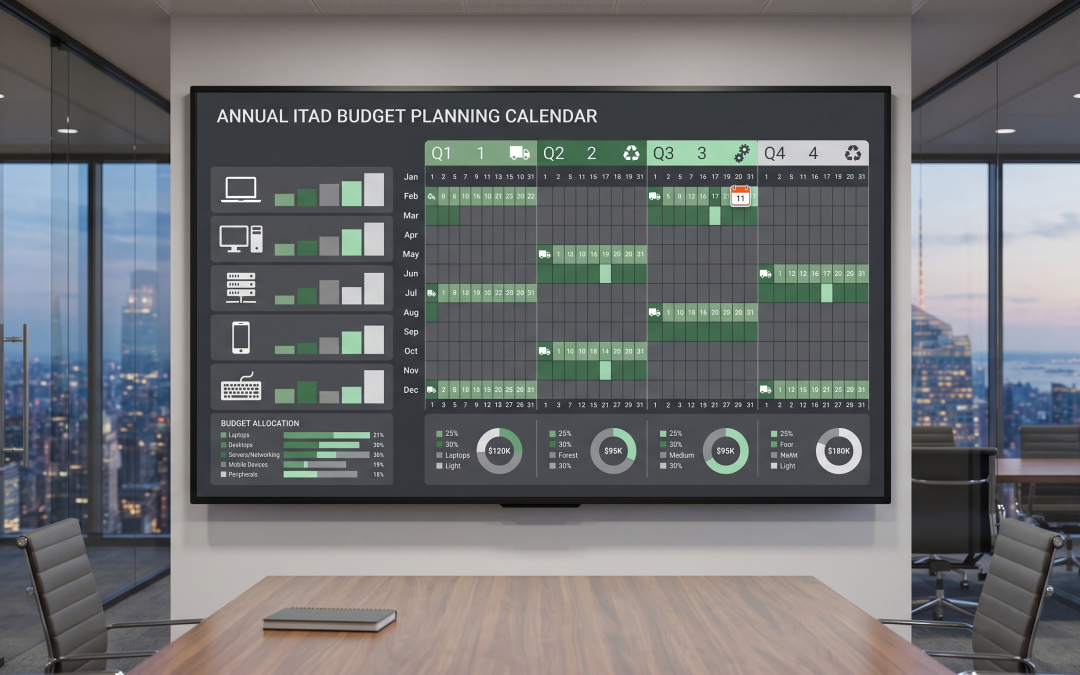
Budgeting for IT asset disposition requires a different approach than budgeting for most IT expenses. ITAD costs vary with volume and timing, value recovery can offset expenses in unpredictable ways, and the consequences of under-budgeting (stockpiled equipment, security risks, compliance gaps) are more severe than for many other line items. A structured approach to ITAD budgeting ensures your program is adequately funded without unpleasant surprises.
Components of an ITAD Budget
A comprehensive ITAD budget includes several cost categories. Processing fees cover the per-device or per-kilogram charges from your ITAD provider for collection, data destruction, and recycling. These are the most predictable costs and can be estimated from your provider’s price list and your expected disposal volumes.
Transport and logistics costs cover the movement of equipment from your premises to the processing facility. For single-site organisations, this may be bundled into processing fees. For multi-site organisations, transport costs can be significant and should be estimated separately.
On-site services include any work performed at your premises, such as on-site data destruction for high-security assets, asset auditing, or equipment staging and packing. These services typically carry a premium over standard off-site processing.
Internal costs are easy to overlook but real. Staff time for coordinating disposals, managing the provider relationship, auditing equipment, and handling documentation represents a genuine cost to the organisation. Estimate the hours involved and apply appropriate labour costs.
Value recovery is the offset. Revenue from remarketing should be estimated conservatively and treated as a reduction in net ITAD cost rather than a guaranteed income stream. Market conditions can change, and the actual value of your equipment is not confirmed until it is tested and graded.
Estimating Volume
The accuracy of your ITAD budget depends heavily on your volume estimate. Several inputs help build a reliable forecast. Your technology refresh schedule tells you how many devices are planned for replacement. Historical disposal data from previous years shows actual volumes, which are often higher than planned due to ad hoc disposals, failed equipment, and discovered stockpiles.
Planned projects such as office moves, consolidations, or cloud migrations can generate large one-off volumes that need to be budgeted separately from routine disposals. Employee turnover and organisational changes create ongoing disposal needs that are harder to predict but can be estimated from historical patterns.
Add a contingency of 10-20% above your planned volume to account for unplanned disposals and the inevitable discovery of equipment that was not in anyone’s plan.
Budgeting for Value Recovery
Value recovery projections should be conservative. Estimate based on the age and condition of equipment you expect to dispose of, adjusted for current secondary market conditions. Your ITAD provider can help with these estimates, but treat their projections as a guide rather than a guarantee.
Budget for value recovery as a range rather than a single number. If your provider estimates $50,000 in returns, budget for a range of $30,000-50,000 to account for market fluctuations and condition variances. This prevents your budget from being over-reliant on optimistic value recovery assumptions.
For organisations where value recovery is significant, track it as a separate line item rather than netting it against processing costs. This provides better visibility into both the cost and revenue sides of your ITAD program.
Annual vs Project-Based Budgeting
Organisations with ongoing ITAD programs should budget annually, with quarterly allocation based on planned disposal cycles. This approach smooths costs across the year and aligns with financial planning processes.
Large one-off projects (data centre decommissions, office relocations, post-merger equipment consolidation) should be budgeted separately as project expenses. These projects have different cost profiles, timelines, and value recovery characteristics than routine disposals.
Some organisations maintain a standing ITAD budget for routine disposals supplemented by project-specific budgets for major initiatives. This dual approach ensures routine program funding is protected while major projects get appropriate separate attention.
Cost Reduction Strategies
Several strategies can reduce ITAD costs without compromising security or compliance. Consolidating disposals into fewer, larger batches often achieves better per-unit pricing than frequent small collections. Standardising equipment across your organisation simplifies processing and improves remarketing efficiency. Disposing of equipment promptly while it still has resale value reduces net costs. Negotiating volume-based pricing with your ITAD provider for annual commitments typically secures better rates.
Presenting the ITAD Budget
When presenting your ITAD budget to management, frame it in terms of risk management and compliance, not just cost. The budget funds data security (preventing breaches from improper disposal), regulatory compliance (meeting Privacy Act and environmental obligations), space recovery (freeing up office and storage space), and environmental responsibility (proper recycling and reuse).
Showing the cost of not budgeting for ITAD, including potential breach costs, compliance penalties, and lost value from delayed disposal, often makes the case more effectively than justifying the budget in isolation.
EWV handles IT asset disposition (ITAD) end-to-end for Victorian businesses — from collection and data destruction through to certified recycling or refurbishment for resale. Get in touch for a tailored ITAD quote.