
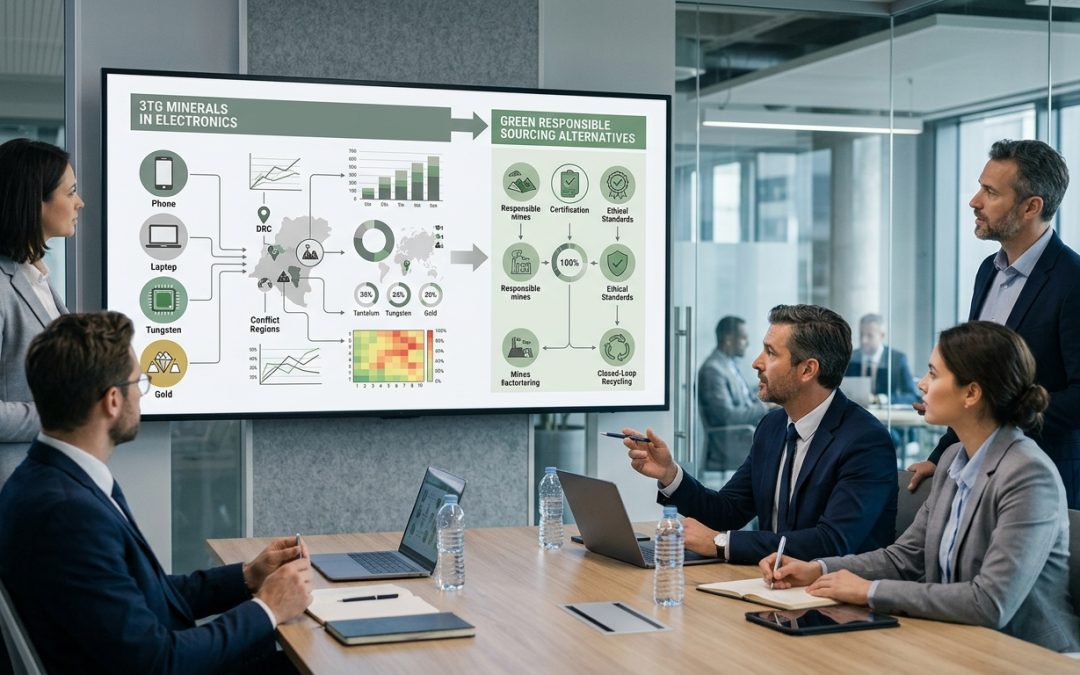
What Are Conflict Minerals?
The term “conflict minerals” refers to natural resources extracted in conditions of armed conflict and human rights abuse, where the profits from mining finance armed groups, perpetuate violence, or rely on forced labour. In the electronics industry, four minerals are at the centre of this issue: tin, tantalum, tungsten, and gold, collectively known as 3TG. These minerals are essential components in virtually every electronic device manufactured today.
Tin is used in solder that connects components on circuit boards. Tantalum provides the capacitors that store electrical charge in smartphones, laptops, and other devices. Tungsten gives mobile phones their vibration function and provides weight and balance to devices. Gold conducts electricity in connectors, switches, and circuit board traces. Without these four minerals, modern electronics couldn’t function.
Where the Problem Lies
While 3TG minerals are mined globally, the conflict mineral issue is most acute in the Democratic Republic of Congo (DRC) and surrounding countries in central Africa. The eastern DRC holds vast mineral wealth, including some of the world’s largest deposits of tantalum (coltan) and significant deposits of tin, tungsten, and gold. For decades, armed groups have controlled mines and trading routes in this region, using mineral revenue to fund operations and sustain conflicts that have caused millions of deaths and displaced millions more.
The dynamics are complex. Mining provides livelihoods for millions of artisanal miners in the region, and the minerals are not inherently problematic. The issue is the conditions under which extraction occurs: forced labour, child labour, dangerous working conditions, environmental destruction, and the flow of revenue to armed groups that perpetuate violence against civilian populations.
The supply chain from mine to finished electronic device passes through multiple intermediaries, including local traders, regional aggregators, smelters and refiners, component manufacturers, and finally device assemblers. This complexity makes tracing the origin of minerals in a finished product extremely challenging.
Regulatory Responses
Several regulatory frameworks have been established to address conflict minerals in electronics supply chains:
The US Dodd-Frank Act Section 1502 (2010) required publicly listed companies to investigate and disclose whether their products contain 3TG minerals originating from the DRC or adjoining countries. While the rule’s enforcement has fluctuated with changing administrations, it established the principle that electronics companies bear responsibility for understanding their mineral supply chains.
The EU Conflict Minerals Regulation (fully applicable from January 2021) requires EU importers of 3TG minerals and metals to conduct supply chain due diligence aligned with OECD guidelines. Unlike Dodd-Frank, which focused on disclosure, the EU regulation requires active due diligence and risk mitigation.
The OECD Due Diligence Guidance for Responsible Supply Chains of Minerals from Conflict-Affected and High-Risk Areas provides the internationally recognised framework for mineral supply chain due diligence. Most regulatory frameworks reference or build upon the OECD guidance.
Australia does not currently have specific conflict minerals legislation, but Australian companies listed on the ASX or operating in US or EU markets may be subject to those jurisdictions’ requirements. The Modern Slavery Act 2018 (Cth) requires certain large entities to report on risks of modern slavery in their operations and supply chains, which can include mining supply chains.
Industry Initiatives
The electronics industry has developed several mechanisms to address conflict mineral sourcing:
The Responsible Minerals Initiative (RMI), formerly the Conflict-Free Smelter Program, audits and certifies smelters and refiners of 3TG minerals. Certified facilities have demonstrated that their mineral sourcing doesn’t contribute to conflict. Major electronics manufacturers use RMI certifications as the primary tool for supply chain due diligence.
Blockchain and digital traceability systems are being piloted to create tamper-resistant records of mineral provenance from mine to smelter. These technologies can potentially provide greater assurance about mineral origins than paper-based certification systems, though they face challenges around adoption at the artisanal mining level where infrastructure is limited.
Industry coalitions including the Responsible Business Alliance bring together major electronics companies to share due diligence resources, develop common standards, and exert collective leverage on supply chain actors. These collaborative approaches are more effective than individual company efforts because the mineral supply chain is shared across the industry.
The Connection to E-Waste Recycling
Responsible e-waste recycling provides a partial solution to the conflict minerals challenge. When gold, tin, tantalum, and other metals are recovered from electronic waste and re-enter the supply chain as secondary raw materials, they reduce demand for newly mined minerals. This “urban mining” approach provides a supply of critical materials without the human rights and environmental risks associated with primary mining in conflict-affected regions.
The circular economy model for electronics explicitly recognises this connection. By keeping materials in productive use through refurbishment and recovering them through proper recycling when devices reach end of life, the industry can gradually reduce its dependence on primary mineral extraction from conflict-affected areas.
Current recycling technology can recover gold, tin, and copper from circuit boards at high efficiency. Tantalum recovery from capacitors is more challenging but improving. As recycling technology advances and collection rates increase, the proportion of critical minerals sourced from recycled electronics will grow, easing pressure on primary mining.
What Businesses Can Do
Even without specific Australian legislation on conflict minerals, businesses can take practical steps:
Ask suppliers about conflict mineral policies. When procuring electronics, inquire about the manufacturer’s conflict mineral due diligence. Major manufacturers publish annual Conflict Minerals Reports detailing their supply chain investigations and smelter audit results.
Factor supply chain ethics into procurement. Manufacturers that invest in supply chain transparency and responsible sourcing may cost slightly more, but they offer lower reputational risk and alignment with ESG commitments. For organisations reporting under the Modern Slavery Act or preparing ESG disclosures, demonstrating awareness of conflict mineral risks in IT procurement strengthens reporting quality.
Support the secondary materials market. By ensuring your retired IT equipment goes through proper recycling channels that recover and recirculate critical materials, you contribute to reducing primary mining demand. Every gram of gold recovered from a recycled circuit board is a gram that doesn’t need to be mined.
Conflict minerals represent one of the most challenging ethical dimensions of the electronics industry. Perfect solutions don’t exist yet, but informed procurement decisions, proper recycling, and engagement with supply chain transparency initiatives all contribute to progress.
EWV helps Victorian businesses manage e-waste and IT asset disposal compliantly and sustainably — including collection, certified data destruction, and recycling. Contact us for a free quote.