
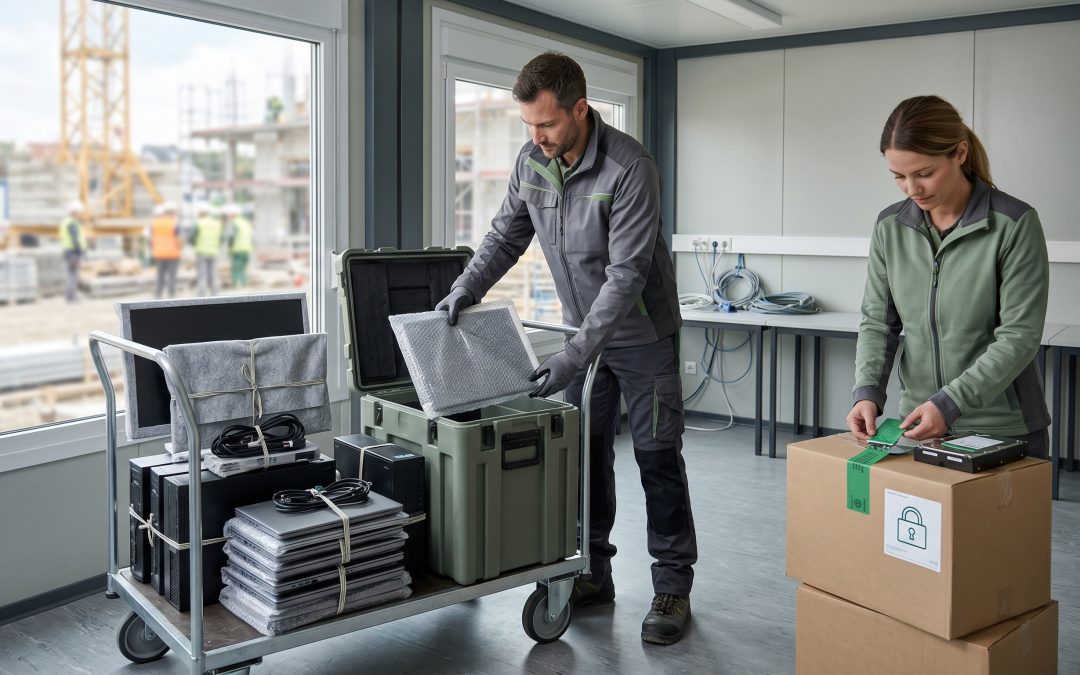
The Overlooked IT Footprint of Construction Site Offices
Construction site offices are temporary by nature, but the IT equipment inside them stores data that is anything but temporary. Project management computers, engineering workstations, security systems, and communication equipment accumulate sensitive data throughout the life of a construction project. When the project finishes and the site office is dismantled, this equipment and its data need to be handled with the same care as any other IT disposal, yet the temporary and often chaotic nature of site demobilisation means data security is frequently overlooked.
Construction projects can run for months or years, and the site office serves as the operational hub during that entire period. By the time the project concludes, the IT equipment has accumulated project documentation, financial records, subcontractor information, employee details, engineering drawings, and communications that could be commercially sensitive or contain personal information.
Types of Data on Construction Site IT Equipment
Project management systems store comprehensive project data including budgets, schedules, variation claims, progress reports, and correspondence with clients, architects, and subcontractors. This information has both commercial sensitivity and potential legal relevance, particularly for projects where disputes may arise after completion.
Engineering and design workstations hold CAD drawings, BIM models, structural calculations, specifications, and design documentation. For projects involving proprietary designs or innovative construction methods, this intellectual property has significant value. For government or defence construction projects, the design information may be classified.
Financial systems on site computers contain project cost data, subcontractor payment records, purchase orders, and invoicing information. This data includes the personal details and banking information of subcontractors and suppliers.
HR and safety systems store employee induction records, working-with-children checks (for projects near schools), safety training records, incident reports, and personal contact details for all workers who accessed the site. On large projects, this could represent hundreds or thousands of individuals.
CCTV and access control systems monitor site security and record footage of workers, visitors, and the public. Time-lapse cameras documenting construction progress also capture identifiable images of individuals.
Communication systems including email, messaging, and phone systems retain records of all project communications, which may include commercially sensitive negotiations, dispute-related correspondence, and personal information.
Challenges of Site Office Demobilisation
Construction site demobilisation is driven by project timelines and site handover deadlines. Once the construction work is complete, there is strong pressure to vacate the site quickly, return site offices (which are often portable buildings), and close out the project. IT equipment handling can be compressed into the final days when attention is focused on physical cleanup, defect rectification, and contract close-out.
Site offices are often managed by project teams rather than corporate IT departments. The project manager or site administrator may be responsible for IT equipment, and they may not have the technical knowledge or tools to perform proper data destruction. The corporate IT team may be at head office, hours away from the construction site.
Equipment ownership can be mixed. Some IT equipment belongs to the company, some may be leased, and some may belong to joint venture partners or client-provided systems. Each ownership category may have different disposal requirements, and the responsibility for data destruction may not be clearly defined.
Remote site locations, common for infrastructure, mining, and regional construction projects, add logistical complexity. Getting equipment to a central IT facility or having an ITAD provider visit a remote site requires planning and may not be practical within tight demobilisation timeframes.
Planning IT Demobilisation as Part of Project Close-Out
IT equipment handling should be included in the project close-out plan, not treated as an afterthought during the final site cleanup. As the project approaches completion, an inventory of all IT equipment on site should be compiled, noting what data each system contains and what needs to happen to that data.
Determine which data needs to be archived for ongoing retention. Construction projects generate records that must be retained for extended periods, including as-built documentation (potentially indefinitely), financial records (minimum five to seven years), safety records and incident reports, and warranty documentation. This data should be migrated from site equipment to the company’s central IT infrastructure before site equipment is wiped.
Schedule data destruction activities to occur before the final demobilisation push. Having IT personnel visit the site, or arranging for equipment to be transported to a central facility, works best when it is planned weeks in advance rather than attempted in the last 48 hours before site handover.
Data Destruction Methods for Site Equipment
Standard office computers and laptops from the site office should undergo NIST 800-88 compliant data sanitisation using the same tools and processes applied to any other business IT equipment. If the equipment will be redeployed to the next project site, full disk wiping before redeployment ensures that data from the completed project does not carry over.
CCTV DVRs and security equipment should have their storage media wiped or physically removed. For systems being returned to a security contractor, ensure that all footage has been removed before handover.
Specialist equipment such as survey instruments, drones, and monitoring devices with data storage should be included in the data clearing process. These devices may contain site survey data, aerial imagery, and monitoring records that have both commercial value and privacy implications.
For equipment being retired rather than redeployed, engaging a certified ITAD provider to handle disposal ensures professional data destruction with proper documentation. For remote sites, some ITAD providers offer mobile destruction services that can process equipment on-site.
Multi-Party Projects and Joint Ventures
Construction projects involving joint ventures, alliances, or multiple contractors create additional complexity. Data on site office equipment may belong to multiple parties, and the responsibility for data destruction should be addressed in the project alliance agreement or joint venture deed.
When the project concludes, each party should confirm that their data has been either retrieved or destroyed. A joint data clearing process, with representatives from each party verifying that their interests have been addressed, helps prevent disputes about data handling after the project closes.
Closing the Project Cleanly
A construction project is not truly complete until all aspects of the site have been properly closed out, and that includes the IT environment. Treating data destruction as a standard project close-out activity, alongside defect rectification, financial reconciliation, and physical site restoration, ensures that the data generated during the project’s life is handled with the same professionalism applied to every other aspect of the work.
EWV handles IT asset disposition (ITAD) end-to-end for Victorian businesses — from collection and data destruction through to certified recycling or refurbishment for resale. Get in touch for a tailored ITAD quote.