
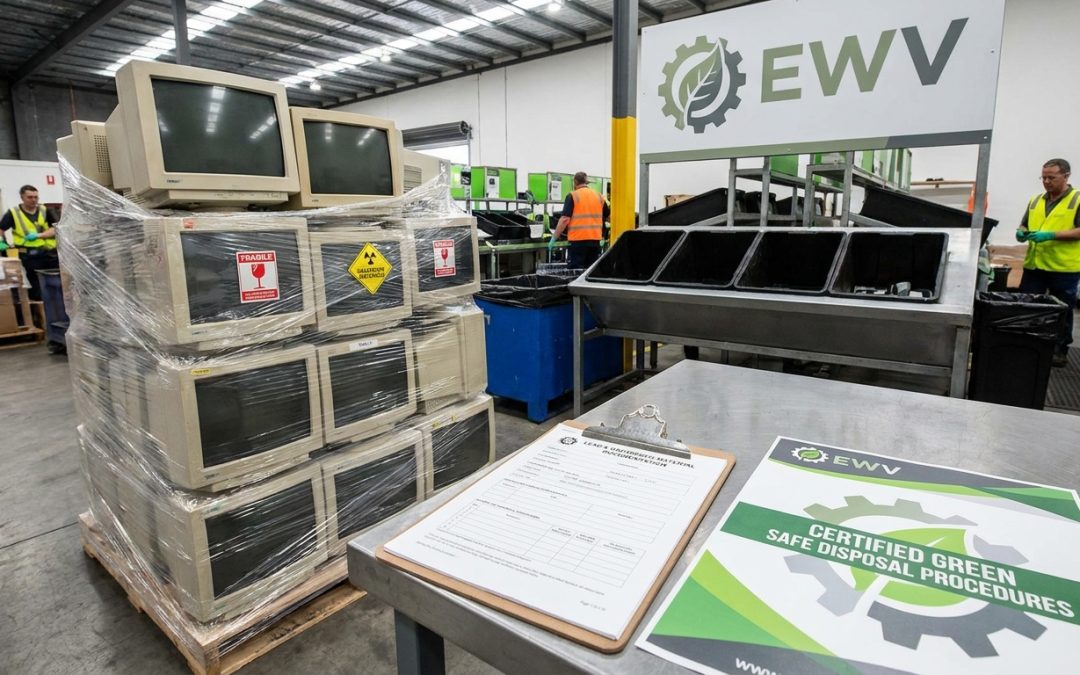
The Legacy of CRT Technology
Cathode ray tube (CRT) monitors and televisions were the dominant display technology for decades, from the earliest television sets through to the computer monitors that sat on office desks well into the 2000s. While flat-panel LCD and LED displays have completely replaced CRTs in new products, millions of old CRT devices remain in storage across Australia, in garages, storerooms, offices, and warehouses, waiting for disposal.
CRT disposal is one of the most challenging aspects of e-waste management. These devices are heavy, fragile, and contain significant quantities of hazardous materials, particularly lead. They are expensive to recycle, difficult to transport safely, and there are limited markets for the recovered materials. Understanding why CRTs need special handling helps explain why they cannot simply be thrown out with general waste and why proper recycling is essential.
What Makes CRTs Hazardous
The defining hazard in CRT monitors and televisions is lead. The glass used in CRT tubes contains lead oxide, which serves as radiation shielding to protect users from X-rays generated by the electron beam during operation. A typical CRT computer monitor contains approximately 2 to 4 kilograms of lead, while larger CRT televisions can contain even more.
The lead is integrated into the glass itself, not applied as a coating. The funnel section of the CRT (the conical portion connecting the screen face to the narrow neck) has the highest lead concentration, with lead content sometimes exceeding 20% by weight. The screen face also contains some lead, though typically at lower concentrations.
- Lead: 2-4 kg per monitor in the glass, a potent neurotoxin
- Barium: used in the front panel glass as a radiation shield
- Phosphor coating: the luminescent coating on the screen face contains compounds of zinc, cadmium, and rare earth elements
- Capacitors: can retain dangerous electrical charges even when unplugged
- Solder: lead-based solder on the circuit boards
Beyond lead, CRTs contain other hazardous substances. The phosphor coating on the inside of the screen face, which produces the visible image, can contain cadmium and other toxic compounds. The high-voltage capacitors inside CRTs can retain dangerous electrical charges for extended periods after the device is unplugged, presenting an electric shock risk to anyone who opens the casing without proper precautions.
Why CRTs Cannot Go to Landfill
The lead in CRT glass is the primary reason these devices are banned from Victorian landfills and should never be disposed of in general waste anywhere. When a CRT is placed in landfill, the glass can break during compaction or over time, exposing the lead-containing glass to moisture and acidic conditions in the landfill environment.
Under these conditions, lead can leach out of the glass and into the surrounding soil and groundwater. Lead is a persistent environmental contaminant that does not break down over time. Once in groundwater, it can spread over significant distances and contaminate drinking water sources, agricultural land, and waterways.
Given that a single CRT contains kilograms of lead, and that millions of CRTs have been produced and are still awaiting disposal, the cumulative environmental risk from improper disposal is substantial. This is why proper recycling through facilities equipped to handle lead-containing glass is the only acceptable disposal pathway.
The CRT Recycling Challenge
Recycling CRTs is technically possible but economically challenging. The process involves carefully dismantling the CRT unit, separating the leaded glass components from other materials, and processing the glass for reuse or safe disposal.
The dismantling process must be done carefully to avoid breaking the glass in an uncontrolled way, which would release lead dust. Workers handling CRT glass need personal protective equipment including respiratory protection. The phosphor coating must be removed from the screen face before the glass can be processed.
Historically, recycled CRT glass was used as a feedstock for manufacturing new CRTs, creating a closed-loop recycling system. However, with CRT production having ceased globally, this market no longer exists. Finding end markets for recycled CRT glass has become one of the biggest challenges in e-waste recycling.
Current options for processed CRT glass include use in lead smelting as a flux material, incorporation into construction materials under controlled conditions, and specialised glass recycling processes. However, the economics are difficult because the cost of safely processing the glass typically exceeds the value of the recovered materials. This means CRT recycling often requires subsidies or cross-subsidisation from other, more economically viable recycling streams.
The Stockpiling Problem
The economic challenges of CRT recycling have led to stockpiling issues in Australia and internationally. Some recycling operators have accumulated large volumes of CRT glass or intact CRTs without having viable processing or disposal pathways. Several high-profile cases internationally have involved recyclers stockpiling CRTs in warehouses that were eventually abandoned, leaving clean-up costs to landowners and governments.
In Australia, regulatory authorities monitor e-waste recyclers to prevent excessive stockpiling and ensure that collected CRTs are actually being processed rather than just accumulated. When choosing an e-waste recycler or ITAD provider for CRT disposal, it is worth asking about their specific process for CRT glass and verifying that they have a genuine processing or disposal pathway rather than simply stockpiling.
Safe Handling of CRT Monitors
If you have CRT monitors or televisions that need disposal, handling them safely requires some basic precautions.
Do not break the glass. Keeping the CRT intact during storage and transport prevents the release of lead dust and eliminates the risk of cuts from sharp glass edges. Handle CRTs carefully and transport them in a way that prevents them from falling or being crushed.
Be aware of the electrical hazard. CRTs contain high-voltage capacitors that can retain a dangerous charge for weeks or even months after the device is unplugged. Do not attempt to dismantle a CRT yourself. Leave dismantling to trained professionals at licensed recycling facilities.
Do not store CRTs outdoors where they are exposed to weather. Rain can accelerate deterioration of the casing and potentially lead to lead leaching if the glass is already damaged. Store CRTs indoors on a stable surface where they will not be knocked over.
Where to Dispose of CRT Monitors
In Victoria, CRT monitors and televisions can be disposed of through several channels. Council e-waste drop-off points accept CRTs, and they are covered by the National Television and Computer Recycling Scheme (NTCRS), which provides free recycling for televisions and computer monitors.
For businesses with quantities of CRT monitors, commercial e-waste recyclers and ITAD providers can arrange collection. Be aware that CRT disposal may carry a per-unit fee due to the higher processing costs compared to flat-panel displays. This fee reflects the genuine cost of safely managing the lead-containing glass.
If you still have CRTs in storage, now is a good time to get them recycled rather than continuing to store them. The recycling infrastructure is available, and every CRT that is properly recycled is one fewer source of lead contamination in the environment. For guidance on responsible disposal of all types of electronic equipment, see our complete guide to e-waste recycling in Australia.
EWV helps Victorian businesses manage e-waste and IT asset disposal compliantly and sustainably — including collection, certified data destruction, and recycling. Contact us for a free quote.