
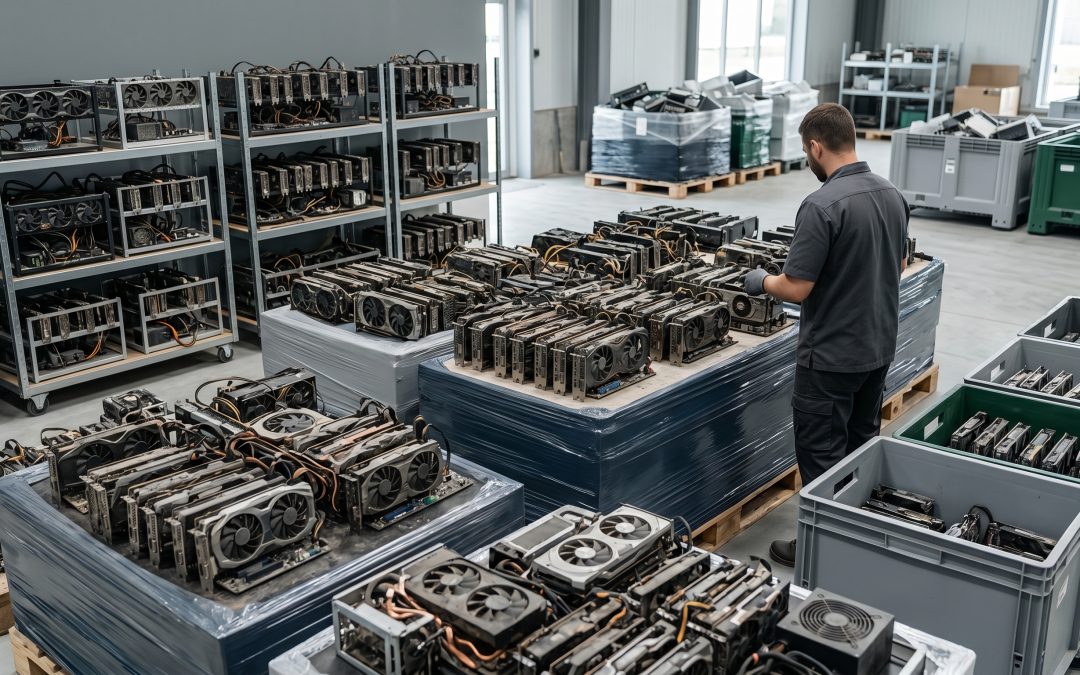
The Lifecycle Challenge of Crypto Mining Equipment
Cryptocurrency mining has driven a massive demand for specialised computing hardware. Application-specific integrated circuits (ASICs), high-performance GPUs, and the infrastructure supporting them have been manufactured, deployed, and consumed at an extraordinary rate. As mining difficulty increases and hardware becomes obsolete, or as cryptocurrency market conditions make mining unprofitable, vast quantities of mining equipment need to be disposed of. This equipment presents both data security and environmental challenges that are distinct from standard IT disposal.
Mining hardware has a particularly short useful life compared to general IT equipment. ASIC miners may become economically obsolete within 18 to 24 months as newer, more efficient models are released. GPU mining rigs are somewhat more flexible but still face rapid depreciation as mining algorithms and profitability shift. This short lifecycle means mining hardware enters the disposal stream faster and in larger volumes than most other IT equipment categories.
Data Risks on Mining Hardware
While cryptocurrency mining itself does not generate personal data in the traditional sense, mining equipment does contain data that can pose security and financial risks. Mining software configurations include wallet addresses, mining pool credentials, and payout information. If wallet private keys or seed phrases were stored on mining equipment, the financial exposure is direct and potentially catastrophic.
Mining pool authentication credentials stored on mining hardware could be used to impersonate the miner on the pool, potentially redirecting mining rewards or accessing pool account settings. API keys for exchange accounts, used for automated selling of mined cryptocurrency, may be cached on mining management systems.
Mining management and monitoring systems, which may run on standard computers alongside the mining hardware, store more extensive data including performance logs, profitability calculations, electricity cost records, and network configurations. These systems may also contain personal information if the mining operation involves employees or contractors.
For commercial mining operations that are incorporated businesses, the IT infrastructure supporting the operation, such as office computers, accounting systems, and communication equipment, contains standard business data subject to the same Australian Privacy Act obligations as any other business.
Environmental Concerns
Cryptocurrency mining has generated an extraordinary volume of electronic waste. The rapid obsolescence cycle means that hardware that was purchased new just one or two years ago may already be destined for disposal. Unlike general-purpose computers that can be repurposed for less demanding tasks when they are no longer suitable for their original purpose, ASIC miners have no alternative use once they are no longer profitable for mining.
ASIC miners contain custom silicon chips, circuit boards, fans, and power components. The materials recovery potential from these devices is similar to other electronics, with recoverable copper, aluminium, and precious metals in the circuit boards. However, the custom ASIC chips have no resale value once they are obsolete for mining.
GPU mining rigs have better second-life options, as the GPUs can be resold into the gaming, content creation, or AI/ML markets. However, GPUs that have been run at high temperatures for extended periods under mining loads may have reduced lifespans, creating concerns about the reliability of second-hand mining GPUs.
Victoria’s e-waste landfill ban applies to mining hardware just as it does to any other electronic equipment. Mining hardware must be recycled through appropriate e-waste channels rather than sent to landfill, regardless of its specialised nature.
Data Destruction for Mining Equipment
ASIC miners typically have minimal local storage, often just enough for the mining firmware and configuration. However, this storage contains the mining configuration including pool credentials and wallet addresses. A factory reset or firmware reflash is usually sufficient to clear this data, though verification that all credentials have been removed is important.
GPU mining rigs based on standard computer hardware (motherboards, storage drives, RAM) should undergo the same NIST 800-88 compliant data destruction as any other computer. The storage drives in these systems may contain mining software, wallet files, and management data that needs to be securely removed.
Mining management and monitoring servers that managed fleets of mining equipment often contain the most sensitive data in a mining operation. These servers should receive the same attention as any other business server during disposal, with full data sanitisation or physical destruction of storage media.
Network equipment including routers, switches, and firewalls used in mining operations store configuration data that may include credentials and network architecture information. These devices should be factory reset and have all configurations cleared before disposal.
Responsible Disposal of Mining Operations
For commercial mining operations that are closing down or significantly reducing their hardware fleet, engaging a certified ITAD provider ensures professional handling of both data destruction and environmental compliance. ITAD providers can process mining hardware through appropriate e-waste recycling channels, recover value from salvageable components, and provide documentation of proper disposal.
Mining hardware that retains economic value, such as GPUs that can be resold or newer ASICs that can still mine profitably, should have all data and credentials removed before entering the secondary market. Selling mining hardware with wallet credentials or exchange API keys still accessible is an invitation for financial loss.
The cryptocurrency mining industry has a responsibility to address the environmental impact of its hardware consumption. Proper disposal through certified recycling channels, value recovery where possible, and responsible handling of both data and hazardous materials are basic requirements for any mining operation’s approach to end-of-life equipment management.
EWV helps Victorian businesses manage e-waste and IT asset disposal compliantly and sustainably — including collection, certified data destruction, and recycling. Contact us for a free quote.