
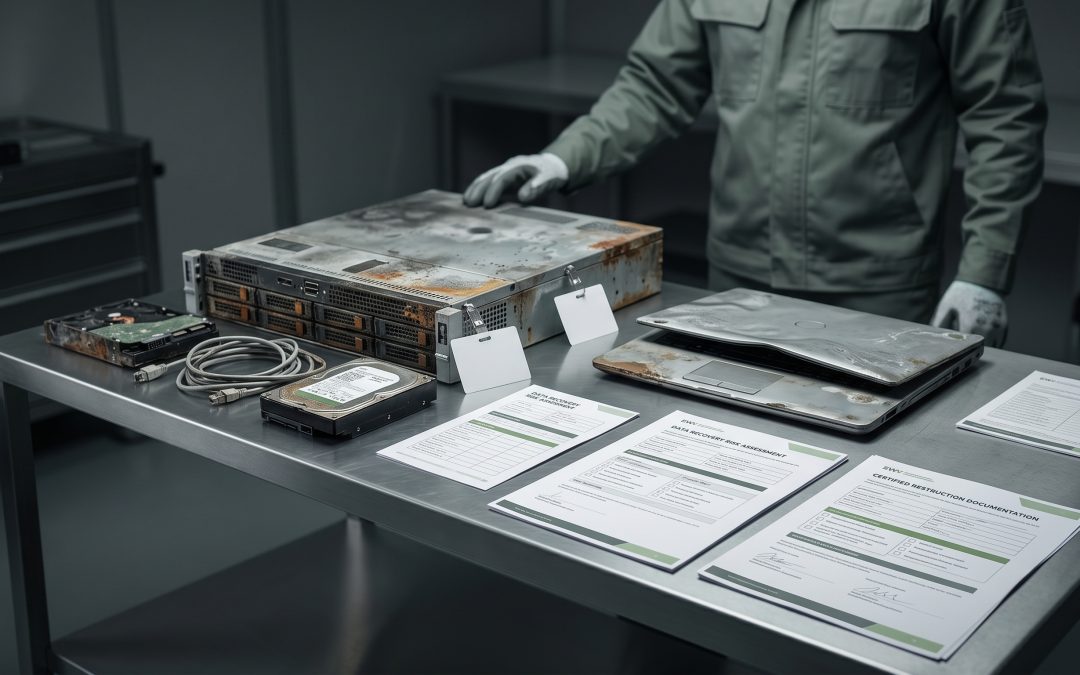
Physical Damage Does Not Equal Data Destruction
After a flood, fire, or other natural disaster, the immediate focus is on safety, insurance, and getting the business operational again. IT equipment that has been submerged in water, exposed to fire, or damaged by smoke is typically written off as a total loss. The assumption is that if the equipment is destroyed, the data must be destroyed too. This assumption is frequently wrong, and it creates a data security risk that many organisations fail to recognise during the chaos of disaster recovery.
Hard drives and solid-state drives are engineered to be remarkably resilient. The data stored on these devices can survive conditions that render the rest of the computer completely non-functional. Professional data recovery services regularly extract data from devices that have been submerged, burned, crushed, or otherwise severely damaged. If a recovery specialist can retrieve data from a damaged drive, so can anyone else with the motivation and resources to try.
How Data Survives Water Damage
Water damage from flooding, burst pipes, or firefighting efforts does not typically destroy data on hard drives. The magnetic platters inside a hard drive are sealed in an airtight enclosure that can resist water penetration for extended periods. Even if water does enter the drive enclosure, the magnetic data on the platters is not affected by water contact. Once the drive is dried in a controlled environment, the platters can be read using specialised equipment.
Solid-state drives are even more resistant to water damage. With no moving parts and data stored as electrical charges in flash memory cells, SSDs can often survive complete submersion. After drying, many water-damaged SSDs function normally, with all data intact.
The electronic components of the computer surrounding the drive, including the motherboard, power supply, and display, may be irreparably damaged by water. But the storage media itself, where the data lives, is frequently recoverable. This means that a flood-damaged computer that will never boot again may still contain a perfectly readable drive full of business data.
How Data Survives Fire Damage
Fire presents a more variable risk to data, depending on the intensity and duration of heat exposure. Hard drive platters can withstand temperatures of several hundred degrees Celsius before the magnetic coating begins to degrade. In many office fires, particularly those that are extinguished relatively quickly, the temperatures inside computer cases may not reach levels sufficient to destroy data on the platters.
The external casing of the hard drive provides some insulation, and the drive’s position within the computer case provides additional thermal buffering. A drive near the centre of a server rack, surrounded by other equipment, may experience significantly lower temperatures than the ambient fire temperature.
SSDs are generally more susceptible to heat damage than magnetic drives, as the flash memory cells can be damaged at lower temperatures. However, even partially heat-damaged SSDs may contain recoverable data on the cells that survived.
Smoke damage, while destructive to electronics, does not affect the data stored on sealed hard drive platters. Equipment that is non-functional due to smoke damage to circuit boards and connectors may have drives with fully intact data.
The Insurance and Disposal Gap
After a disaster, damaged IT equipment enters an insurance claim and disposal process that may not include data security considerations. Insurance assessors focus on the replacement value of the hardware. Disaster cleanup contractors focus on clearing the site. Neither party is typically responsible for, or even aware of, the data on the damaged equipment.
Damaged equipment may be removed from the site by cleanup crews and transported to waste facilities, scrap dealers, or recyclers without any data destruction. In the aftermath of a major disaster affecting multiple businesses, large quantities of damaged equipment may enter waste streams simultaneously, creating opportunities for opportunistic data recovery by anyone who acquires the equipment.
The disposal of damaged equipment through insurance salvage processes presents similar risks to standard equipment disposal, with the added complication that the organisation may have limited control over the process during disaster recovery.
Protecting Data on Damaged Equipment
Before any damaged IT equipment leaves your premises or control, assess whether data destruction is feasible. For devices where the drive is accessible and can be removed, extract the drive and handle it separately from the rest of the equipment. The chassis and other components can proceed through normal disaster disposal channels, while the drives are retained for secure destruction.
For drives that are not physically damaged and can be connected to a working computer, perform NIST 800-88 compliant data sanitisation before releasing the equipment. Use external adapters or docking stations to connect the drives to a clean system for wiping.
For drives that cannot be reliably wiped due to physical damage, physical destruction is the appropriate approach. Shredding, crushing, or degaussing (for magnetic drives) renders data unrecoverable regardless of the drive’s condition. A certified ITAD provider can process damaged drives alongside other disaster recovery equipment.
If physical access to the damaged site is restricted, such as during structural safety assessments after a fire, communicate data security requirements to whoever is authorised to access the site. Ensure that damaged IT equipment is not removed or disposed of until data destruction has been addressed.
Incorporating Data Security into Disaster Recovery Plans
Your organisation’s disaster recovery plan should include specific provisions for data security on damaged equipment. These provisions should identify who is responsible for IT equipment handling during disaster recovery, specify that drives should be removed from damaged equipment before disposal where possible, include contact details for an ITAD provider who can handle emergency processing of damaged drives, and establish protocols for communicating data security requirements to insurance assessors and cleanup contractors.
Pre-disaster encryption is the most effective measure for protecting data on equipment that may be damaged or displaced by a disaster. If all devices are encrypted, the data remains protected even if the damaged equipment cannot be securely disposed of through normal channels. This is one of the strongest arguments for deploying full disk encryption across the entire device fleet as a standard security measure.
Acting During Chaos
Natural disasters create overwhelming situations where data security can easily be forgotten. Building data protection steps into your disaster recovery plan, and designating specific responsibility for IT equipment handling, ensures that data security is maintained even when everything else is in disarray. The few hours spent addressing data on damaged equipment during disaster recovery can prevent a data breach that compounds the already significant impact of the disaster itself.
EWV helps Victorian businesses manage e-waste and IT asset disposal compliantly and sustainably — including collection, certified data destruction, and recycling. Contact us for a free quote.