
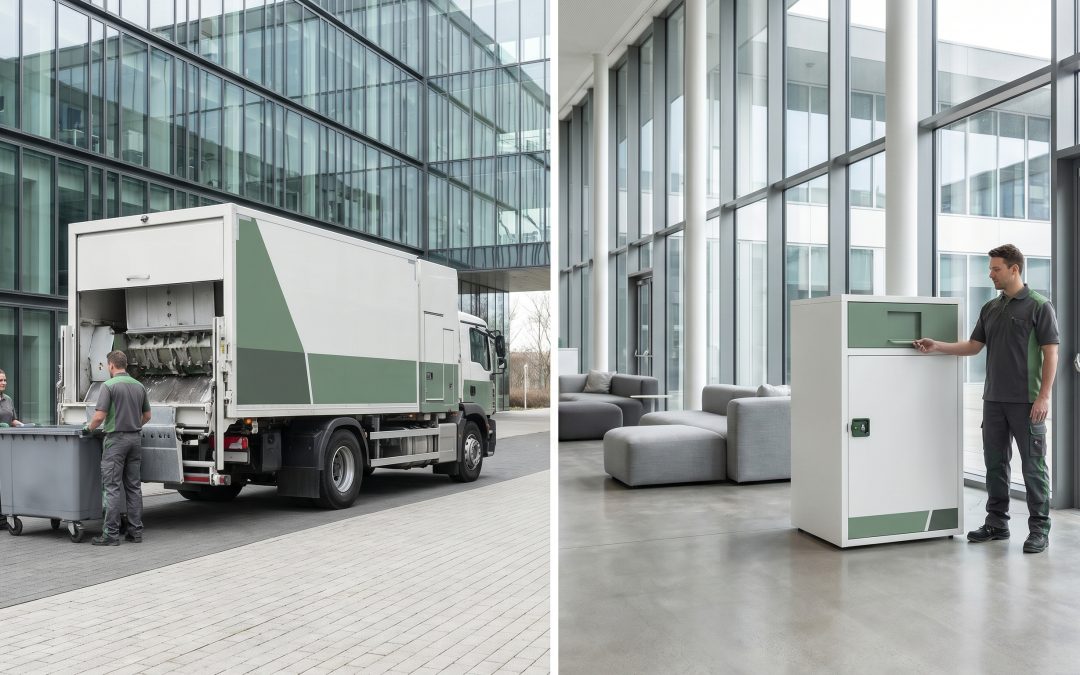
When planning data destruction for IT equipment, organisations must decide whether to destroy data at the source, meaning at their own premises before equipment leaves, or have the ITAD provider collect equipment and perform destruction at their facility. This decision balances security, cost, and operational convenience.
Destruction at Source
Destruction at source means performing data destruction before equipment leaves your premises. This can involve using in-house destruction tools like degaussers or software sanitisation, or having a mobile destruction unit come to your site.
Security advantages: Data never leaves your premises intact. You maintain full custody of equipment until destruction is verified. Staff can witness the destruction process. There is zero transport risk for data-bearing equipment.
Practical considerations: In-house destruction requires investment in equipment and training. Software-based sanitisation takes time, especially for large fleets. Mobile shredding units need access to your premises and can be noisy. And on-site destruction typically costs more per unit than facility-based processing due to mobilisation costs and lower throughput.
Destruction at source is most appropriate for your highest-sensitivity equipment where the security benefit of eliminating transport risk justifies the additional cost. Executive devices, servers containing regulated data, and equipment from secure areas are common candidates.
Collection and Destruction
The more common model involves the ITAD provider collecting equipment from your premises and performing data destruction at their processing facility. Equipment travels with data intact (or with a preliminary wipe) to the provider’s site.
Efficiency advantages: Purpose-built facilities process equipment faster and more cost-effectively. Higher throughput means lower per-unit costs. Equipment can be assessed, sanitised, and routed to the appropriate disposition channel in one integrated operation. And the provider’s facility is designed for destruction, with appropriate equipment, ventilation, and waste handling.
Security considerations: Equipment is in transit with data present, creating a window of vulnerability. Chain of custody must be rigorous. Transport vehicles should be secure, ideally with GPS tracking. And the time between collection and confirmed destruction may be days rather than minutes.
Collection and destruction works well for standard enterprise equipment where the data sensitivity is manageable through proper chain of custody controls, and where the cost and efficiency benefits of facility-based processing outweigh the incremental transport risk.
A Middle Ground: Pre-Sanitisation
A practical middle ground involves performing software-based sanitisation in-house as a first pass, then sending the sanitised equipment to the provider for verification, remarketing, or recycling. This approach reduces the data risk during transport (because the primary sanitisation has already been performed) while still leveraging the provider’s facility for efficient processing. The provider can perform a verification pass to confirm the sanitisation was successful and issue formal certificates.
EWV helps Victorian businesses manage e-waste and IT asset disposal compliantly and sustainably — including collection, certified data destruction, and recycling. Contact us for a free quote.