
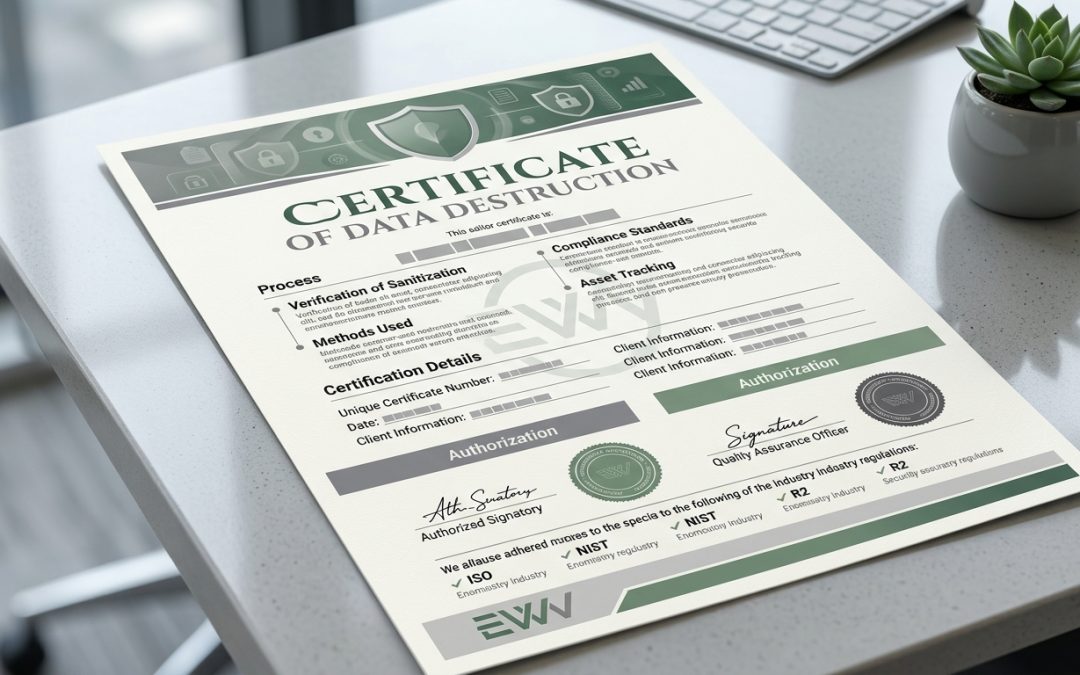
What Is a Certificate of Destruction?
A certificate of destruction (also called a certificate of data destruction, certificate of disposal, or sanitisation certificate) is a formal document confirming that data on specific IT assets has been destroyed using a defined method. It serves as your evidence that personal, corporate, or regulated data was properly handled at end of life, and it’s one of the most important documents in the IT disposal process.
For compliance, audit, and legal purposes, a destruction certificate is often the only evidence that data destruction actually occurred. Without one, you’re relying on the provider’s word, which isn’t adequate for regulatory scrutiny.
Why Destruction Certificates Matter
Destruction certificates serve multiple critical functions:
Compliance evidence: Under the Privacy Act, GDPR, PCI DSS, APRA CPS 234, and virtually every other data protection framework, organisations must be able to demonstrate that data was destroyed when no longer needed. A destruction certificate provides this proof.
Audit documentation: ISO 27001 auditors, PCI QSAs, APRA supervisors, and internal auditors all look for evidence of data destruction. Without certificates, disposal events are effectively undocumented, which is an audit finding waiting to happen.
Legal protection: If your organisation faces a data breach claim or regulatory investigation, destruction certificates demonstrate that you took appropriate steps to destroy data. They can be the difference between a defensible position and an indefensible one.
Asset reconciliation: Certificates linked to specific serial numbers confirm that particular devices have been through the destruction process. This allows you to reconcile your asset register and confirm that no devices have gone missing between decommission and destruction.
What a Good Certificate Should Include
Not all destruction certificates are created equal. A certificate that says “equipment was destroyed” with no further detail is barely better than no certificate at all. A comprehensive certificate should include the following elements:
Provider details: The full legal name, address, and contact details of the organisation that performed the destruction. If the provider holds relevant certifications (ADISA, ISO 27001, AS/NZS 5377), these should be referenced with certificate numbers.
Customer details: The name of the organisation whose equipment was destroyed, along with a reference to the service agreement or job number.
Asset-level detail: Individual identification of each asset destroyed, including the device type (laptop, server, HDD, phone, etc.), manufacturer and model, serial number, and your internal asset tag if applicable. This level of detail allows you to reconcile the certificate against your asset register.
Destruction method: The specific method used, such as software overwriting to NIST 800-88 Purge standard, physical shredding to a specified particle size, degaussing using a specific degausser model, or cryptographic erasure. The method should be stated clearly enough that a technically competent person can assess its adequacy.
Verification: Confirmation that the destruction was verified. For software wiping, this means a verification pass confirmed the data is unrecoverable. For physical destruction, visual confirmation that the media has been destroyed beyond any possibility of recovery.
Date and time: When the destruction was performed. Some regulatory frameworks require specific timelines, and the date allows you to demonstrate compliance.
Authorised signature: The name, title, and signature of the person at the destruction provider who authorises the certificate. This should be someone with appropriate authority, not just a technician.
- Provider name, address, and certifications
- Customer name and reference number
- Individual asset details (type, make, model, serial number)
- Destruction method and standard followed
- Verification method and results
- Date and time of destruction
- Location where destruction occurred
- Authorised signatory name, title, and signature
- Certificate unique reference number
Red Flags in Destruction Certificates
Be wary of certificates that exhibit any of the following issues:
No serial numbers: A certificate that lists “50 hard drives” without individual serial numbers doesn’t allow you to verify which specific drives were destroyed. This is the most common and most significant deficiency.
Vague destruction method: “Data was securely destroyed” or “equipment was processed” without specifying the actual method used. You need to know how the data was destroyed, not just that it was.
No standard referenced: If the provider performed software wiping but doesn’t reference a specific standard (NIST 800-88, DoD 5220.22-M, or similar), there’s no way to assess whether the method was adequate for your data classification.
Batch-only certificates: Some providers issue a single certificate for an entire batch without itemising individual assets. While batch certificates are common for large volumes, they should still include an attached manifest listing each item with its serial number.
Unsigned or lacking authorisation: A certificate without a named, authorised signatory has questionable legal weight. It could have been generated by anyone.
No verification statement: Claiming data was destroyed without confirming it was verified is incomplete. Verification is the step that confirms the destruction was successful, and its absence is a gap.
Delayed issuance: Certificates issued weeks or months after the destruction event, without a clear reason for the delay, may indicate poor process controls at the provider.
Digital vs Physical Certificates
Destruction certificates can be issued in digital or physical form. Digital certificates are increasingly common and offer advantages in terms of storage, searchability, and integration with asset management systems.
Digital certificates should be digitally signed or otherwise authenticated to prevent tampering. PDF documents with digital signatures are a common format. Some ITAD platforms provide online portals where customers can access and download certificates linked to specific job numbers.
Physical certificates with wet signatures are still used and may be required for certain government or legal contexts. If you receive physical certificates, ensure they’re stored securely and consider scanning them for digital backup.
Regardless of format, certificates should be retained for the same period as your data retention records, typically 7 years or longer depending on regulatory requirements. They should be readily accessible for audit purposes.
How to Assess Your Current Certificates
If you already have a disposal provider, review your recent destruction certificates against the elements listed above. Pull the last three or four certificates and check them against this assessment.
Do they list individual serial numbers? Do they specify the destruction method and standard? Do they include verification statements? Are they signed by a named, authorised person? Can you reconcile the listed assets against your asset register? Do the dates and quantities make sense given the work that was performed?
If the certificates fall short, raise the gap with your provider. A reputable provider will work with you to improve their certificate format. A provider that resists providing adequate documentation should be reconsidered.
Requesting Better Certificates
The best time to establish certificate requirements is before you engage a provider, not after the first batch has been processed. Include certificate specifications in your disposal contract or service level agreement.
Specify the information that must be included on each certificate (using the list above as a starting point). Define the format (digital, physical, or both). Set a timeline for certificate delivery after destruction (within 5 business days is a reasonable expectation for routine processing). Require that certificates reference the chain of custody documentation. And specify the retention period for the provider’s copy of the certificates.
- Every asset listed by serial number (not just batch totals)
- Specific destruction method stated (not just “securely destroyed”)
- Standard referenced (NIST 800-88, DoD 5220.22-M, etc.)
- Verification method and results included
- Named authorised signatory with signature
- Unique certificate reference number
- Issued within a reasonable timeframe after destruction
- Can be reconciled against your asset register
A destruction certificate is only as good as the information it contains. Insist on comprehensive certificates from the start, and you’ll have the compliance documentation you need when auditors, regulators, or legal proceedings come calling.
For more on the complete data destruction process and provider selection, see our complete guide to data destruction and our guide on how to choose an ITAD provider.
EWV helps Victorian businesses manage e-waste and IT asset disposal compliantly and sustainably — including collection, certified data destruction, and recycling. Contact us for a free quote.