
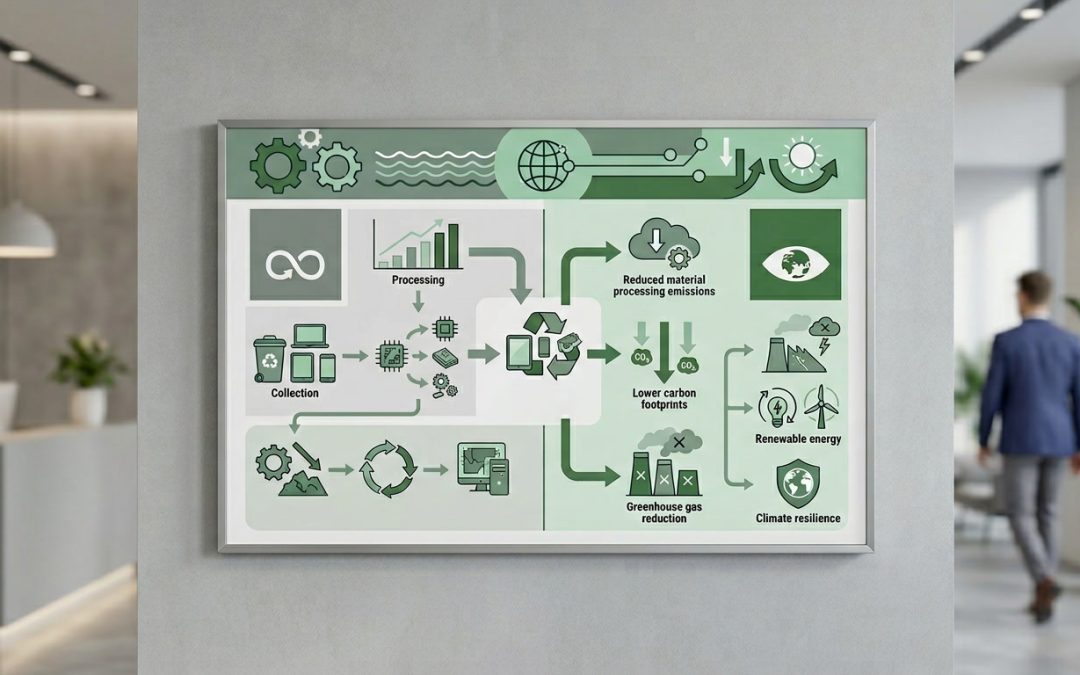
Connecting E-Waste to the Sustainable Development Goals
The United Nations Sustainable Development Goals (SDGs) provide a framework of 17 interconnected goals designed to address the world’s most pressing challenges by 2030. While electronic waste might not be the first thing that comes to mind when thinking about global development, responsible e-waste management directly supports at least eight of the 17 SDGs. For organisations reporting on sustainability, understanding these connections provides a compelling narrative for why e-waste recycling matters far beyond simple compliance.
This article maps the specific ways that proper electronic waste management contributes to global sustainable development objectives, and why Australian businesses should be thinking about these connections in their sustainability reporting.
SDG 3: Good Health and Well-Being
Electronic waste contains hazardous substances including lead, mercury, cadmium, brominated flame retardants, and various other chemicals that pose direct risks to human health when improperly handled. When e-waste ends up in landfill or is processed through informal recycling operations without proper controls, these substances contaminate soil, water, and air.
Proper e-waste recycling prevents these exposures. Certified processing facilities use controlled environments, protective equipment, and specialised handling procedures to safely manage hazardous materials. By choosing responsible recycling pathways, businesses contribute to protecting both workers in the recycling industry and communities near processing and disposal facilities.
The health connection extends globally. E-waste that’s exported from developed countries to informal processing sites in developing nations creates severe health impacts for workers, often including children, who dismantle devices without protection. Supporting domestic, properly regulated recycling infrastructure helps address this global health inequity.
SDG 8: Decent Work and Economic Growth
The e-waste recycling and refurbishment industry creates skilled employment across the value chain: collection logistics, testing and diagnostics, repair technicians, data destruction specialists, materials processing engineers, and quality assurance roles. In Australia, the formal e-waste sector supports thousands of jobs, many of which provide career pathways in growing industries.
The refurbishment segment is particularly important for economic growth because it captures and redistributes value that would otherwise be lost. A laptop worth $500 on the refurbished market generates economic activity through the refurbishment process, creates a more affordable technology option for price-sensitive buyers, and delays the environmental cost of new manufacturing.
SDG 9: Industry, Innovation and Infrastructure
Developing effective e-waste recycling infrastructure requires innovation in sorting technologies, materials recovery processes, and reverse logistics systems. Australia’s investment in e-waste processing capacity, driven by both regulation and market demand, builds industrial infrastructure that serves the broader circular economy.
Innovation in this sector is accelerating. Automated disassembly robots, AI-powered sorting systems, hydrometallurgical recovery processes, and digital tracking systems for chain of custody all represent technological advancement driven by the e-waste challenge. These innovations often have applications beyond e-waste, contributing to broader industrial capability.
SDG 11: Sustainable Cities and Communities
As urbanisation continues globally and in Australia, the e-waste generated by city populations grows proportionally. Sustainable cities need effective systems for managing all waste streams, including the electronics that modern urban life depends on. Victoria’s e-waste landfill ban represents exactly this kind of city-level sustainability infrastructure.
Accessible e-waste collection points, council collection events, and convenient drop-off facilities all contribute to making cities and communities more sustainable. When residents and businesses have easy access to responsible disposal options, e-waste diversion rates improve and the environmental burden on communities decreases.
SDG 12: Responsible Consumption and Production
This is perhaps the most directly relevant SDG for e-waste management. SDG 12 specifically targets sustainable consumption and production patterns, and Target 12.5 aims to substantially reduce waste generation through prevention, reduction, recycling, and reuse by 2030.
Every stage of responsible e-waste management contributes here. Extended product lifespans through repair and refurbishment reduce consumption. Proper recycling ensures materials re-enter production cycles. Structured recycling programs provide the infrastructure for responsible production-consumption loops. And corporate reporting on e-waste management drives accountability for consumption patterns.
Target 12.4 specifically addresses the environmentally sound management of chemicals and waste throughout their lifecycle, directly relevant to the hazardous materials contained in electronic equipment.
SDG 13: Climate Action
The carbon implications of e-waste management connect directly to climate action. Manufacturing new electronics is carbon-intensive, with production accounting for 70-80% of a typical device’s lifetime emissions. By extending device lifespans through refurbishment and recovering materials through recycling (reducing the need for virgin material extraction and processing), responsible e-waste management contributes measurably to carbon reduction.
Organisations tracking Scope 3 emissions from IT equipment can quantify this contribution. The avoided emissions from choosing refurbished equipment, properly recycling materials, and extending asset lifespans all translate into reportable carbon benefits under established frameworks.
SDG 14 and 15: Life Below Water and Life on Land
Improper e-waste disposal contaminates both aquatic and terrestrial ecosystems. Heavy metals leaching from landfilled electronics enter waterways and soil, accumulating in food chains and damaging biodiversity. Microplastics from degrading electronic casings add to ocean pollution. By diverting e-waste from landfill and ensuring proper processing, responsible recycling protects both marine and terrestrial environments.
The mining impacts of virgin material extraction for electronics manufacturing are also significant. Rare earth element mining, copper extraction, and gold mining all involve substantial land disturbance and water contamination. Recovering these materials from e-waste reduces the pressure to mine new deposits, supporting ecosystem preservation.
Reporting the Connection
For Australian businesses preparing ESG reports or sustainability disclosures, mapping e-waste management activities to relevant SDGs strengthens the narrative and demonstrates strategic alignment with globally recognised frameworks. The connections described here aren’t theoretical. They’re measurable, reportable, and increasingly expected by investors, customers, and regulators.
The SDG framework helps explain why e-waste management matters beyond compliance. It’s not just about meeting Victorian regulations or avoiding fines. Responsible electronics management contributes to a web of interconnected global objectives that touch health, economic development, climate action, innovation, and environmental protection. For an issue that affects every organisation with IT equipment, that’s a powerful story to tell.
EWV helps Victorian businesses manage e-waste and IT asset disposal compliantly and sustainably — including collection, certified data destruction, and recycling. Contact us for a free quote.