
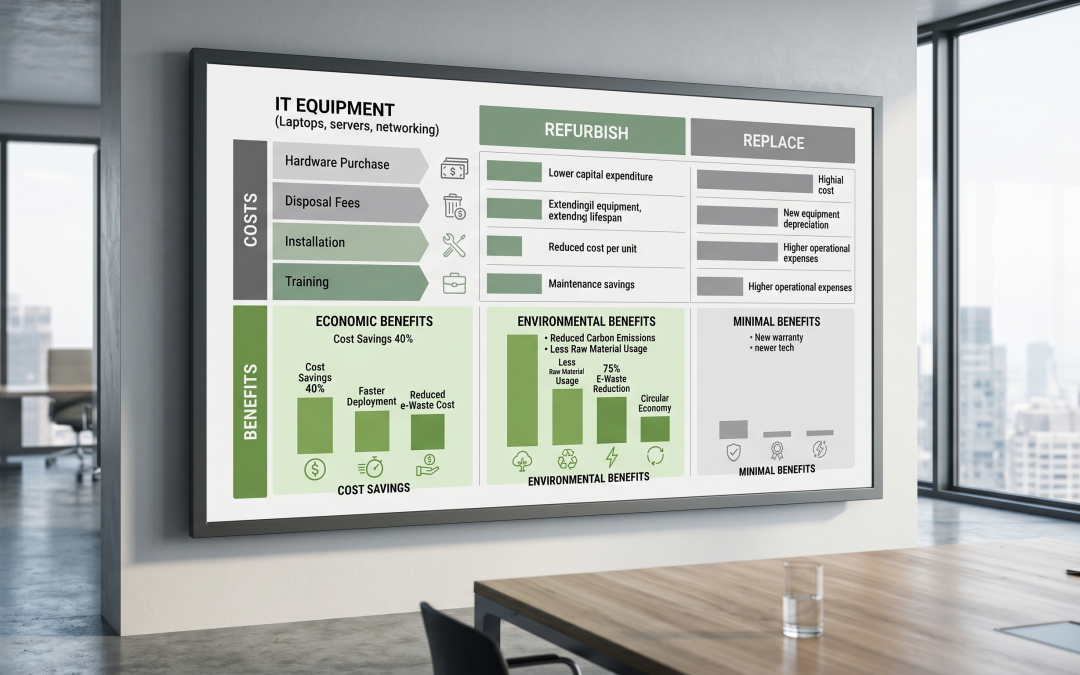
Refurbishment sits at the intersection of environmental responsibility and financial pragmatism. Extending the life of IT equipment through professional refurbishment avoids the cost and environmental impact of manufacturing new devices while creating economic value for both the refurbisher and the end user. Understanding the economics helps organisations decide when refurbishment makes sense and how to get the most from it.
What Refurbishment Involves
Professional IT refurbishment goes beyond simply wiping a device and reselling it. A proper refurbishment process includes certified data sanitisation to remove all previous user data, comprehensive functional testing of every component, replacement of worn or degraded parts (batteries, keyboards, screens, storage drives), cosmetic restoration including cleaning, de-branding, and minor cosmetic repairs, software installation with a fresh operating system and any included software, quality assurance testing to verify the device meets defined standards, and grading and packaging for sale.
The depth of refurbishment varies by device condition and intended market. A near-new device might need only data wiping and testing, while an older device in rougher condition might require battery replacement, keyboard swap, and screen cleaning to be market-ready.
The Cost-Benefit Calculation
The economics of refurbishment depend on the relationship between the cost of refurbishment (labour, parts, testing) and the selling price of the refurbished device. For a typical business laptop, refurbishment costs might range from $50-150 depending on the work required. If the refurbished device sells for $300-600, the margin after costs makes refurbishment economically attractive.
The calculation becomes more nuanced for older or lower-value devices. If the refurbishment cost approaches or exceeds the potential selling price, the device is better directed to parts harvesting or materials recycling. Effective triage, accurately assessing each device’s refurbishment potential, is crucial to maintaining the economics.
For the organisation disposing of equipment, refurbishment economics translate directly into value recovery. Devices that are refurbished and remarketed return significantly more than devices sent directly to recycling. A refurbished laptop might return $300-400 to the original owner, while the same device recycled for materials might generate only $5-10 in commodity value.
When Refurbishment Makes Economic Sense
Refurbishment is most economically viable when the equipment is relatively recent (typically within three to four years of manufacture), when the device is from a brand with strong secondary market demand, when the core components (processor, motherboard, screen) are in good condition, when replacement parts are readily available and affordable, and when there is active demand in the secondary market for that model.
Refurbishment becomes less viable for equipment older than five years (limited market demand, high parts costs relative to value), heavily damaged devices where repair costs approach replacement cost, proprietary or unusual equipment with limited spare parts availability, and devices where the technology is fundamentally obsolete.
The Secondary Market for Refurbished Equipment
The market for refurbished IT equipment has grown significantly, driven by budget-conscious buyers who want business-grade quality at lower prices, sustainability-minded consumers and organisations preferring reuse over new, schools and educational institutions with limited technology budgets, small businesses seeking capable equipment without premium prices, and developing markets where refurbished equipment fills an affordability gap.
Refurbished equipment typically sells at 40-70% below the equivalent new device price, depending on age, condition, and brand. This price point makes business-grade equipment accessible to buyers who might otherwise purchase lower-quality consumer alternatives.
Environmental Economics
The environmental economics of refurbishment are overwhelmingly positive. Manufacturing a new laptop generates approximately 300-400 kg of CO2 equivalent. Refurbishing an existing laptop generates a fraction of that, primarily from transportation and the energy used in the refurbishment process. The environmental cost savings from extending product life through refurbishment are substantial.
For organisations tracking their environmental footprint, every device refurbished and reused rather than recycled represents a significant CO2e avoidance that can be reported in sustainability disclosures. This environmental benefit has its own economic value through improved ESG performance and the associated business benefits.
Internal Refurbishment vs Outsourcing
Some organisations consider refurbishing equipment internally rather than through an ITAD provider. Internal refurbishment can make sense for large organisations with dedicated IT workshop capabilities, consistent high volumes that justify the investment in processes and tools, and a clear internal demand for refurbished equipment (redeployment within the organisation).
For most organisations, outsourcing refurbishment to a professional ITAD provider is more efficient. Professional refurbishers have economies of scale, established testing and refurbishment processes, access to replacement parts at trade prices, and secondary market channels for selling refurbished equipment. The savings from these advantages typically outweigh the overhead of managing refurbishment in-house.
Quality and Warranty Considerations
The credibility and pricing of refurbished equipment depend on quality assurance. Professionally refurbished devices sold with a warranty (typically 6-12 months) command better prices than “as-is” used equipment. The warranty cost is built into the refurbishment economics but adds significant value for buyers and supports the refurbished equipment market.
For organisations buying refurbished equipment (rather than selling), the warranty and the reputation of the refurbisher are important considerations. A refurbished device from a certified ITAD provider with ISO standards is a very different proposition from a used device purchased from an unknown seller online.
EWV handles IT asset disposition (ITAD) end-to-end for Victorian businesses — from collection and data destruction through to certified recycling or refurbishment for resale. Get in touch for a tailored ITAD quote.