
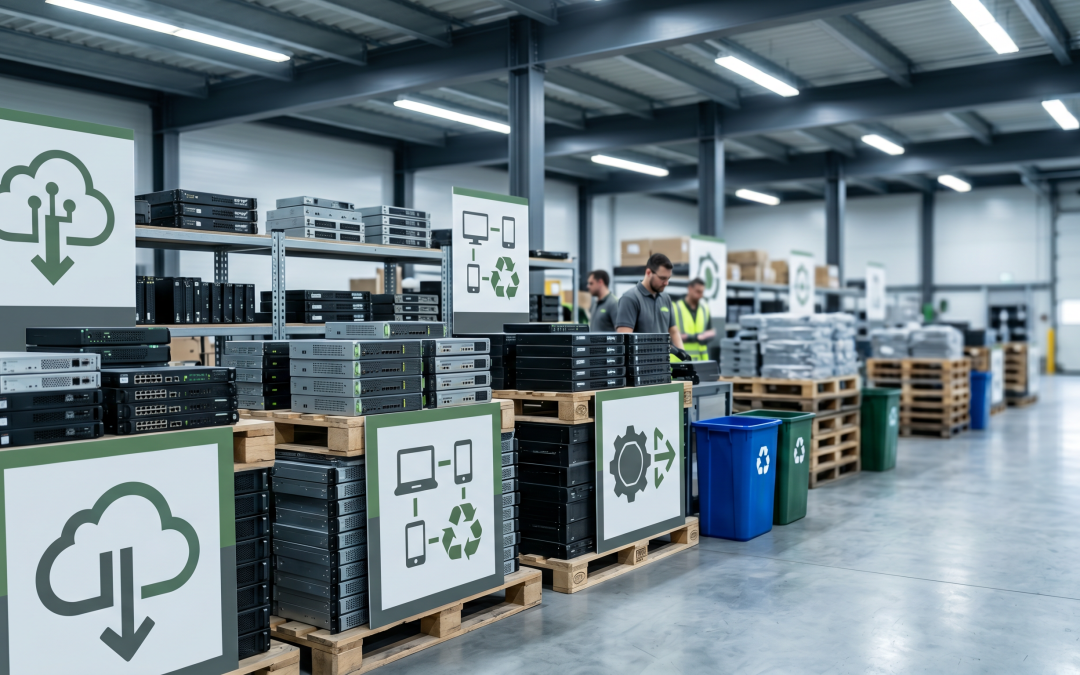
The Rise of Edge Computing and Its Disposal Challenge
Edge computing has emerged as a fundamental shift in IT architecture. Instead of processing all data in centralised data centres, organisations are deploying computing resources at the network edge, closer to where data is generated and consumed. Retail stores, factory floors, hospital wards, cell tower sites, branch offices, and even vehicles now host compact servers and processing nodes that handle latency-sensitive workloads locally.
This distributed model creates a disposal challenge that is fundamentally different from traditional IT decommissioning. Instead of retiring equipment from one or two data centre locations, organisations must manage the lifecycle of computing hardware scattered across dozens, hundreds, or thousands of edge locations. Each of these sites has equipment that stores and processes business data, and each requires proper data destruction when that equipment reaches end of life.
What Data Edge Computing Equipment Contains
Edge nodes process and cache data that would traditionally reside only in the data centre. A retail edge server might cache customer transaction data, inventory databases, and loyalty program information to enable fast local processing. A manufacturing edge node might store production parameters, quality control data, and sensor readings from the factory floor.
Content delivery and caching nodes at the edge store copies of frequently accessed data to reduce latency. While this data is typically a subset of what exists in the central data centre, it can include customer-facing content, application data, and cached database queries that contain personal or business-sensitive information.
AI inference at the edge is a growing workload. Edge devices running AI models for computer vision, predictive maintenance, or real-time analytics may store training data, model weights, and inference results locally. As discussed in the context of on-device AI, this data can be challenging to identify and remove.
Operational data including logs, performance metrics, configuration files, and authentication credentials accumulates on edge devices during their operational life. Configuration data is particularly sensitive, as it may include API keys, database connection strings, and network credentials that could be used to access other parts of the organisation’s infrastructure.
Challenges of Disposing of Distributed Equipment
Physical access is often the first challenge. Edge equipment may be located in remote cell tower sites, locked retail backrooms, factory floors with access restrictions, or third-party co-location facilities. Collecting equipment from these diverse locations for centralised processing requires logistics coordination that is significantly more complex than gathering equipment from a single office or data centre.
Local management at edge sites may not include IT-qualified personnel. A retail store manager or factory supervisor responsible for an edge node may not understand the data destruction requirements when the equipment is being replaced. Without clear instructions and processes, edge equipment may be disposed of through local waste channels without any data consideration.
The variety of edge computing hardware adds complexity. Edge deployments may include standard rack servers in micro data centres, ruggedised industrial computers, compact form-factor devices like Intel NUCs, purpose-built edge appliances from various vendors, and even single-board computers in some IoT gateway applications. Each form factor may require different handling during data destruction.
Network connectivity at edge sites may be limited, making remote management and remote wiping unreliable. An edge node that has lost connectivity cannot receive a remote wipe command, and if it has been powered off at the end of its service, it cannot be remotely managed at all.
Strategies for Edge Equipment Disposal
Centralised asset tracking is essential. Every edge node deployed across the organisation should be registered in a central asset management system with its location, configuration, and the types of data it processes. This register becomes the foundation for systematic decommissioning when equipment reaches end of life.
Standardised decommissioning procedures should be developed for each type of edge deployment. For a retail chain, this might mean a step-by-step guide that a store manager can follow when an edge server is being replaced. For industrial edge nodes, the procedure might involve coordination with the operations team to safely take the node offline before IT personnel handle data destruction.
Where possible, initiate data destruction remotely before physical equipment collection. Edge management platforms that support remote wipe functionality can sanitise devices while they are still at the edge location. This reduces the data risk during the collection and transport phase. However, remote wipe should be verified, not assumed, and a physical sanitisation step should still occur when the device is collected.
For organisations with large edge deployments, engaging an ITAD provider with multi-site capability simplifies the logistics of edge equipment disposal. A provider who can collect equipment from multiple edge locations, process it at a central facility, and provide consolidated reporting and NIST 800-88 compliant certificates of destruction streamlines what would otherwise be an extremely complex coordination task.
Edge Equipment Refresh and Replacement
Edge computing equipment typically has a shorter refresh cycle than traditional data centre hardware, driven by the rapid evolution of edge-specific hardware and the increasing demands of edge workloads. This means that edge disposal is not a one-time event but a recurring operational requirement.
Building data destruction into the equipment refresh process ensures that every replacement cycle includes proper handling of the outgoing equipment. When new edge hardware is shipped to a site, the process for returning and securely handling the old hardware should be included in the deployment plan.
For leased edge equipment being returned to vendors, the same principles that apply to any lease return apply here: wipe the device before it leaves your control, regardless of what the vendor’s return process may or may not include regarding data handling.
The Edge Is Everywhere
Edge computing is transforming how organisations process and store data, pushing intelligence and data closer to where it is needed. But every edge node is a potential data exposure point when it reaches end of life. Managing the disposal of distributed computing resources with the same discipline applied to centralised infrastructure is essential for maintaining data security in an increasingly edge-centric IT landscape.
EWV helps Victorian businesses manage e-waste and IT asset disposal compliantly and sustainably — including collection, certified data destruction, and recycling. Contact us for a free quote.