
Victoria’s Modern Environmental Law
The Environment Protection Act 2017 is Victoria’s primary piece of environmental legislation, replacing the original 1970 Act that had served the state for over five decades. The new Act came into full effect on 1 July 2021 and introduced a fundamentally different approach to environmental regulation in Victoria, shifting from a reactive, pollution-response model to a preventative, duty-based framework. For anyone managing electronic waste in Victoria, understanding this Act is essential because it provides the legal foundation for the e-waste landfill ban and the broader obligations around waste management.
The 2017 Act was the result of an extensive review process that recognised the limitations of the 1970 legislation in addressing modern environmental challenges. The old Act was largely reactive, dealing with pollution after it occurred. The new Act is proactive, requiring individuals and businesses to prevent environmental harm before it happens. This philosophical shift has significant practical implications for how e-waste is managed.
The General Environmental Duty
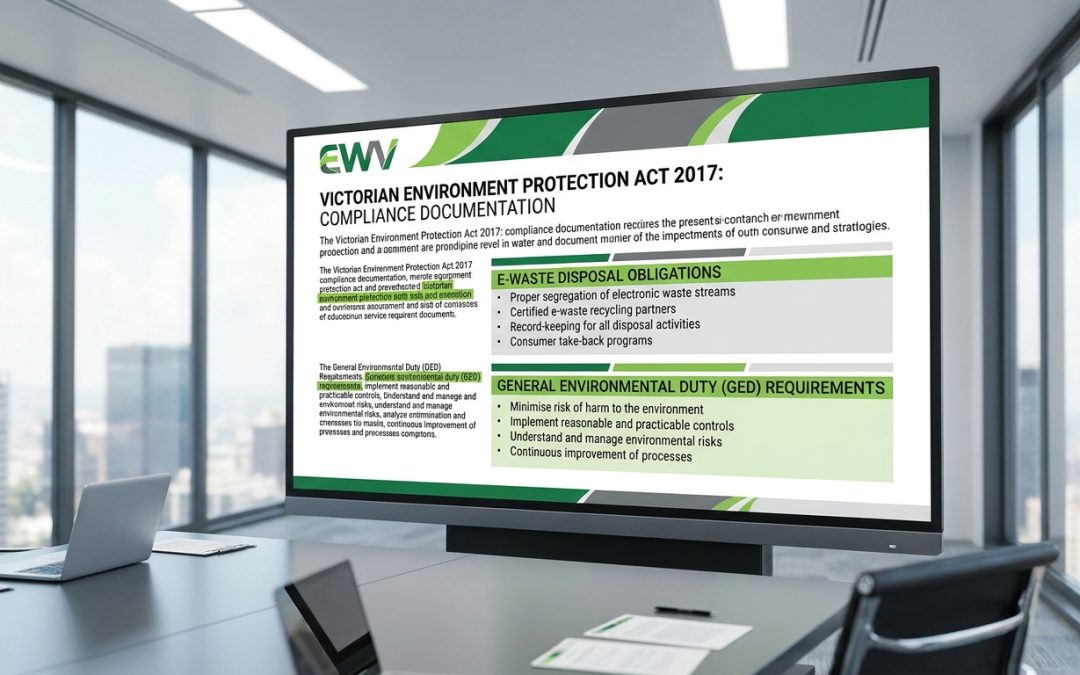
The centrepiece of the 2017 Act is the general environmental duty (GED), set out in section 25. This duty requires every person in Victoria, including businesses, to take reasonably practicable steps to minimise risks of harm to human health and the environment from pollution and waste. It applies universally, not just to specific industries or activities.
For e-waste management, the GED has far-reaching implications. It means that businesses are expected to proactively manage their e-waste rather than simply complying with specific rules about where waste can and cannot be sent. The duty covers the entire chain from how e-waste is generated and stored through to how it is transported and processed.
- Know what e-waste your business generates and understand its hazards
- Store e-waste safely (prevent battery fires, contain hazardous materials)
- Prevent e-waste from entering general waste streams
- Use appropriate disposal channels (licensed recyclers, ITAD providers)
- Verify that your waste contractor handles e-waste properly
- Keep records demonstrating your compliance
The GED applies even where no specific regulation exists. If a particular type of electronic equipment is not specifically mentioned in regulations but contains hazardous materials that could harm the environment if improperly disposed of, the GED still requires you to manage it responsibly. This catch-all nature of the duty is intentional, designed to prevent businesses from finding technical loopholes in specific regulations.
For a deeper look at how EPA Victoria enforces these requirements, see our article on EPA Victoria and e-waste.
Permissions and Licensing
The 2017 Act restructured Victoria’s environmental licensing system. Businesses involved in e-waste collection, storage, processing, or recycling may need permissions under the Act, depending on the scale and nature of their operations.
The Act establishes different categories of permissions including development licences, operating licences, and pilot project licences. E-waste recycling facilities that process waste above specified thresholds require operating licences that set conditions for how the operation is conducted, including environmental performance standards, monitoring requirements, and reporting obligations.
For businesses that generate e-waste (as opposed to processing it), a specific licence is generally not required for normal waste management activities. However, the GED still applies, and businesses storing large quantities of e-waste may trigger specific requirements if the storage creates environmental or safety risks. Stockpiling lithium batteries, for example, could create fire risks that engage the GED and potentially trigger requirements for risk management plans.
Waste Management Hierarchy
The 2017 Act incorporates the waste management hierarchy, which establishes a preferred order for managing waste. From most preferred to least preferred, the hierarchy is: avoidance, reuse, recycling, recovery of energy, containment, and disposal. This hierarchy is not just aspirational. It informs regulatory decision-making, licensing conditions, and expectations about how businesses manage their waste.
For e-waste, the hierarchy supports approaches that prioritise keeping products in use for as long as possible, followed by refurbishment and reuse, then material recycling, with disposal as a last resort. Businesses that work with ITAD providers to refurbish and resell working equipment are operating higher on the hierarchy than those that send everything directly to recycling. Both are far preferable to landfill disposal, which the e-waste ban has effectively removed as an option in Victoria.
The hierarchy also supports the circular economy principles that are increasingly shaping waste policy. Our article on the circular economy for electronics explores how these principles apply to IT equipment.
Contaminated Land and Legacy E-Waste
The 2017 Act includes provisions for managing contaminated land, which can be relevant to sites where e-waste has been improperly stored or disposed of in the past. If historical e-waste dumping or poor storage practices have resulted in soil or groundwater contamination (from lead, mercury, or other hazardous substances in electronics), the Act’s contaminated land provisions may apply.
Property owners, developers, and businesses acquiring or redeveloping land should be aware that legacy e-waste contamination can create obligations for assessment, management, or remediation under the Act. This is particularly relevant for sites that have historically been used for waste processing, storage, or informal recycling.
Enforcement and Penalties Under the Act
The 2017 Act provides EPA Victoria with a comprehensive enforcement toolkit. The range of responses includes improvement notices, prohibition notices, remedial notices, infringement notices, and prosecution for serious offences.
For e-waste-related breaches, the most relevant enforcement tools include infringement notices for disposing of e-waste in landfill (breaching the specific ban), remedial notices requiring businesses to clean up improperly stored or dumped e-waste, and prosecution for serious or repeated breaches of the GED or specific waste regulations.
The maximum penalties under the Act are substantial. For the most serious environmental offences, individuals face penalties of up to approximately $400,000 and corporations up to approximately $2 million (actual amounts vary based on penalty unit values). Imprisonment of up to 5 years is possible for certain offences. While e-waste breaches would rarely attract maximum penalties, the potential exposure for deliberate or large-scale non-compliance is significant.
For a detailed look at the penalty framework, see our article on penalties for illegal e-waste dumping in Victoria.
Interaction with Other Legislation
The Environment Protection Act 2017 does not operate in isolation. It interacts with several other pieces of legislation that affect e-waste management in Victoria.
The Environment Protection Regulations 2021 provide the detailed rules that implement the Act, including the specific provisions for the e-waste landfill ban. The Waste Management Policy documents set out the government’s strategic approach to waste management, including targets and priorities for e-waste.
At the federal level, the Product Stewardship Act 2011, the Recycling and Waste Reduction Act 2020, and the Hazardous Waste Act 1989 all interact with Victorian legislation to create the overall regulatory framework for e-waste. Businesses operating nationally need to understand both state and federal requirements.
The Privacy Act 1988 intersects with e-waste management through the obligation to securely destroy personal information on devices being disposed of. While not an environmental law, the Privacy Act creates parallel obligations that businesses must address alongside their environmental responsibilities.
Practical Compliance for Businesses
For businesses operating in Victoria, complying with the Environment Protection Act 2017 in relation to e-waste comes down to a few core practices:
Understand your GED obligations and take reasonable steps to manage e-waste responsibly. Separate e-waste from general waste and store it safely. Use licensed recyclers or certified ITAD providers for disposal. Keep records of your waste management practices and disposal activities. Verify that your waste contractors are handling e-waste appropriately. And stay informed about changes to regulations and guidance from EPA Victoria.
For businesses looking to establish or improve their e-waste management processes, our guide on building an IT asset disposal policy provides a practical framework. And for selecting the right disposal partner, see our article on choosing an ITAD provider in Australia.
EWV helps Victorian businesses manage e-waste and IT asset disposal compliantly and sustainably — including collection, certified data destruction, and recycling. Contact us for a free quote.