
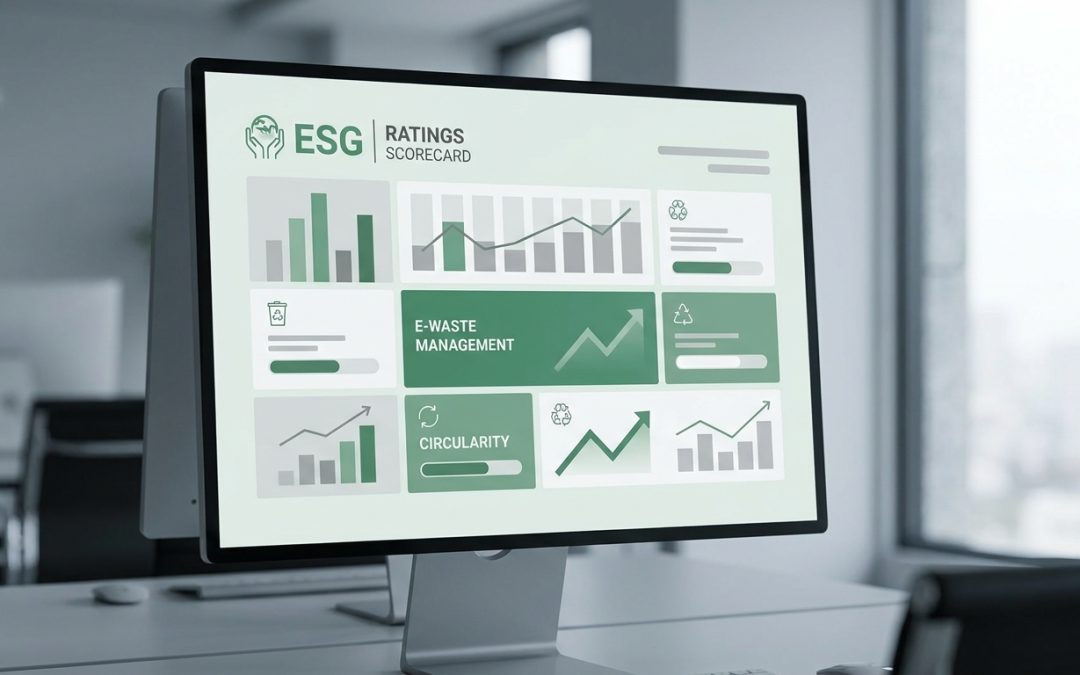
ESG ratings agencies assess and score the environmental, social, and governance performance of companies, providing investors and other stakeholders with standardised benchmarks for comparing corporate sustainability. For organisations concerned about their ESG ratings, understanding how e-waste management feeds into these assessments helps you identify where IT lifecycle improvements can lift your score and demonstrate stronger environmental stewardship.
How ESG Ratings Work
ESG ratings agencies collect data from public disclosures, company questionnaires, news sources, and third-party databases to assess performance across dozens of criteria. Each agency has its own methodology, weighting system, and scoring approach. Major agencies include MSCI ESG Research, which provides letter ratings from AAA to CCC and is widely used by institutional investors. Sustainalytics, which provides risk ratings that measure exposure to and management of ESG risks. S&P Global ESG Scores (incorporating the former SAM assessment), which produces the annual Corporate Sustainability Assessment. ISS ESG, which provides ratings focused on corporate responsibility and environmental performance. And Moody’s ESG Solutions, which evaluates ESG credit risk alongside traditional financial analysis.
While each agency uses different methodologies, they all evaluate waste management, environmental compliance, and supply chain sustainability, areas where e-waste management directly contributes to your score.
Where E-Waste Affects Your Rating
E-waste performance typically influences ESG ratings through several assessment categories. Waste management scores evaluate how your organisation manages its waste streams, including electronic waste. Demonstrating a formal e-waste programme with measurable outcomes, including diversion rates, recycling volumes, and refurbishment percentages, directly supports this category.
Environmental management systems scores look at whether you have structured approaches to managing environmental impacts. An IT asset disposal policy that is documented, implemented, and monitored contributes to this assessment area.
Supply chain management evaluates how you assess and manage environmental and social risks in your supply chain, including your IT procurement and ITAD vendor relationships. Demonstrating due diligence on both upstream (equipment suppliers) and downstream (ITAD providers) partners strengthens this score.
Climate and emissions performance looks at your greenhouse gas emissions across all scopes and your efforts to reduce them. IT-related Scope 3 emissions from procurement and disposition, and the CO2e avoidance from refurbishment and reuse programmes, are relevant here.
Regulatory compliance assesses your track record on environmental compliance. In Victoria, demonstrating compliance with the e-waste landfill ban is a basic requirement that supports this category.
Improving Your E-Waste Score
Several practical actions can improve your e-waste-related ESG performance and how it is captured in ratings. Quantify and disclose your e-waste data, including total volumes, disposition methods, diversion rates, materials recovered, and CO2e avoided. Ratings agencies rely on disclosed data, so comprehensive reporting is essential.
Set and track targets for improvement, such as increasing your refurbishment rate, reducing total e-waste generated, or improving materials recovery percentages. Targets demonstrate ambition and accountability.
Obtain third-party verification for your e-waste data where possible. Working with certified ITAD providers who can supply verified environmental impact reports strengthens the credibility of your disclosures.
Align your reporting with recognised frameworks like GRI, CDP, or TCFD. Ratings agencies map their assessments against these frameworks, so aligned reporting makes it easier for them to capture your performance.
Respond to rating agency questionnaires thoroughly and on time. Many ratings allow companies to review and supplement the data before scores are finalised. Take advantage of this opportunity to ensure your e-waste performance is fully reflected.
The Investor Perspective
ESG ratings increasingly influence investment decisions. Institutional investors use ESG ratings to screen potential investments, with poor ratings leading to exclusion from portfolios. Asset managers incorporate ESG ratings into portfolio construction, overweighting companies with strong scores. Superannuation funds in Australia are under growing pressure to demonstrate ESG integration, and ratings are a primary tool for this. And proxy advisory firms reference ESG ratings when making voting recommendations on shareholder resolutions.
For publicly listed organisations, improving your ESG rating can directly affect your access to capital and your cost of capital. For private organisations, strong ESG performance demonstrated through ratings can be a differentiator in competitive procurement processes and customer relationships.
Limitations of ESG Ratings
It is worth noting that ESG ratings have well-documented limitations. Different agencies frequently assign different scores to the same company because their methodologies, data sources, and weightings differ. Ratings tend to favour larger companies with more resources for disclosure, potentially disadvantaging smaller organisations with strong practices but limited reporting capacity. Some ratings focus more on policy and process than on actual environmental outcomes, which can mean that organisations with sophisticated documentation score well even if their practical performance is mediocre.
Despite these limitations, ESG ratings remain influential in the investment and business community, making them worth managing alongside your actual sustainability performance. The best approach is to focus on genuine performance improvement and comprehensive disclosure, which will tend to improve your ratings across all agencies over time.
For comprehensive guidance on how to structure your e-waste disclosures for maximum impact, see our guide on ESG reporting and e-waste for Australian businesses.
]]>