
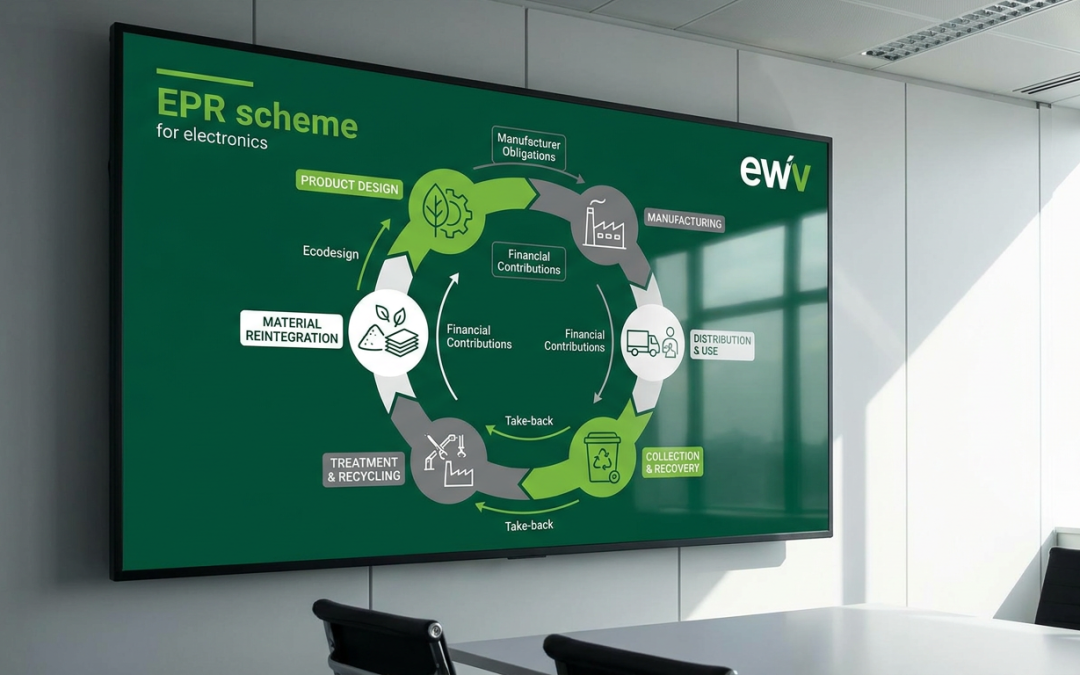
What Is Extended Producer Responsibility?
Extended Producer Responsibility, commonly known as EPR, is a policy approach that shifts the financial and operational responsibility for end-of-life product management from consumers and local governments back to the companies that manufacture and sell products. For electronics, this means that the brands putting devices into the market bear responsibility for what happens when those devices are no longer wanted or functional.
The concept was first articulated by Swedish academic Thomas Lindhqvist in 1990, and it has since become one of the most widely adopted frameworks for managing product waste globally. The logic is straightforward: if manufacturers bear the cost of disposal, they have a direct financial incentive to design products that are easier to recycle, longer-lasting, and less toxic.
How EPR Works in Practice
EPR schemes for electronics typically operate through one of several models. In the most common approach, manufacturers pay fees into a collective scheme based on the volume and type of products they sell. These fees fund collection infrastructure, recycling operations, and public awareness campaigns. The more products a manufacturer puts on the market, the more they pay.
Individual producer responsibility goes further, making each manufacturer responsible for collecting and recycling their own branded products. This model creates the strongest incentive for design improvements because the manufacturer directly experiences the cost of processing their specific products. If a manufacturer uses difficult-to-recycle materials or designs that complicate disassembly, they pay more at end of life.
Collective schemes pool responsibilities across all producers in a product category. While administratively simpler, they dilute the individual incentive for design improvement because the costs are shared regardless of product-specific recyclability. Most operating EPR systems use collective models, including Australia’s approach.
EPR in Australia: The National Television and Computer Recycling Scheme
Australia’s primary EPR scheme for electronics is the National Television and Computer Recycling Scheme (NTCRS), which has been operating since 2011 under the Product Stewardship Act 2011. The scheme covers televisions, computers, printers, and computer peripherals, requiring manufacturers and importers to fund free collection and recycling services for these products.
The scheme is administered by the Department of Climate Change, Energy, the Environment and Water, with approved co-regulatory arrangements operated by industry-funded organisations. These organisations, including major operators like MRI and E-Cycle Solutions, manage collection points, logistics, and contracted recycling operations across the country.
Each year, the government sets recycling targets based on a percentage of the weight of products placed on the market in previous years. Liable parties (manufacturers and importers above a threshold) must collectively meet these targets or face regulatory consequences. The targets have gradually increased over the scheme’s lifetime to drive higher collection and recycling rates.
However, the NTCRS has faced criticism for its limited product scope. Many common electronics, including smartphones, tablets, small appliances, and IoT devices, fall outside the scheme. As the electronics landscape has shifted dramatically since 2011, calls for expanding the scheme’s coverage have grown louder.
How EPR Affects Product Design
One of EPR’s primary theoretical benefits is driving design for environment (DfE) improvements. When manufacturers internalise end-of-life costs, they should logically design products that are cheaper to recycle, which means easier to disassemble, fewer material types, less hazardous substances, and more recyclable content.
In practice, the strength of this design signal depends heavily on how the EPR scheme structures its fees. Eco-modulated fees adjust charges based on product-specific characteristics like recyclability, durability, and hazardous substance content. Products that are easier to recycle pay lower fees, creating a direct financial incentive for better design. France’s EPR scheme for electronics uses extensive eco-modulation, and the EU is pushing all member states to adopt this approach.
Without eco-modulation, collective schemes provide weak design signals because every manufacturer in a category pays the same rate per kilogram regardless of how recyclable their specific products are. Australia’s NTCRS does not currently employ significant eco-modulation, which limits its effectiveness as a design-improvement mechanism.
Global Trends in Electronics EPR
The trend globally is toward broader product scope, higher collection targets, eco-modulated fees, and stronger integration with circular economy objectives. Several developments are particularly noteworthy:
The EU’s revised WEEE Directive sets a collection target of 65% of equipment placed on the market, one of the highest globally. It covers virtually all electronics categories and is being supplemented by the new Ecodesign for Sustainable Products Regulation, which addresses durability and repairability requirements that EPR alone cannot drive.
Emerging economies are adopting EPR rapidly. India implemented e-waste EPR regulations in 2016 and has revised them several times since. Countries across Southeast Asia, Africa, and Latin America are at various stages of developing or implementing electronics EPR frameworks, often learning from the successes and failures of earlier schemes in Europe and elsewhere.
Battery-specific EPR is becoming increasingly important as portable electronics, electric vehicles, and energy storage systems drive exponential growth in battery production. The EU’s new Battery Regulation introduces comprehensive EPR requirements with collection targets, recycled content mandates, and carbon footprint declarations.
What EPR Means for Businesses Disposing of IT Equipment
For businesses, EPR schemes primarily affect the consumer and small business collection infrastructure rather than commercial IT disposal directly. Most businesses generate e-waste volumes that require professional ITAD services rather than dropping items at a community collection point.
However, EPR shapes the broader recycling ecosystem that businesses interact with. The processing infrastructure funded by EPR schemes, including collection networks, sorting facilities, and downstream recycling operations, creates capacity that commercial recyclers also utilise. When EPR schemes are well-funded and well-managed, the overall quality of recycling infrastructure in a region improves.
Businesses should also be aware that EPR obligations may expand in scope. If Australia broadens its scheme to cover more product categories or introduces higher recycling standards, this could affect procurement decisions, disposal options, and sustainability reporting. Staying informed about EPR policy developments helps organisations anticipate changes rather than react to them.
The trajectory is clear: producer responsibility for electronics will continue to expand in scope and ambition globally. For Australian businesses, understanding EPR provides context for the regulatory landscape that governs how electronic waste is managed and where responsibility ultimately sits.
EWV helps Victorian businesses manage e-waste and IT asset disposal compliantly and sustainably — including collection, certified data destruction, and recycling. Contact us for a free quote.