
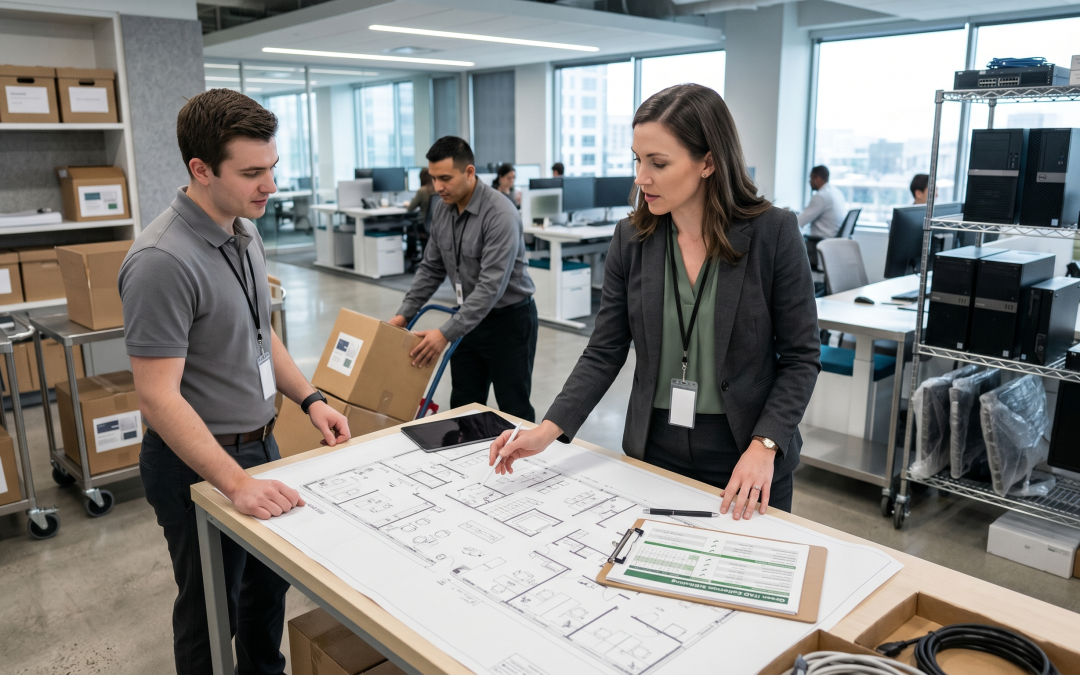
Facilities managers often find themselves at the sharp end of IT asset disposition without much warning. Someone from IT drops off a pallet of old laptops, the server room needs clearing, or a floor is being refurbished and all the equipment has to go. The logistics of staging, storing, securing, and moving end-of-life IT equipment is fundamentally a facilities challenge, and getting it right requires planning.
The Facilities Dimension of ITAD
While IT and procurement typically own the strategic and financial aspects of ITAD, facilities managers own the physical reality. Where does decommissioned equipment go? How is it secured while waiting for collection? What are the occupational health and safety considerations? How does equipment movement fit with building access, loading dock schedules, and other facilities operations?
These practical questions often get overlooked in ITAD planning, and the result is equipment piling up in corridors, server rooms doubling as storage areas, and ad-hoc arrangements that create both security and safety risks.
Staging and Storage Planning
Every ITAD program needs a designated staging area where decommissioned equipment is collected before it is handed over to the ITAD provider. The staging area should be secure, with restricted access controlled by key card or lock. It should be large enough to handle your peak disposal volumes, which often occur during refresh cycles or office moves. It needs to be accessible for both internal equipment delivery and external collection, ideally close to a loading dock or ground-floor entry point.
The staging area should have adequate shelving or racking for organised storage. Equipment piled on the floor is inefficient, harder to track, and more likely to be damaged. Good organisation also speeds up the collection process because equipment can be counted and verified quickly.
Consider the weight loading of your staging area. IT equipment is heavy, and a full pallet of servers or monitors can weigh several hundred kilograms. Ensure the floor can handle the load and that there is a clear path for pallet jacks or trolleys between the staging area and the collection point.
Security Considerations
End-of-life IT equipment contains sensitive data until it has been through certified data destruction. From a facilities perspective, this means the staging area needs the same level of security as any area where sensitive information is handled.
Access should be restricted to authorised personnel only. Install security cameras covering the staging area and any access points. Maintain a log of who enters the area and when. Ensure that equipment cannot be removed without authorisation, and consider alarm systems or motion sensors for after-hours protection.
The collection process itself needs security protocols. When the ITAD provider arrives to collect equipment, verify their identity and authorisation. Count and record every item being removed. Obtain a signed collection manifest that lists all equipment by serial number. These procedures create the chain of custody documentation that protects your organisation if questions arise later.
Logistics and Movement
Moving IT equipment through a building and onto a collection vehicle involves more logistics than most people expect. Heavy items need trolleys or pallet jacks. Lifts may be needed for multi-storey buildings. Loading docks need to be booked. Building management may need to be notified if equipment is being moved through common areas or public spaces.
For large disposals, plan the movement sequence carefully. Start with the equipment furthest from the collection point and work inward. Have enough trolleys and helpers on hand to keep the process moving efficiently. If the building has narrow corridors, small lifts, or awkward access points, factor extra time into the schedule.
Coordinate with building management about loading dock access, particularly in shared buildings or commercial precincts where dock access may be scheduled. Ensure the ITAD provider’s vehicles can access the loading area, and that there is adequate space for loading. Large collections may require multiple truck loads, so plan for the time this takes.
Multi-Site Coordination
Organisations with multiple locations face additional facilities challenges. Equipment may need to be consolidated from satellite offices to a central location before collection, or the ITAD provider may need to collect from multiple sites on different days.
For multi-site operations, establish consistent procedures at every location. Each site should have a designated staging area, a local contact person responsible for equipment collection and staging, and clear documentation of what is being held for collection. Central coordination ensures that nothing falls through the cracks and that the ITAD provider can plan efficient collection routes.
Remote or regional sites present particular challenges. The cost of individual collections from small, distant offices can be disproportionate to the value of the equipment. Consider consolidating equipment from regional sites during staff visits to head office, or using courier services for small volumes of high-value or high-sensitivity equipment.
Occupational Health and Safety
IT equipment disposal involves physical handling that creates OHS risks. CRT monitors contain lead. Batteries in laptops and UPS systems can be hazardous if damaged. Heavy equipment like servers and UPS units require proper lifting techniques or mechanical aids. Broken equipment may have sharp edges.
Ensure that anyone involved in handling end-of-life equipment has appropriate training. Provide personal protective equipment where needed, including gloves for handling damaged equipment and back supports for heavy lifting. Follow manual handling guidelines for heavy items and use trolleys, pallet jacks, or forklifts for palletised equipment.
Document the OHS procedures specific to IT equipment disposal and include them in your site safety management system. If your organisation has an OHS committee, ensure they are aware of disposal activities and have reviewed the procedures.
Space Recovery
One of the most tangible benefits of a well-run ITAD program, from a facilities perspective, is the space it frees up. Many organisations are effectively using expensive commercial floor space to store obsolete IT equipment. Server rooms half-filled with decommissioned equipment, storage rooms packed with old monitors, and under-desk stockpiles of retired laptops all represent wasted space.
Quantify the space currently consumed by stockpiled equipment and calculate its cost in terms of rent per square metre. This figure can be a powerful argument for more frequent disposal cycles and can help justify the investment in a proper ITAD program. In prime commercial locations, the cost of storing old equipment can exceed the equipment’s remaining value within just a few months.
Working with the ITAD Provider
As a facilities manager, you will likely be the primary operational contact for the ITAD provider. Build a good working relationship with their logistics team. Share your building access requirements, loading dock procedures, and any site-specific constraints well in advance of collections. The smoother the collection process, the less disruption to normal building operations.
Provide the ITAD provider with a site contact who can be reached on collection day to resolve any last-minute access issues. Have the equipment staged and ready before the collection team arrives, rather than having them wait while equipment is gathered. These practical courtesies help ensure reliable, efficient service.
EWV handles IT asset disposition (ITAD) end-to-end for Victorian businesses — from collection and data destruction through to certified recycling or refurbishment for resale. Get in touch for a tailored ITAD quote.