
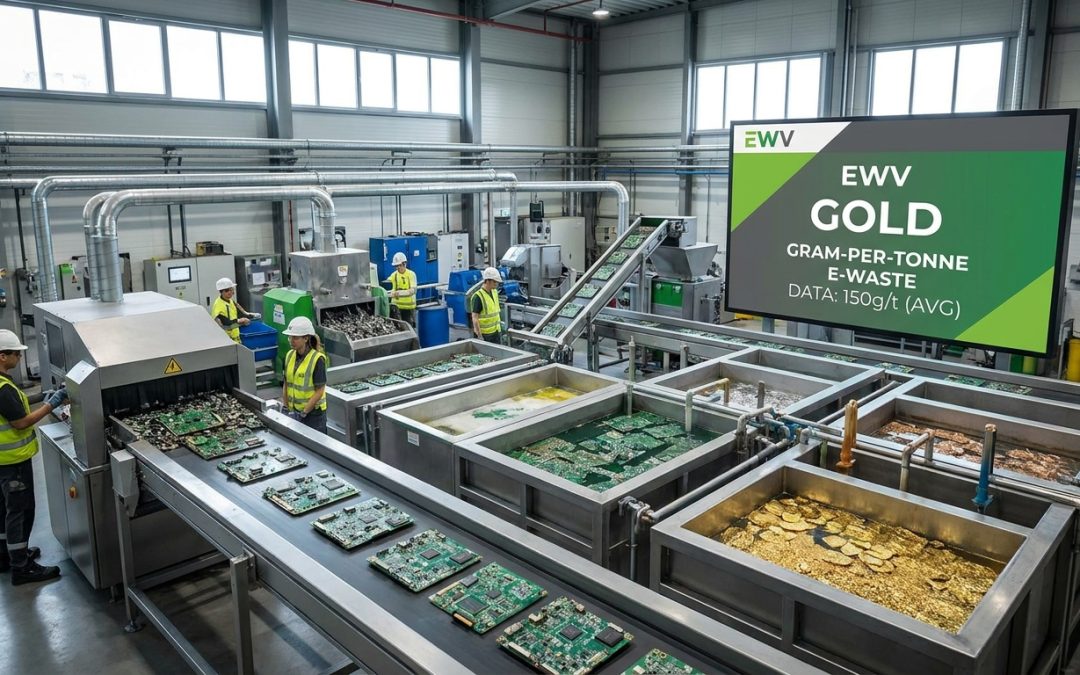
Gold in Your Old Electronics
There is real gold in the old computers, phones, and servers sitting in your office or storage room. Not just trace amounts, but quantities that make circuit board recycling one of the most economically valuable segments of the e-waste recycling industry. Gold is used in electronics because of its exceptional conductivity, resistance to corrosion, and reliability in making electrical connections. These same properties that make it valuable in electronics make it worth recovering when those electronics reach end of life.
Every circuit board, connector, and integrated circuit in your electronic devices contains gold in some form. The amount varies by device and component, but the concentrations are significantly higher than what you would find in gold mining ore. A tonne of high-grade circuit boards can contain 200 to 300 grams of gold, compared to just 5 to 10 grams per tonne from a typical gold mine. This concentration advantage is what makes e-waste an increasingly attractive “ore” for gold recovery operations worldwide.
Where Gold Is Used in Electronics
Gold serves specific functions in electronic devices, and understanding where it is used helps explain why certain components are more valuable for recovery than others.
Edge connectors and contact points are coated with a thin layer of gold to ensure reliable electrical connections. The gold plating on the edge connectors of RAM sticks, graphics cards, and expansion cards is one of the most visible uses of gold in electronics. This plating is typically only a few micrometres thick, but across millions of components, the total gold content is substantial.
- Edge connectors: gold plating on RAM, graphics cards, and expansion cards
- IC chip pins and leads: gold wire bonding inside integrated circuits
- CPU processors: among the highest gold content per unit weight
- Connector pins: gold plating on USB, HDMI, and other connectors
- Relay contacts: gold or gold-alloy contact points
- PCB traces: some high-reliability boards use gold plating on circuit traces
- SIM cards and smart cards: gold-plated contact pads
Integrated circuits (ICs) contain gold in the form of tiny bonding wires that connect the silicon die to the package leads. These gold wires are extremely fine, typically 25 to 50 micrometres in diameter, but each IC may contain several hundred such connections. CPU processors from the Pentium era through to modern chips are among the richest single components for gold recovery, with some older ceramic-packaged CPUs containing several grams of gold per kilogram of material.
Telecommunications equipment and server-grade hardware often contain more gold than consumer-grade products because of the higher reliability requirements. Gold-plated backplane connectors, high-density IC packages, and gold-plated chassis connectors contribute to higher per-unit gold content in enterprise equipment.
How Gold Is Recovered from Circuit Boards
Commercial gold recovery from circuit boards uses several established processes, often in combination.
Preprocessing is the first stage. Circuit boards are sorted by grade (high-grade boards with many ICs and gold connectors are separated from low-grade boards with less gold content). Some operations manually remove the highest-value components, like CPU processors and gold-rich connectors, for separate processing. Boards may then be shredded to reduce size and increase the surface area available for chemical processing.
Pyrometallurgical processing (smelting) involves melting the shredded board material in a high-temperature furnace. The precious metals, including gold, silver, and palladium, concentrate in a metallic phase that can be separated from the slag (waste material). The metallic phase is then further refined to separate individual metals. This is the method used by large-scale operations and is the dominant commercial approach globally.
Hydrometallurgical processing uses chemical solutions to dissolve gold from circuit board material. The most common approach uses aqua regia (a mixture of hydrochloric and nitric acid) or cyanide solutions to dissolve gold, which is then recovered from solution through precipitation or electrolysis. Hydrometallurgical methods can achieve very high recovery rates but generate chemical waste that requires proper management.
For a broader look at how circuit boards and other e-waste components are processed, see our article on the full journey of your old electronics.
The Economics of Gold Recovery
Gold recovery from circuit boards is economically viable and profitable at commercial scale. With gold prices consistently above AUD $3,000 per troy ounce in recent years, even small quantities of recovered gold have meaningful value. A tonne of high-grade circuit boards containing 250 grams of gold represents approximately AUD $25,000 to $30,000 in gold value alone, before accounting for silver, palladium, copper, and other recovered metals.
However, the economics depend on several factors. Processing costs including collection, sorting, shredding, smelting, and refining must be covered. Environmental compliance costs for managing emissions and chemical waste are significant. And the grade of input material matters enormously. High-grade boards from servers and telecommunications equipment are far more valuable than low-grade boards from consumer appliances.
The total recovered metal value from a tonne of mixed circuit boards, including gold, silver, palladium, and copper, can range from AUD $10,000 to $50,000 depending on the grade and composition of the boards. This value is what makes circuit board recycling one of the most economically attractive segments of the e-waste recycling industry.
Why DIY Gold Recovery Is a Bad Idea
The value of gold in electronics occasionally leads individuals to attempt home-based gold recovery using acids and other chemicals. This is strongly discouraged for several reasons.
The chemicals involved, particularly aqua regia, cyanide solutions, and concentrated acids, are extremely hazardous. Improper handling can cause serious chemical burns, release toxic fumes (including chlorine gas and hydrogen cyanide), and create contaminated waste that is difficult to dispose of safely. Several people have been seriously injured or killed attempting home gold recovery from electronics.
The environmental damage from uncontrolled chemical processing can be significant. Acid waste contaminating soil and waterways, toxic fumes polluting air quality, and improperly disposed chemical residues all create environmental harm that far outweighs the value of any gold recovered.
In Victoria, improper handling of hazardous chemicals and release of pollutants would breach the Environment Protection Act 2017 and the general environmental duty. The penalties for causing environmental harm through amateur chemical processing can be severe.
Professional recyclers have the equipment, expertise, and environmental controls to recover gold safely and efficiently. Individuals and businesses should channel their e-waste through licensed recyclers rather than attempting recovery themselves.
What This Means for Your E-Waste
The gold content of your old electronics is one reason why recycling through proper channels makes economic sense. While individual businesses are unlikely to see direct payments based on the gold content of their retired equipment (unless dealing in very large volumes), the gold value in circuit boards supports the economics of the entire e-waste recycling industry. Higher-value input streams like circuit boards help cross-subsidise the recycling of lower-value items like plastic casings and cable scrap.
For businesses with significant volumes of server, networking, or telecommunications equipment, the gold and precious metal content can be substantial. Working with an ITAD provider who understands the value of different component grades and processes them accordingly can maximise the financial return from retired equipment. Some providers offer transparent reporting on metal recovery values, which can be useful for both financial and sustainability reporting.
Every circuit board that goes to landfill or sits forgotten in a storeroom represents lost gold and other valuable metals that could be recovered and returned to productive use. Recycling your e-waste is not just environmentally responsible. It is contributing to a valuable recovery industry that turns waste into resources.
For more on the broader value recovery opportunity, see our articles on urban mining and the circular economy for electronics.
EWV helps Victorian businesses manage e-waste and IT asset disposal compliantly and sustainably — including collection, certified data destruction, and recycling. Contact us for a free quote.