
Why E-Waste Cannot Go to Landfill
Electronic waste is not just another category of rubbish. The reason e-waste is banned from Victorian landfills and increasingly regulated around the world comes down to one fundamental issue: electronic products contain hazardous materials that pose genuine risks to human health and the environment when they are not handled properly. Understanding what those materials are, where they are found, and what makes them dangerous is essential context for anyone involved in managing e-waste.
The hazardous materials in electronics are not there by accident. They are used because they have properties that make electronic products work: conductivity, flame resistance, light emission, energy storage, and corrosion protection. The challenge is that the same properties that make them useful in a functioning product make them dangerous when the product breaks down in a landfill or is processed without proper controls.
When e-waste is dumped in landfill, these materials can leach into soil and groundwater over time as casings deteriorate and components break down. When e-waste is burned or processed informally without proper controls, hazardous substances are released into the air, soil, and water, creating direct exposure risks for workers and surrounding communities.
Lead: The Most Widespread Hazard
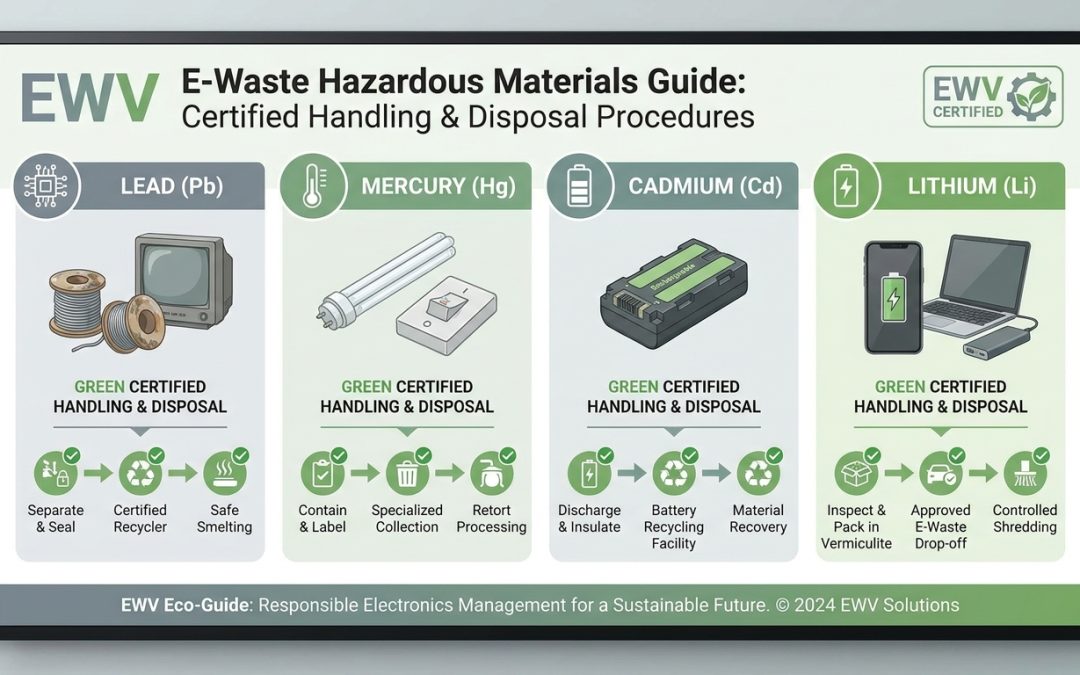
Lead is one of the most common hazardous materials in electronic waste. It has been used extensively in electronics for decades, primarily in solder (the material that joins electronic components to circuit boards) and in the glass of cathode ray tube (CRT) monitors and televisions.
A single CRT monitor can contain 2 to 4 kilograms of lead in its glass. While CRT technology is largely obsolete, millions of old CRT monitors and televisions are still in storage rooms, garages, and warehouses across Australia, waiting for disposal. The lead in CRT glass is a significant challenge for recyclers because the glass must be processed carefully to prevent lead release.
Lead-based solder is found in virtually all electronic products manufactured before the mid-2000s and in many products still manufactured today (particularly those not subject to the EU’s RoHS directive). When circuit boards from these products end up in landfill, lead can leach into the surrounding environment as the boards deteriorate.
Mercury: Small Amounts, Big Risks
Mercury is found in several types of electronic and electrical products. The most common sources are fluorescent backlights in older LCD screens, compact fluorescent lamps (CFLs), fluorescent tubes, and some types of switches and relays. While the amounts of mercury in individual devices are small (typically milligrams), the cumulative volume across millions of products is significant.
Mercury is a potent neurotoxin that can cause damage to the brain, kidneys, and developing foetuses. It is particularly dangerous because it can change form in the environment, converting from elemental mercury into methylmercury, which accumulates in the food chain. Mercury released from e-waste in landfill can eventually contaminate waterways and fish populations.
The good news is that mercury use in electronics has declined significantly with the shift to LED backlighting in screens and the phase-out of fluorescent lighting. However, the legacy stock of mercury-containing products still in use and awaiting disposal remains substantial.
Cadmium: Batteries and Beyond
Cadmium is found in nickel-cadmium (NiCd) rechargeable batteries, some older semiconductor components, and certain types of solder. While NiCd batteries have been largely replaced by lithium-ion technology in consumer electronics, they are still found in some power tools, emergency lighting, and older devices.
Cadmium is classified as a Group 1 carcinogen by the International Agency for Research on Cancer (IARC), meaning there is sufficient evidence that it causes cancer in humans. Inhalation of cadmium dust or fumes during informal recycling or burning of e-waste is the primary exposure pathway. In landfill, cadmium can leach into groundwater and contaminate agricultural land.
Brominated Flame Retardants
Brominated flame retardants (BFRs) are added to plastic casings, circuit boards, and cables to reduce fire risk. They are found in virtually all electronic products, from computers and televisions to small consumer devices. The most concerning BFRs are polybrominated diphenyl ethers (PBDEs) and tetrabromobisphenol A (TBBPA).
BFRs are persistent organic pollutants that do not break down readily in the environment. They accumulate in soil, water, and living organisms, and have been detected in human blood and breast milk worldwide. Health effects associated with BFR exposure include endocrine disruption, reproductive problems, and developmental effects.
When e-waste containing BFRs is burned, either in informal recycling operations or in waste incineration without proper controls, the combustion can produce brominated dioxins and furans, which are among the most toxic substances known. This is one reason why proper processing through licensed facilities with appropriate emission controls is essential.
Lithium: The Growing Fire Risk
Lithium-ion batteries present a different kind of hazard compared to the toxic metals in older electronics. While lithium itself is not as toxic as lead or mercury, lithium batteries are a significant fire and explosion risk when damaged, improperly stored, or processed without proper precautions.
Lithium battery fires in waste facilities have become an increasingly serious problem worldwide, including in Australia. When lithium batteries are crushed, punctured, or exposed to heat during waste processing, they can undergo thermal runaway, producing intense fires that are difficult to extinguish and can release toxic fumes. These fires have caused significant damage to waste processing facilities, vehicles, and collection infrastructure.
The volume of lithium batteries in the waste stream is growing rapidly as they are now found in smartphones, laptops, tablets, power tools, electric vehicles, e-bikes, and countless other products. Managing this fire risk is one of the most pressing challenges in modern waste management.
Other Hazardous Substances in E-Waste
Beyond the headline hazards, electronic waste contains a range of other substances that require careful management:
Arsenic is used in some semiconductor materials, particularly in LEDs and certain types of solar cells. Beryllium is found in connectors and switches, and beryllium dust is a serious inhalation hazard. Hexavalent chromium is used as a corrosion inhibitor in some metal components. Polyvinyl chloride (PVC) in cable insulation can release hydrogen chloride gas and dioxins when burned.
Rare earth elements used in magnets, displays, and other components are not acutely toxic but their extraction and processing has significant environmental impacts, making their recovery from e-waste both economically and environmentally valuable.
Why Proper Processing Matters
The hazardous materials in e-waste are safely contained within products during their normal useful life. A working laptop sitting on your desk does not pose a health risk from the lead in its solder or the flame retardants in its casing. The risks emerge when products are broken, dismantled, or deteriorate in landfill environments.
Licensed e-waste recycling facilities are designed to manage these hazards. They use controlled dismantling processes that minimise dust generation, separate hazardous components for specialist processing, and operate under environmental licences that set standards for emissions, waste handling, and worker safety. This is fundamentally different from informal recycling or landfill disposal where no such controls exist.
Understanding the hazards in e-waste reinforces why Victoria’s landfill ban and proper recycling are so important. The environmental and health costs of improper disposal far outweigh the modest effort required to recycle electronics through appropriate channels.
For more on the environmental impact of electronic waste, see our article on the true environmental cost of e-waste. And for practical guidance on responsible disposal, see our complete guide to e-waste recycling in Australia.
EWV helps Victorian businesses manage e-waste and IT asset disposal compliantly and sustainably — including collection, certified data destruction, and recycling. Contact us for a free quote.