
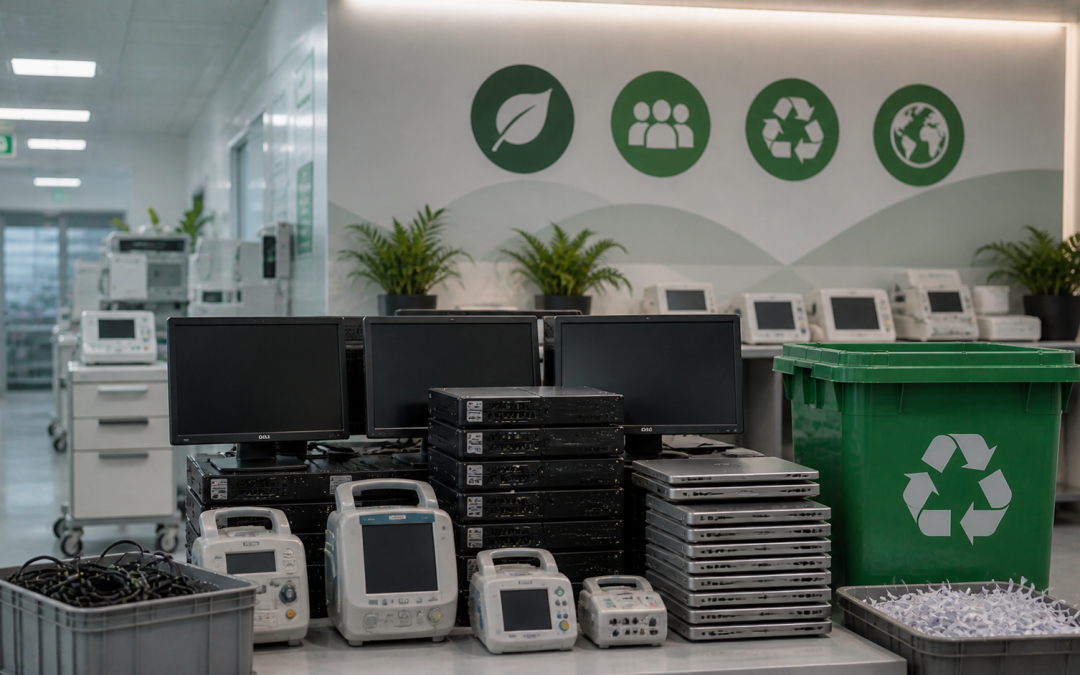
Healthcare is one of Australia’s most technology-intensive sectors, and the volume of IT equipment flowing through hospitals, clinics, and health networks creates both a significant environmental challenge and a substantial ESG opportunity. From patient monitoring systems and diagnostic imaging workstations to administrative computers and mobile devices used by clinical staff, healthcare generates e-waste at scale, and managing it responsibly requires navigating the additional complexity of strict data security requirements.
The Healthcare E-Waste Challenge
Hospitals and health services operate large, diverse IT fleets. A mid-sized hospital might have thousands of computers, monitors, tablets, and specialist medical devices connected to its network. These devices handle some of the most sensitive personal data imaginable, including medical records, diagnostic results, and patient identifiers, meaning end-of-life management must satisfy both environmental and privacy requirements simultaneously.
The healthcare sector also faces unique equipment challenges. Medical devices often have shorter useful lives than standard IT equipment due to rapid technological advancement and regulatory requirements for clinical accuracy. Specialist imaging equipment, laboratory analysers, and patient monitoring systems are expensive to purchase and complex to dispose of, with components that require specialist processing.
Data Security as the Non-Negotiable
In healthcare, data destruction is not just good practice. It is a legal requirement under the Privacy Act, the My Health Records Act, and various state health records legislation. Patient data on end-of-life devices must be destroyed to standards that eliminate any possibility of recovery. This means certified data wiping to NIST 800-88 standards or physical destruction with documented certification.
Healthcare organisations that fail to properly destroy data on disposed equipment face regulatory action, potential civil liability, and devastating reputational damage. Any e-waste management program in healthcare must place data security at the centre, not as an afterthought.
ESG Reporting in Healthcare
Healthcare organisations are increasingly expected to report on their environmental performance. Large hospital networks, particularly those with government ownership or oversight, face formal sustainability reporting requirements. Private health providers competing for contracts and partnerships find that ESG credentials influence commercial outcomes.
E-waste management provides specific, measurable data for healthcare ESG reports: tonnes of equipment diverted from landfill, data destruction compliance rates, material recovery volumes, and CO2e avoidance from refurbishment and recycling. These metrics complement other sustainability indicators like energy consumption and general waste management.
Opportunities for Improvement
Many healthcare organisations manage e-waste reactively rather than strategically. Equipment accumulates in storage rooms until someone decides to clear it out, at which point it is disposed of through whatever channel is most convenient rather than most responsible. Shifting to proactive management, with scheduled decommissioning, formal disposal procedures, and consistent processing through certified partners, delivers better environmental outcomes and better data.
Lifecycle extension is another significant opportunity. Standard administrative computers in healthcare settings often have useful life well beyond the three-year refresh cycle that many organisations default to. Clinical workstations running basic applications do not need cutting-edge hardware. Extending lifecycles where clinically appropriate reduces both costs and environmental impact.
Medical Device Complexity
Specialist medical devices present unique disposal challenges. They may contain radioactive materials, biological contaminants, or proprietary components that require manufacturer involvement in disposal. Some devices are classified as medical waste rather than e-waste, triggering different regulatory requirements.
A comprehensive healthcare e-waste strategy needs to account for these specialist devices alongside standard IT equipment. This often means maintaining relationships with multiple processing partners, each specialising in different equipment categories.
Staff Engagement in Clinical Settings
Engaging healthcare staff in e-waste programs requires sensitivity to their primary focus: patient care. Collection processes need to be simple and non-disruptive. Communication should be brief and relevant. And the program should never create situations where environmental procedures interfere with clinical operations.
Positioning e-waste management as part of infection control and data security, both topics that clinical staff already take seriously, can increase engagement more effectively than environmental messaging alone.
For more on how ESG reporting frameworks apply to sustainability in technology-dependent sectors, see our guide on ESG reporting and e-waste for Australian businesses.
Building a Sustainable Healthcare IT Program
Start with a clear inventory of your current IT fleet and its disposal pathways. Establish relationships with certified processing partners who understand healthcare’s unique data security requirements. Set measurable targets for diversion, recovery, and data destruction compliance. And integrate e-waste reporting into your broader sustainability and ESG disclosures. These steps transform healthcare e-waste from an administrative burden into a genuine ESG strength.