
Why Cheap Electronics Are Rarely a Bargain
It’s tempting to buy the cheapest option when shopping for electronics. A $200 laptop or a $15 pair of earbuds seems like a smart financial decision, especially when the product looks similar to alternatives costing three or four times as much. But the sticker price tells only a fraction of the story. Cheap electronics carry hidden costs that show up later, both for the buyer and for the environment, and these costs often dwarf the initial savings.
Understanding these hidden costs isn’t about being elitist about technology. It’s about making genuinely informed purchasing decisions that account for total cost of ownership, data security risks, and environmental consequences that don’t appear on the receipt.
The Durability Gap
Budget electronics are typically built to a price point, which means cheaper materials, thinner plastics, lower-grade solder joints, and components sourced from the lowest bidder. The result is a dramatically shorter useful lifespan. A business laptop from a major manufacturer with enterprise-grade build quality might last 5-7 years with normal use. A budget alternative might start failing at 18-24 months.
The financial impact compounds quickly. If a $400 budget laptop lasts two years and a $1,200 business-class laptop lasts six years, the annual cost of the budget option is $200 per year while the quality option costs $200 per year. The prices look identical on an annual basis, but the budget option generates three times as much e-waste and requires three times the procurement, setup, data migration, and disposal effort.
For businesses, the productivity cost of device failures often exceeds the device cost. An employee waiting for a replacement laptop, recovering from data loss, or dealing with persistent performance issues represents lost productive hours that never appear on the IT budget line.
The Environmental Toll
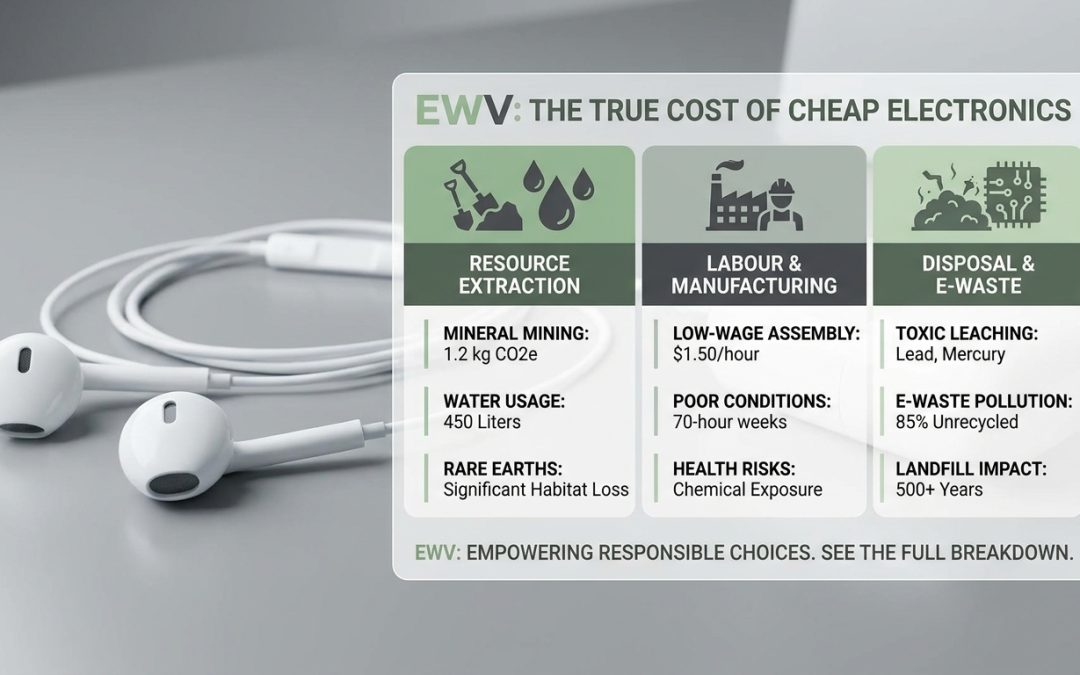
The environmental cost of cheap electronics is perhaps the most significant hidden expense, even though the buyer never sees the bill. Manufacturing any electronic device requires significant resources: rare earth minerals, water, energy, and chemical processing. When a cheap device fails prematurely and gets replaced, all those manufacturing inputs are consumed again far sooner than necessary.
A device that lasts two years instead of six effectively triples the manufacturing emissions per year of use. It triples the resource extraction, the water consumption, the chemical processing, and the eventual waste volume. Scale this across the millions of cheap electronics sold globally and the environmental impact is staggering.
Budget electronics also tend to be harder to repair and less likely to be refurbished. Proprietary components, glued assemblies, and lack of available spare parts mean that when something breaks, the entire device becomes waste rather than a repair candidate. This stands in contrast to business-class equipment that’s often designed for serviceability and has a robust secondary market for refurbished units.
Data Security Risks
For businesses, cheap electronics can introduce serious data security vulnerabilities. Budget devices may ship with outdated firmware, receive fewer security updates, or stop receiving updates entirely after a short support window. Some ultra-budget devices from lesser-known manufacturers have been found to contain pre-installed malware or undisclosed data collection software.
The storage components in budget devices also raise concerns. Cheap solid-state drives from unverified manufacturers may not support the secure erase commands needed for proper data destruction at end of life. If you can’t reliably wipe a device, you’re left with physical destruction as the only option, which eliminates any possibility of value recovery through resale or refurbishment.
Businesses handling sensitive data, whether that’s customer records, financial information, or intellectual property, need to consider the full security lifecycle of their devices. The cheapest hardware often creates the most expensive security problems.
Supply Chain and Labour Considerations
The aggressive cost-cutting required to produce very cheap electronics often extends to labour practices and supply chain standards. While major manufacturers have made progress on supply chain auditing and responsible sourcing (though imperfectly), ultra-budget brands often lack the transparency or accountability mechanisms that provide some assurance about working conditions and material sourcing.
Conflict minerals, unsafe factory conditions, excessive working hours, and inadequate worker protections are all more likely to appear in supply chains optimised purely for lowest cost. This doesn’t mean expensive products are automatically ethically sourced, but rock-bottom pricing makes ethical production virtually impossible.
For businesses with ESG commitments or responsible procurement policies, the supply chain behind cheap electronics can create reporting problems and reputational risks. Stakeholders increasingly ask about the conditions under which purchased goods were produced.
The E-Waste Multiplication Effect
Cheap electronics don’t just fail faster; they also tend to be harder to recycle responsibly. Budget devices may use more mixed materials, less standardised components, and lower-grade plastics that are difficult to process through conventional recycling streams. The combination of shorter lifespans and lower recyclability creates a multiplication effect on e-waste generation.
The circular economy works best when products are designed to last, designed to be repaired, and designed to be recycled. Cheap electronics typically fail on all three counts. They’re designed to hit a price point and little else.
In Australia, where the Victorian e-waste landfill ban prohibits sending electronic waste to landfill, the disposal of cheap devices that can’t be easily refurbished or recycled creates additional cost and logistical challenges. The device that was cheap to buy becomes expensive to deal with responsibly at end of life.
Making Smarter Purchasing Decisions
The alternative to buying cheap isn’t necessarily buying the most expensive option. It’s buying with total cost of ownership in mind. This means evaluating expected lifespan, repairability, manufacturer support commitment, build quality, security update policy, and end-of-life recyclability alongside the purchase price.
For businesses, the calculation should also include procurement and deployment costs (which are the same regardless of device price), productivity impact of reliability, IT support burden, and disposal costs. When all these factors are tallied, quality equipment almost always costs less per year of productive use than budget alternatives.
Refurbished business-class equipment offers perhaps the best value proposition of all. It provides the build quality and reliability of enterprise hardware at a price point competitive with budget new equipment, while generating a fraction of the environmental impact. For organisations looking to balance cost, performance, and sustainability, a refurbished-first procurement policy tackles all three goals simultaneously.
The true cost of cheap electronics is paid in shortened lifespans, increased waste, security vulnerabilities, and environmental damage. The savings on the price tag are rarely worth it.
EWV helps Victorian businesses manage e-waste and IT asset disposal compliantly and sustainably — including collection, certified data destruction, and recycling. Contact us for a free quote.