
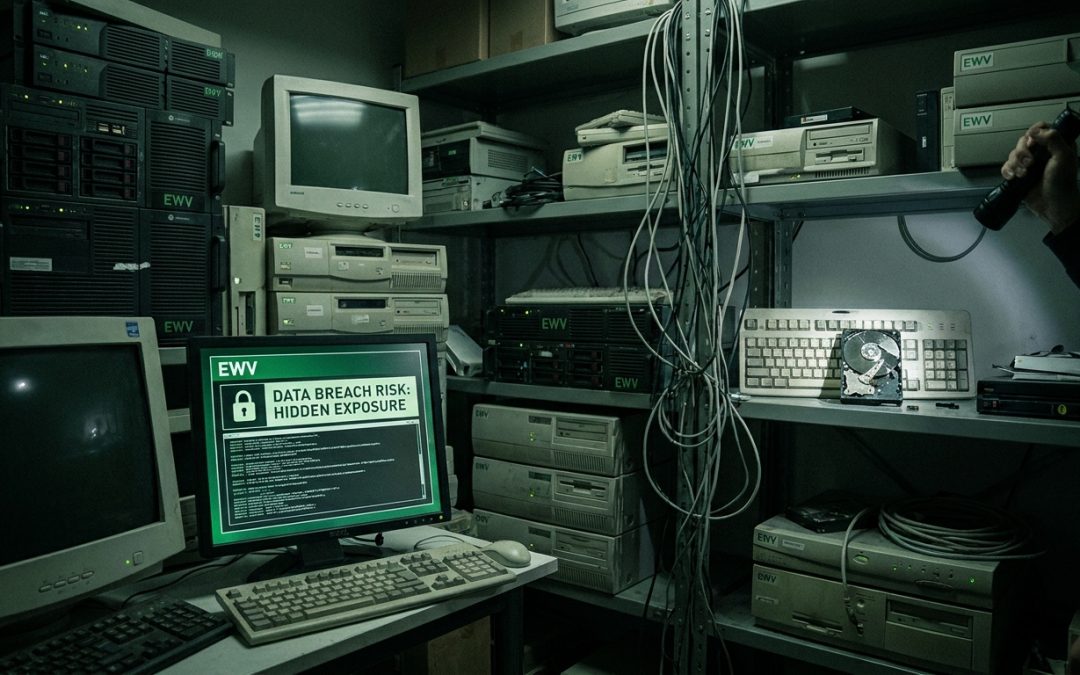
Most organisations invest heavily in protecting data on live systems. Firewalls, encryption, multi-factor authentication, endpoint detection — these are well-understood tools, and the investment is justified. But a growing body of evidence points to a blind spot that consistently falls outside the security perimeter: end-of-life IT equipment.
According to current ITAD industry data, nearly 29% of data breaches are linked to misconfigured or improperly decommissioned assets. That means retired laptops stacked in a storeroom, old servers bundled for general recycling, and hard drives donated alongside equipment could all be active data risks right now. For Australian businesses, this is not a theoretical concern.
What Happens to Data When Hardware Gets Retired?
When staff hand in old laptops or a server refresh cycle ends, the instinct is often to move quickly. IT teams are busy, storage space is limited, and retired equipment feels like a solved problem once it leaves the office.
But “deleted” does not mean “destroyed.” Standard operating system deletion leaves data recoverable with freely available tools. Even a factory reset on many devices leaves residual data intact. Without a structured, standards-based approach to data sanitisation, every device that leaves your premises is a potential liability.
The methods that actually eliminate data risk include:
- Software wiping to NIST 800-88 Rev. 2 standards, which overwrites all addressable storage locations and produces a verifiable audit trail
- Physical destruction, including hard drive shredding, crushing, or degaussing, for devices where software wiping is impractical or insufficient
- Certified chain-of-custody documentation, tracking each asset from collection through to final destruction or remarketing
Without these steps in place, businesses are effectively leaving the door open.
The Business Cost of Getting It Wrong
The average cost of a data breach globally reached USD $4.88 million in 2024, a 10% increase from the year before. While not every breach originates from hardware disposal failures, those that do are entirely avoidable — and that tends to attract close regulatory scrutiny.
In Australia, the Notifiable Data Breaches (NDB) scheme under the Privacy Act 1988 requires organisations to notify the OAIC and affected individuals when a breach is likely to result in serious harm. A recoverable hard drive in the hands of an unauthorised party almost certainly meets that threshold.
Beyond notification obligations, businesses face reputational damage, client contract exposure, and potential regulatory action. For industries handling sensitive data — healthcare, legal, financial services, government contracting — the stakes are even higher.
The Regulatory Context Has Tightened
Australia’s obligations under the Basel Convention were expanded in January 2025 to include non-hazardous e-waste, meaning cross-border movement of all categories of electronic waste now requires Prior Informed Consent procedures. Domestically, Victoria has maintained its ban on e-waste from general waste streams since 2019, a framework that runs alongside AS/NZS 5377, the Australian standard governing the collection, storage, transport, and treatment of end-of-life electrical and electronic equipment.
For businesses engaging an ITAD partner, these regulatory layers underscore the importance of working with a provider that understands and operates within both the data security and environmental compliance frameworks simultaneously. Choosing a partner based on convenience or price alone creates real exposure.
What Responsible Hardware Disposal Looks Like
A well-structured IT asset disposition process covers the full lifecycle from the moment a device is flagged for retirement:
- Asset tracking and tagging at collection, with serial numbers logged before anything else moves
- Data destruction using a method appropriate to the device type and sensitivity, aligned to NIST 800-88 Rev. 2
- Environmental processing meeting AS/NZS 5377 requirements, diverting hazardous materials from landfill
- Destruction and environmental reporting, with itemised certificates suitable for compliance records or ESG reporting
Organisations that approach ITAD as a compliance process, rather than a logistics exercise, are the ones that avoid the headline-making failures.
How Electronic Waste Victoria Can Help
Electronic Waste Victoria provides end-to-end ITAD and secure data destruction services for businesses across Victoria. The team handles on-site and depot-based collection, software data wiping to NIST 800-88 Rev. 2 standards, physical destruction by shredding, degaussing, and crushing, full chain-of-custody asset tracking, and itemised environmental and destruction reporting.
All processes align with ISO 14001 environmental management, ISO 27001 information security management, and AS/NZS 5377. Whether your business is managing a routine device refresh, a major office relocation, or a decommissioning project with specific compliance requirements, the team can design a collection and destruction program that protects your data and meets your environmental obligations.
Contact Electronic Waste Victoria today to arrange a secure collection and destruction service for your business. Visit ewastevictoria.net.au to get in touch with the team.
EWV provides NIST 800-88 certified data destruction for Victorian businesses, covering software-based erasure and physical destruction with full chain-of-custody documentation. Request a quote to discuss your requirements.