
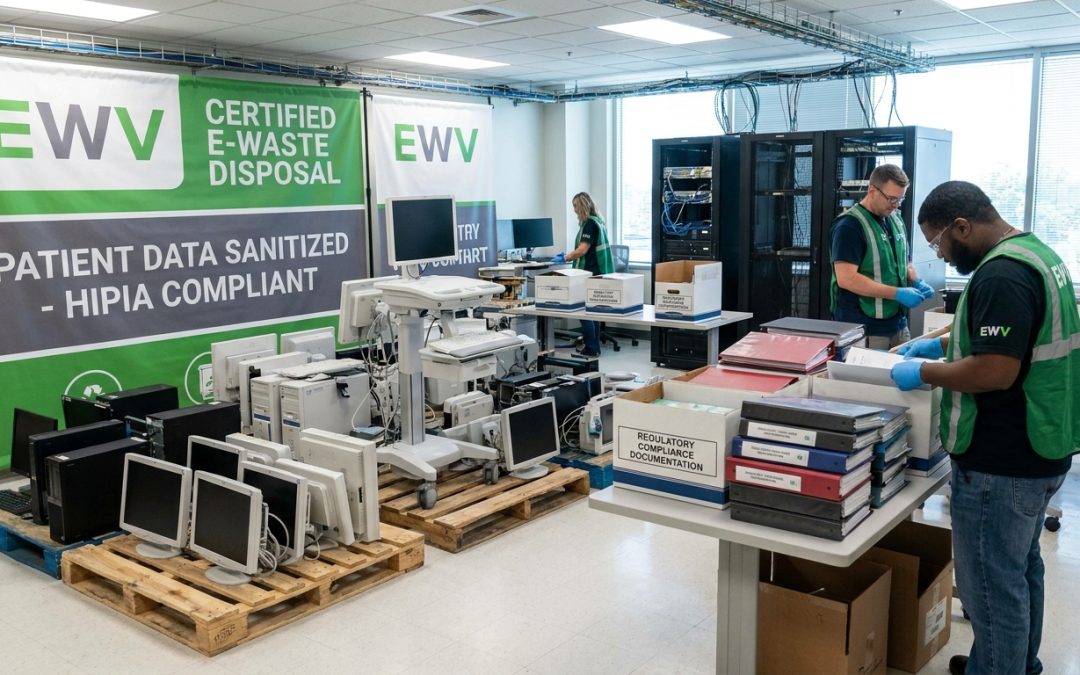
Healthcare facilities generate a unique and complex stream of electronic waste that sits at the intersection of data privacy, biohazard management, regulatory compliance, and environmental responsibility. From clinical workstations and patient monitoring systems to diagnostic imaging equipment, the e-waste produced by hospitals and healthcare organisations demands a more rigorous disposal approach than standard office IT.
The Healthcare E-Waste Landscape
A modern hospital is one of the most technology-dense environments imaginable. Beyond standard office IT (computers, printers, networking), healthcare facilities operate patient monitoring systems (bedside monitors, telemetry, central stations), diagnostic imaging (X-ray, CT, MRI, ultrasound), laboratory analysers and pathology equipment, infusion pumps and medication dispensing systems, electronic health record (EHR) terminals, nurse call and communication systems, pharmacy automation, and telemedicine and video conferencing equipment.
Each of these categories contains devices with storage, network connectivity, and potentially patient health information that requires careful handling during disposal.
Health Data: The Highest Stakes
Patient health information is classified as sensitive personal information under the Privacy Act 1988, attracting the highest level of legal protection. State-level health records legislation (such as the Health Records Act 2001 in Victoria) adds further obligations.
Healthcare e-waste can contain patient names, dates of birth, Medicare numbers, and contact details, clinical notes, diagnoses, and treatment plans, medical images (X-rays, CT scans, pathology images), medication records, test results and lab data, and mental health and counselling records.
A data breach involving patient health information can result in significant fines under the Notifiable Data Breaches scheme, loss of accreditation, professional liability for clinicians, and severe reputational damage to the healthcare facility. The consequences are far more serious than a typical corporate data breach.
Hidden Data-Bearing Devices
In healthcare, data hides in places that general IT disposal processes might miss. Patient monitors store waveform data, patient demographics, and alarm settings. Infusion pumps may store drug libraries, dosing histories, and patient IDs. Imaging equipment contains studies in DICOM format on internal storage. Pharmacy dispensing cabinets store medication records and user access logs. Nurse call systems log call patterns tied to room and bed numbers. Multifunction printers store copies of scanned and printed documents on internal hard drives.
Any disposal program for healthcare facilities must inventory all device types that store data, not just obvious IT equipment like computers and servers.
Biohazard and Infection Control
Some healthcare electronic equipment may have been contaminated with biological material. Equipment used in direct patient care, surgical environments, pathology labs, or isolation rooms may carry infection risk.
Before entering the e-waste recycling stream, potentially contaminated equipment should be assessed for biohazard risk by infection control staff, decontaminated according to the facility’s infection control procedures, and cleared for release from the clinical environment.
Equipment that cannot be adequately decontaminated should be handled through clinical waste channels rather than standard e-waste recycling. This is particularly relevant for devices with porous surfaces or internal channels that cannot be effectively cleaned.
Large Imaging Equipment
Diagnostic imaging equipment deserves special mention because of its size, complexity, and potential hazards. CT scanners can weigh several tonnes and require structural considerations for removal. MRI machines contain superconducting magnets cooled with liquid helium, presenting unique decommissioning challenges. X-ray equipment contains lead shielding. Some older nuclear medicine cameras contain radioactive sources.
Decommissioning of large imaging equipment should be managed by the equipment manufacturer or a specialist decommissioning company. These specialists understand the regulatory requirements, have the technical capability to safely dismantle complex systems, and can manage hazardous materials appropriately.
Notably, large imaging equipment often has significant resale value in developing markets. Equipment brokers specialise in refurbishing and re-exporting clinical equipment that has been superseded but is still functional.
Choosing a Disposal Partner for Healthcare
Healthcare organisations should select disposal partners with demonstrated experience in the health sector. Key requirements include certified data destruction to NIST 800-88 or equivalent standards, with individual certificates for every data-bearing device. The provider should have experience with healthcare-specific equipment types (not just standard IT), the ability to handle or coordinate disposal of clinical equipment with biohazard considerations, documented chain of custody from collection to final disposition, appropriate insurance coverage for handling healthcare data, and reporting that satisfies accreditation and audit requirements.
Do not assume that a general IT recycler understands the nuances of healthcare e-waste. Ask specifically about their healthcare sector experience and references.
Compliance Documentation
Healthcare facilities should maintain comprehensive records of all equipment disposals, including a detailed asset register linking devices to serial numbers and locations, certificates of data destruction for every data-bearing device, chain of custody documentation, records of any biohazard assessment and decontamination, and evidence of environmentally responsible recycling.
These records serve multiple purposes: they demonstrate compliance during privacy audits, support accreditation assessments, provide evidence in the event of a data breach investigation, and contribute to environmental sustainability reporting.
For comprehensive guidance on data destruction across all business types, see our complete guide to data destruction for Australian businesses.
EWV helps Victorian businesses manage e-waste and IT asset disposal compliantly and sustainably — including collection, certified data destruction, and recycling. Contact us for a free quote.