
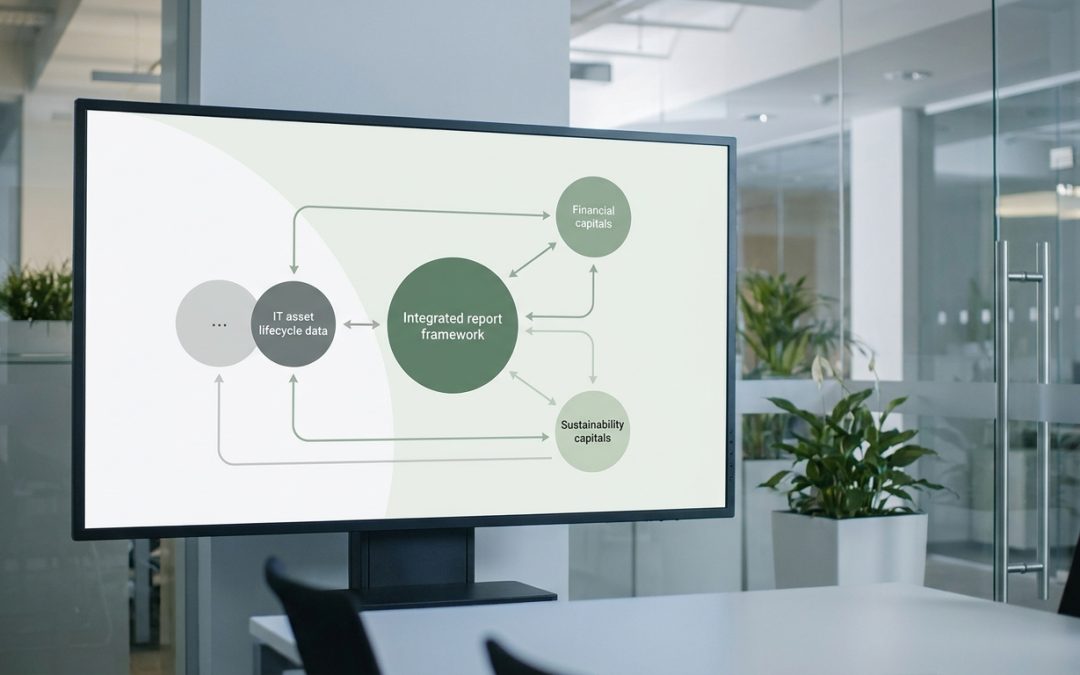
Integrated reporting combines financial and non-financial information into a single, coherent report that explains how an organisation creates value over time. The International Integrated Reporting Framework, now maintained by the IFRS Foundation alongside the ISSB standards, encourages organisations to think beyond financial capital and consider how they use and affect manufactured, intellectual, human, social, and natural capital. IT asset lifecycle management touches several of these capital categories, making it a relevant topic for organisations practising integrated reporting.
The Six Capitals and IT Equipment
The integrated reporting framework identifies six capitals that organisations use and affect. IT equipment management connects to several of them.
Financial capital is the most obvious connection. IT procurement represents significant capital expenditure, and disposition generates returns through remarketing or avoids costs through efficient recycling. The financial implications of IT lifecycle decisions, including total cost of ownership, residual value recovery, and compliance costs, should be visible in integrated reporting.
Manufactured capital includes the physical assets an organisation uses to operate. IT equipment is manufactured capital, and how you manage it through its lifecycle, extending its useful life, maintaining it effectively, and disposing of it responsibly, demonstrates stewardship of these assets.
Natural capital is affected through the environmental impacts of IT equipment procurement (resource extraction, manufacturing emissions), use (energy consumption), and disposition (recycling, materials recovery, or waste generation). Responsible IT lifecycle management preserves natural capital by reducing the demand for virgin resources and minimising pollution.
Human capital connects through the health and safety implications of IT disposal (particularly exposure to hazardous substances in improper processing) and the skills and training of employees involved in IT management and sustainability.
Social and relationship capital is affected through your supply chain relationships with IT vendors and ITAD providers, your community impact through responsible waste management, and your reputation among stakeholders who value environmental responsibility.
Value Creation Through IT Lifecycle Management
Integrated reporting asks organisations to explain their value creation story. For IT asset lifecycle management, value creation occurs through several mechanisms.
Financial value comes from optimising IT procurement to balance upfront cost with lifecycle value, recovering residual value through equipment remarketing, avoiding disposal costs through efficient recycling partnerships, and reducing regulatory compliance costs through proactive e-waste management.
Environmental value is created by extending equipment lifecycles to reduce manufacturing demand, recovering materials through recycling to reduce primary extraction, avoiding greenhouse gas emissions through refurbishment and reuse, and diverting e-waste from landfill (mandatory in Victoria since 1 July 2019).
Social value emerges from ensuring responsible processing that protects worker health and safety, supporting employment in the formal recycling and refurbishment sector, donating refurbished equipment to community organisations, and maintaining data security to protect customers and stakeholders.
Connectivity in IT Reporting
One of the core principles of integrated reporting is connectivity, showing how different aspects of performance relate to each other. For IT asset management, connectivity means linking IT procurement spend to Scope 3 emissions to demonstrate the carbon cost of technology acquisition. It means connecting equipment lifecycle length to both financial returns (reduced annual procurement cost) and environmental outcomes (reduced embodied carbon per year of use). It means showing how ITAD provider selection affects data security risk, environmental performance, and financial returns simultaneously. And it means demonstrating how IT sustainability performance supports broader organisational targets, such as net zero commitments or waste reduction goals.
Practical Reporting Approaches
Including IT lifecycle information in an integrated report does not require a dedicated chapter. Instead, IT asset management can be woven into existing sections. In the business model section, describe how IT equipment supports your operations and how its lifecycle is managed. In the strategy section, explain how IT procurement and disposition decisions align with your sustainability strategy. In the risks and opportunities section, address IT-related risks (data security, regulatory compliance, supply chain disruption) and opportunities (remarketing revenue, carbon reduction, stakeholder reputation). In the performance section, provide key metrics on IT lifecycle management alongside other operational metrics.
Metrics for Integrated Reporting
Useful IT lifecycle metrics for integrated reporting include IT equipment procurement spend and volumes (financial and manufactured capital), average equipment lifecycle by category (manufactured capital efficiency), disposition method breakdown: refurbished, recycled, destroyed (natural and financial capital), CO2e avoided through refurbishment and reuse (natural capital, linked to Scope 3 targets), materials recovered through recycling (natural capital), remarketing revenue recovered (financial capital), data destruction compliance rate (social and relationship capital), and e-waste landfill diversion rate (natural capital, regulatory compliance).
Presenting these metrics with year-on-year comparisons and targets demonstrates management accountability and creates a basis for stakeholder assessment. For comprehensive guidance on ESG reporting for e-waste, see our ESG reporting guide for Australian businesses.
]]>