
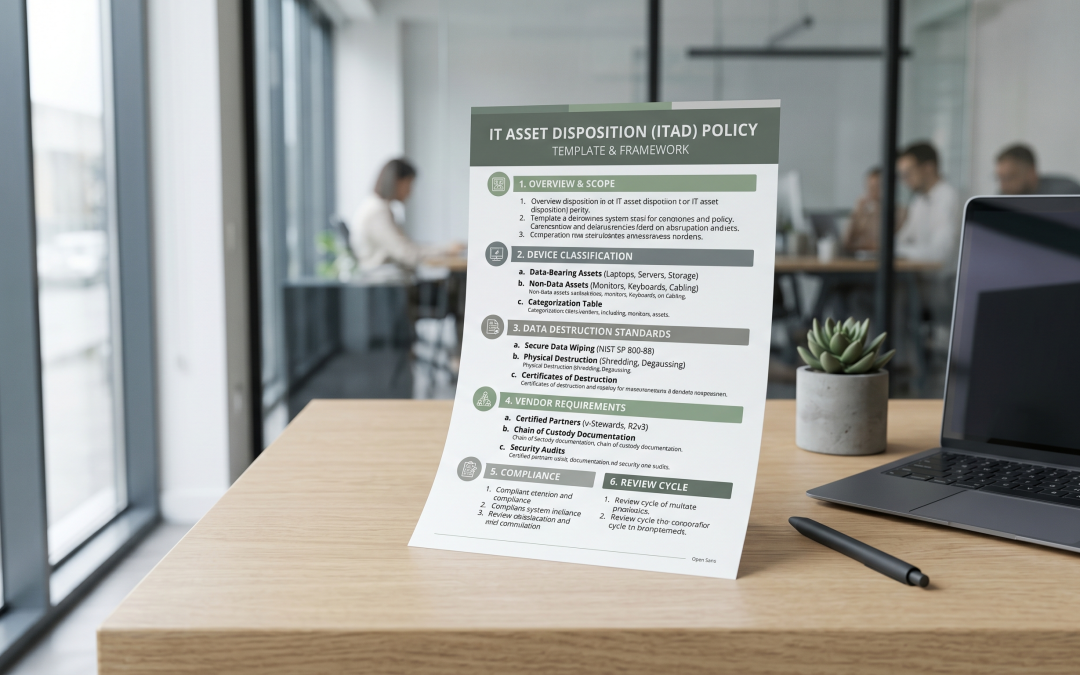
An internal ITAD policy establishes the rules, responsibilities, and procedures your organisation follows when disposing of IT equipment. Without a formal policy, disposal decisions are made ad hoc by different people with different levels of awareness, leading to inconsistent practices, security gaps, and compliance risks. A clear policy ensures everyone knows what is expected and how to handle equipment at end of life.
Why You Need a Formal Policy
Informal disposal practices work until they do not. The IT manager who always handled disposals properly retires, and their replacement does not know the process. A department head decides to give old laptops to staff without wiping them first. A well-meaning office manager arranges for a local scrap dealer to take away old equipment without any data destruction. Each of these scenarios, and they all happen regularly, represents a potential data breach and compliance failure.
A formal policy prevents these situations by documenting what must happen, who is responsible, and what the consequences of non-compliance are. It also demonstrates due diligence to regulators and auditors, showing that your organisation takes its disposal obligations seriously.
Policy Scope
Your ITAD policy should clearly define what equipment it covers. At minimum, this includes all organisation-owned IT equipment: desktops, laptops, servers, mobile devices, tablets, networking equipment, storage devices, printers, and any other electronic equipment that stores or processes data.
Consider also addressing equipment owned by employees but used for work (BYOD devices when they contain organisation data), leased equipment (where disposal may involve return to the lessor), IoT devices and operational technology, and physical records stored on electronic media (backup tapes, external drives, USB sticks).
The policy should apply to all locations, including head office, branch offices, remote workers, and any third-party sites where your equipment is deployed.
Roles and Responsibilities
Clearly assign who is responsible for each aspect of IT disposal. Typical role assignments include an ITAD program owner (often the IT Director or CISO) who has overall accountability for the policy and program, an IT operations team responsible for identifying equipment for disposal, performing initial data classification, and coordinating collections, an information security team that sets data destruction standards, approves providers, and audits compliance, a procurement team that manages ITAD vendor contracts and financial arrangements, a finance team that handles asset write-offs and value recovery accounting, and department heads who are responsible for ensuring their staff comply with the policy.
The key principle is that no individual should be able to dispose of IT equipment without following the documented process. This applies to everyone from the CEO to the newest employee.
Data Classification and Handling
Your policy should define how data sensitivity drives disposal method. A simple three-tier classification works for most organisations. Standard data (general business documents, non-sensitive information) can be sanitised using certified software wiping tools. Confidential data (customer records, financial information, employee data) requires certified wiping with verification, or physical destruction. Highly confidential data (classified information, regulated data, critical IP) requires physical destruction with witnessed procedures.
Each device should be classified before entering the disposal process, and the classification should determine which processing stream it follows. This approach ensures proportional handling without over-processing low-risk equipment or under-processing high-risk assets.
Reference established standards like NIST 800-88 in your policy to provide a clear benchmark for data destruction methods.
Approved Disposal Methods
Define the approved methods for IT equipment disposal within your organisation. Typical approved methods include certified ITAD provider processing (through your contracted provider), on-site data destruction for high-security assets, remarketing through approved channels after certified data destruction, donation to approved recipients after certified data destruction, and recycling through certified e-waste recyclers.
Explicitly state what is not approved: selling equipment through personal channels, giving equipment to staff without proper processing, using unvetted disposal providers, and disposing of electronic equipment through general waste.
Documentation Requirements
Specify what documentation must be created and retained at each stage. This typically includes asset disposal request forms, collection manifests listing every device by serial number, certificates of destruction for all data-bearing devices, environmental recycling certificates, value recovery receipts, and final reconciliation reports. Define how long these records must be retained, aligning with your organisation’s records management policy and applicable regulations.
Provider Selection and Management
Your policy should outline the criteria for selecting and approving ITAD providers, including minimum certification requirements, security standards, and environmental compliance. Define how often providers are reviewed (annually at minimum) and what would trigger a review outside the normal cycle.
Policy Review and Updates
Technology, regulations, and organisational needs change. Build in a regular review cycle, typically annual, to ensure your ITAD policy remains current. Trigger an ad hoc review whenever there is a significant change in regulations, a security incident related to disposal, a major change in your IT environment, or a change in your ITAD provider. The policy owner should be responsible for ensuring reviews happen on schedule and that approved changes are communicated to all affected staff.
EWV handles IT asset disposition (ITAD) end-to-end for Victorian businesses — from collection and data destruction through to certified recycling or refurbishment for resale. Get in touch for a tailored ITAD quote.