
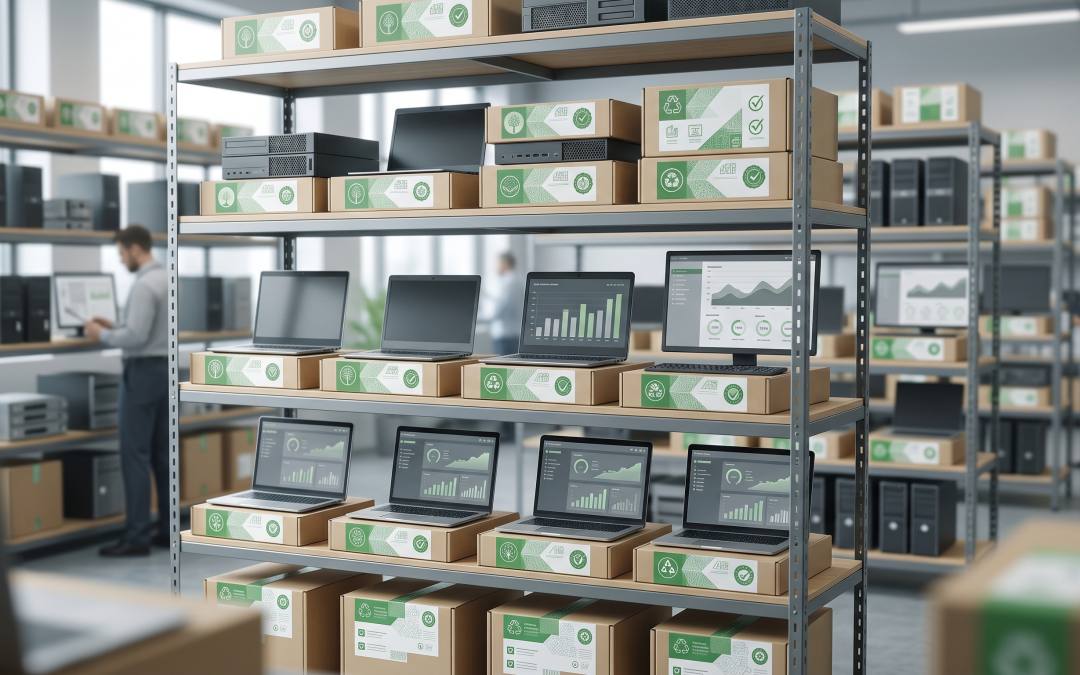
Remarketing is the process of preparing retired IT equipment for resale on secondary markets. Done well, it recovers meaningful financial value from assets that would otherwise be pure disposal cost, while also extending the useful life of equipment and reducing the environmental impact of manufacturing new devices. For organisations with regular equipment refresh cycles, remarketing can become a significant component of their IT financial strategy.
How Remarketing Differs from Simple Resale
Remarketing is more than just selling old equipment. It is a structured process that includes professional data sanitisation to ensure all information is irrecoverably removed, comprehensive functional testing to verify every component works correctly, cosmetic refurbishment where economically justified (cleaning, minor repairs, battery replacement), accurate grading against industry-standard condition scales, professional presentation and listing on appropriate sales channels, and warranty provision on remarked equipment (varying by provider).
This process adds cost, but it also adds value. A professionally remarketed laptop with certified data destruction, a verified functional test report, and a cosmetic grade sells for significantly more than an “as-is, where-is” used laptop with no documentation.
The Secondary IT Market
The global secondary IT market is substantial and growing. Businesses, schools, non-profits, and individual consumers all purchase refurbished equipment for various reasons: budget constraints, sustainability commitments, or simply because refurbished business-grade equipment often outperforms new consumer-grade alternatives at the same price point.
In Australia, the secondary market is served by a mix of online marketplaces, specialist refurbishers, wholesale brokers, and direct-to-business channels. Equipment remarketed through professional ITAD channels typically enters this market through established distribution networks rather than consumer platforms like eBay or Gumtree.
What Sells and What Does Not
Understanding market demand helps set realistic expectations for value recovery. Strong demand categories include recent-model business laptops from major brands, Apple products (MacBooks, iPhones, iPads), enterprise servers with current-generation processors, high-specification workstations, and networking equipment from established brands (Cisco, Juniper, Aruba).
Weaker demand categories include desktop computers (declining demand in the secondary market), older monitors (unless high-resolution or professional-grade), consumer-grade equipment, printers (most have minimal resale value), and highly specialised or proprietary hardware with limited buyer pools.
Equipment that is more than five years old generally has minimal remarketing value regardless of category, though there are exceptions for premium brands and sought-after configurations.
The Remarketing Process Step by Step
When equipment arrives at the remarketing facility, it first goes through data destruction. This is non-negotiable, regardless of the intended sales channel. Software-based sanitisation following NIST 800-88 standards is the preferred method for remarketing because it preserves the device’s functionality.
Functional testing follows, using automated diagnostic tools that check every major component: processor performance, memory integrity, storage health, display quality, keyboard and trackpad functionality, port connectivity, Wi-Fi and Bluetooth, camera and microphone, and battery health (for portable devices).
Devices that pass functional testing receive a cosmetic grade. Common grading scales run from A (near-new condition) through B (good condition with minor wear) to C (functional with visible cosmetic issues). Some providers add finer distinctions within these grades.
Pricing is determined based on the model, specification, condition grade, and current market conditions. Experienced remarketing teams monitor secondary market pricing continuously to optimise returns.
Remarketing Channels
Different equipment and volumes are best served by different sales channels. Direct business-to-business sales yield the highest prices but require an established buyer network and sales capability. Online auction platforms (such as specialised IT auction sites) work well for mid-range volumes and attract competitive bidding. Wholesale channels offer quick, guaranteed sales at lower prices, suitable for large volumes or lower-value equipment. Export markets, particularly in Southeast Asia and the Pacific, provide additional demand for equipment that has limited domestic market.
A good ITAD provider with strong remarketing capabilities will use a mix of channels to optimise returns across your entire equipment portfolio rather than dumping everything through a single channel.
Financial Arrangements
Remarketing revenue can be structured in several ways. A buy-back model means the ITAD provider pays you a fixed amount per device upfront, taking on the risk and reward of the resale themselves. A revenue share model means the provider sells the equipment and splits the proceeds with you according to an agreed formula. A hybrid model combines a guaranteed minimum payment with a share of any upside above that minimum.
Each model has trade-offs. Buy-back gives certainty but typically yields less than revenue share if the equipment sells well. Revenue share has more upside potential but also more uncertainty and a longer payment timeline. Consider your organisation’s preference for certainty versus potential when choosing a model.
Environmental Benefits
Remarketing is inherently sustainable. Every device that finds a second life through remarketing is one fewer device that needs to be manufactured new. Given that the environmental impact of electronics is heavily concentrated in the manufacturing phase, extending product life through remarketing delivers significant carbon and resource savings. This makes remarketing not just a financial strategy but also a meaningful contribution to your organisation’s sustainability goals.
EWV handles IT asset disposition (ITAD) end-to-end for Victorian businesses — from collection and data destruction through to certified recycling or refurbishment for resale. Get in touch for a tailored ITAD quote.