
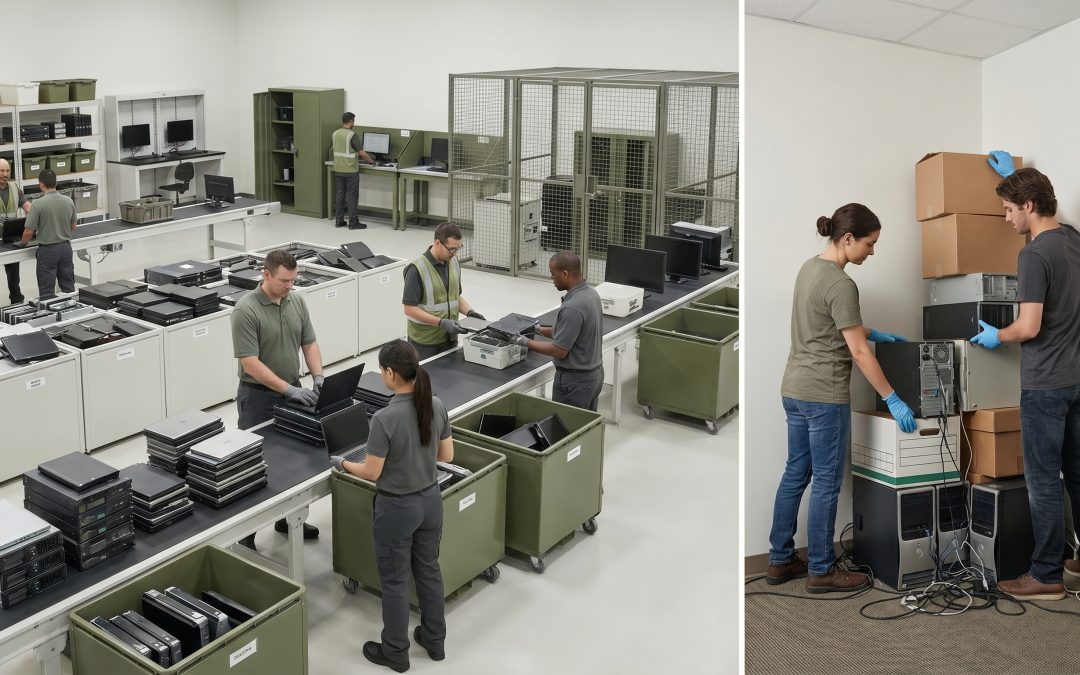
One of the first decisions organisations face when building an IT asset disposition program is whether to manage disposal in-house or engage a specialist ITAD provider. Both approaches have merits, and the right choice depends on your organisation’s size, security requirements, available resources, and the volumes of equipment you process.
The In-House Approach
Managing ITAD in-house means your own staff handle every aspect of the disposition process, from data destruction and equipment testing to remarketing and recycling. This approach gives you maximum control over sensitive data and the ability to customise processes to your exact requirements.
Advantages of in-house ITAD include direct control over data destruction processes, no need to entrust sensitive equipment to third parties, ability to schedule disposition activities around your own operational needs, and the potential to capture full remarketing revenue without sharing with a provider.
Disadvantages of in-house ITAD include the significant capital investment required for destruction equipment such as degaussers and shredders, the need for trained staff with expertise in data destruction standards and verification, limited access to secondary markets for remarketing, the requirement to maintain environmental compliance certifications, and the difficulty of scaling to handle volume spikes during major refresh events.
In-house ITAD makes most sense for organisations that process very high volumes consistently, have extremely sensitive data that justifies the investment in dedicated destruction capabilities, or have existing infrastructure and expertise that can be leveraged.
The Provider Approach
Engaging a specialist ITAD provider means outsourcing some or all of the disposition process to a company whose core business is handling end-of-life IT equipment. Providers bring scale, expertise, and established processes that most organisations cannot replicate internally.
Advantages of using a provider include access to certified destruction capabilities without capital investment, established secondary market channels that typically achieve better remarketing outcomes, environmental compliance handled by the provider, scalability to handle volume fluctuations, and comprehensive documentation and reporting.
Disadvantages of using a provider include the need to entrust sensitive equipment to a third party, potential loss of direct control over timing and processes, ongoing service costs, and dependency on the provider’s capabilities and reliability.
Hybrid Models
Many organisations adopt a hybrid approach that combines elements of both. Common hybrid models include performing data destruction in-house for the most sensitive equipment while outsourcing remarketing and recycling to a provider, using in-house processes for routine small-volume disposals while engaging a provider for major refresh events, or maintaining in-house capability for on-site destruction while using a provider for off-site processing of standard equipment.
The hybrid model can deliver the security benefits of in-house destruction for your most sensitive assets while leveraging the provider’s remarketing expertise and environmental compliance for the broader fleet.
Making the Decision
When evaluating the two approaches, consider the total cost of ownership rather than just the provider’s fees. Factor in the capital cost of destruction equipment if going in-house, staff training and ongoing expertise requirements, the value of remarketing revenue and whether a provider’s market access can generate better returns, insurance and liability implications, audit and compliance overhead, and the opportunity cost of diverting internal resources to ITAD management.
For most organisations processing fewer than several thousand devices per year, a provider-based model delivers the best combination of security, financial outcome, compliance, and operational efficiency. For very large organisations with dedicated ITAD staff and high-security requirements, in-house or hybrid models may be justified.
EWV handles IT asset disposition (ITAD) end-to-end for Victorian businesses — from collection and data destruction through to certified recycling or refurbishment for resale. Get in touch for a tailored ITAD quote.