
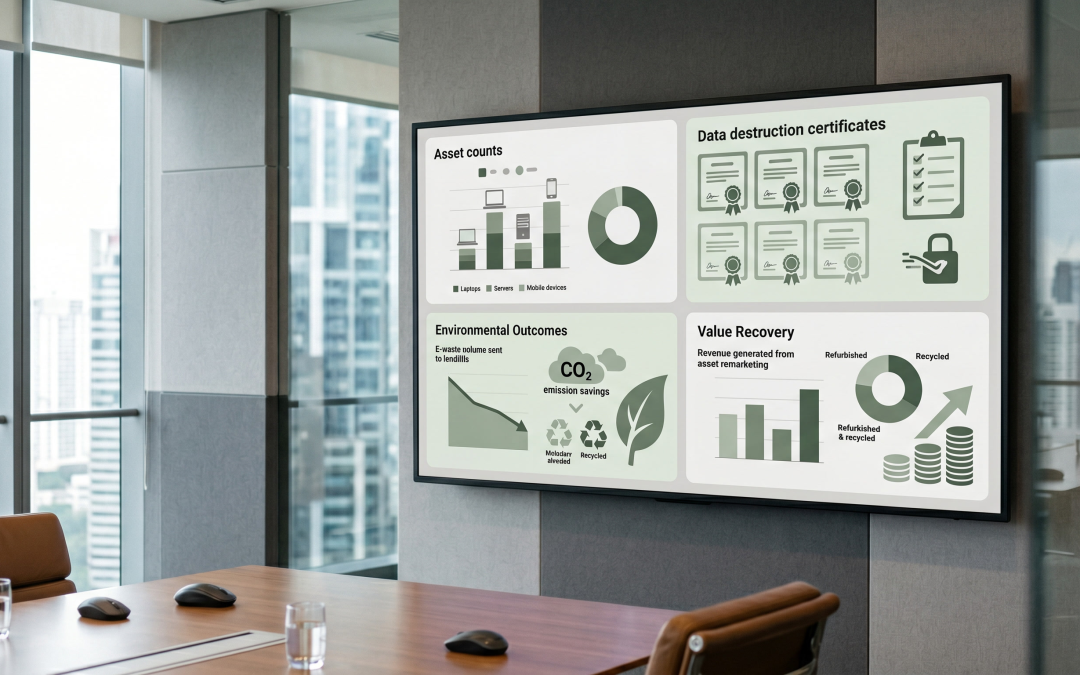
The reports you receive from your ITAD provider are your window into what actually happened to your disposed equipment. Good reporting gives you compliance evidence, financial accountability, environmental metrics, and confidence that your assets were handled properly. Poor reporting leaves you guessing and vulnerable if questions arise during an audit or investigation.
Why Reporting Quality Matters
ITAD reports serve multiple stakeholders within your organisation. Your information security team needs confirmation that data was destroyed according to policy. Your finance team needs documentation for asset write-offs and value recovery reconciliation. Your compliance team needs evidence for regulatory obligations. Your sustainability team needs environmental impact data for ESG reporting. And your executive team needs a summary that demonstrates the program is well-managed.
If your ITAD provider’s reports cannot serve all of these needs, you end up spending internal time and resources trying to fill the gaps.
Asset-Level Detail
The foundation of good ITAD reporting is asset-level detail. Every data-bearing device should appear individually in the reports, identified by serial number and asset tag. For each device, you should be able to see when it was collected, when it arrived at the processing facility, what data destruction method was applied and the result, the functional test outcome and condition grade (for remarketed devices), and the final disposition (remarketed, recycled, or destroyed).
Reports that summarise at the batch level (“200 laptops processed this month”) without individual device detail are insufficient for compliance purposes. If an auditor asks you to demonstrate what happened to a specific server that contained customer financial data, you need to trace that individual device through the report to its destruction certificate.
Data Destruction Reports
Data destruction reporting deserves particular attention. A comprehensive destruction report includes the device serial number and asset tag, the storage media type and capacity, the sanitisation standard applied (for example, NIST 800-88 Purge), the specific method used (software overwrite, degaussing, physical destruction), the tool or equipment used for sanitisation, a pass or fail result, and the date and time of destruction.
Devices that failed software sanitisation should show the escalation path, typically to physical destruction. The report should confirm that every device that entered the process has a documented outcome with no unexplained gaps.
Environmental Impact Reports
Environmental reporting is increasingly important as organisations face growing expectations around sustainability disclosure. Good environmental reports from your ITAD provider include the total weight of equipment processed, the breakdown by material type (metals, plastics, glass, circuit boards), the percentage of material diverted from landfill, the weight of hazardous materials safely handled, CO2e savings from reuse and recycling, and confirmation of compliance with applicable environmental regulations.
These metrics feed directly into your organisation’s sustainability reporting and can be particularly valuable for ESG disclosures.
Financial Reports
If your ITAD arrangement includes value recovery, financial reporting should clearly show the number of devices remarketed, the revenue generated by device type and grade, any processing fees or deductions, the net amount payable to your organisation, and a comparison to estimated values provided at the start of the engagement.
Transparency in financial reporting builds trust and helps you benchmark your provider’s performance over time. If returns consistently fall short of estimates, that warrants a conversation about why.
Reconciliation Reports
A reconciliation report matches every device that was collected against its final documented outcome. This is the report that closes the loop on your chain of custody. It should show the total number of devices collected (matching the collection manifest), the total number processed, broken down by disposition type (remarketed, recycled, destroyed), and any discrepancies with explanations.
The numbers should balance. If 500 devices were collected, 500 devices should appear in the processing outcomes. Any difference needs a clear, documented explanation.
Report Frequency and Format
For organisations with ongoing ITAD programs, monthly or quarterly reports keep you informed of progress and help catch issues early. Project-based engagements should have a final comprehensive report delivered within an agreed timeframe after processing is complete.
Format matters too. Reports should be available in digital formats that are easy to store, search, and share. Many ITAD providers offer online portals where reports can be accessed on demand. If your provider only offers paper-based reporting, that is a sign their systems may not be as mature as you need.
Using Reports for Continuous Improvement
Good ITAD reports are not just compliance documentation. They are a source of insights that can improve your broader IT management. Trends in the age and condition of disposed equipment can inform procurement decisions. The mix of reuse versus recycling can guide sustainability strategy. Value recovery trends can improve financial planning for future refresh cycles. And any recurring issues flagged in processing reports can highlight problems in how equipment is used or stored during its active life.
Build a review of ITAD reports into your regular management routines. The data is there. Using it makes your overall IT lifecycle management smarter over time.
EWV handles IT asset disposition (ITAD) end-to-end for Victorian businesses — from collection and data destruction through to certified recycling or refurbishment for resale. Get in touch for a tailored ITAD quote.