
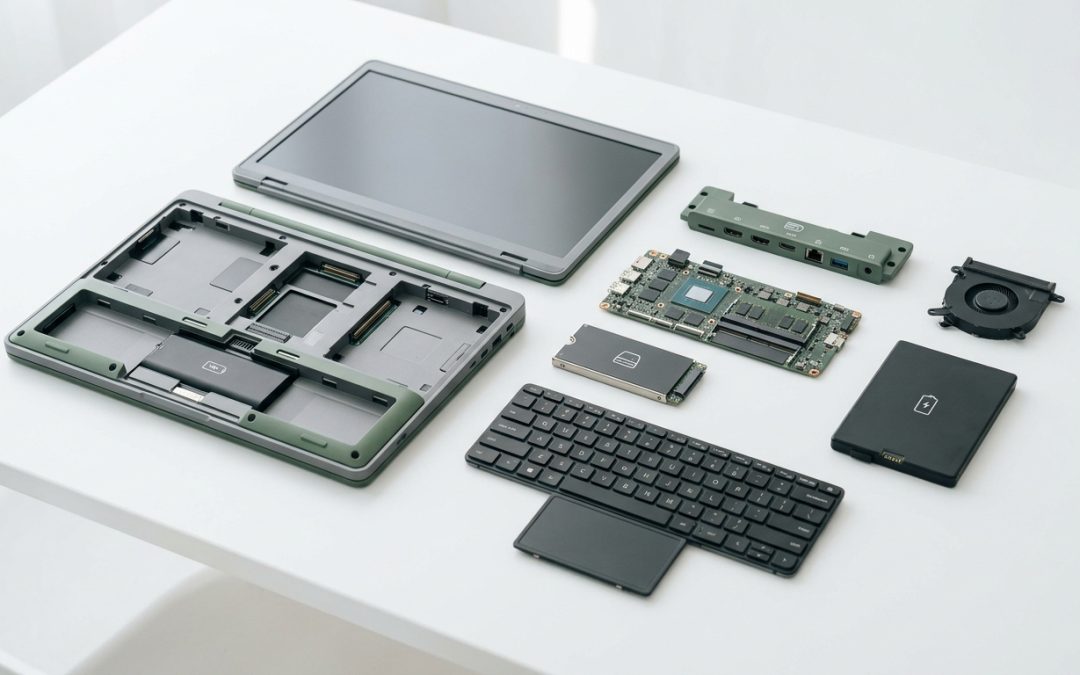
What Are Modular Electronics?
Modular electronics are devices built from discrete, interchangeable components that can be individually replaced, upgraded, or repaired without affecting the rest of the system. Instead of a monolithic device where everything is soldered, glued, and integrated into an inseparable whole, modular design uses standardised connections that allow components to be swapped in and out like building blocks.
The concept isn’t new. Desktop computers have been modular for decades, with standard interfaces for RAM, storage, graphics cards, and expansion slots. What’s new is the push to bring modular design to product categories where integration and miniaturisation have traditionally taken priority: smartphones, laptops, and other portable electronics. This shift is driven by growing recognition that the current model of sealed, disposable devices is environmentally unsustainable.
The Sustainability Case for Modularity
The environmental argument for modular electronics is compelling at every stage of the product lifecycle.
Extended product lifespans. When individual components can be replaced, a device’s life isn’t limited by its weakest part. A smartphone with a worn battery doesn’t need replacement. It needs a new battery module. A laptop that’s become slow doesn’t need to be scrapped. It needs a RAM or storage upgrade. Modularity decouples the lifespan of individual components from the lifespan of the overall device.
Reduced manufacturing demand. Every component that gets upgraded instead of replaced, along with every device that gets repaired instead of discarded, represents manufacturing that didn’t need to happen. Given that manufacturing represents 70-80% of a device’s carbon footprint, reducing manufacturing demand is the single most impactful sustainability strategy in electronics.
Improved recycling outcomes. When a modular device does reach end of life, the modules can be separated cleanly into distinct material streams. A snap-out battery goes to battery recycling. A metal chassis module goes to metals recovery. Circuit boards go to precious metals extraction. This clean separation dramatically improves recovery rates compared to shredding an integrated device and trying to sort the mixed fragments.
Modular Design in Action
Framework Laptop has become the poster child for modular computing. Every major component, from the screen and keyboard to the battery, mainboard, and even the I/O ports, is designed to be user-replaceable. The company sells individual modules and publishes complete repair guides. Users can upgrade their processor by swapping the mainboard while keeping everything else, effectively getting a new laptop in the same chassis.
Fairphone applies similar principles to smartphones. Their devices are designed around snap-fit modules that can be replaced without tools or with a single screwdriver. Battery, screen, camera, speaker, and USB-C port are all individually replaceable modules available for purchase directly from the company.
In enterprise IT, modularity has long been standard in servers and networking equipment. Blade servers, modular switches, and rack systems are built around hot-swappable components precisely because downtime for full device replacement is unacceptable in production environments. The business case for modularity in enterprise computing has been proven for decades.
Google’s Project Ara was an ambitious attempt at a fully modular smartphone in the mid-2010s, ultimately cancelled before commercial launch. While the specific implementation faced technical challenges around connector reliability and electromagnetic interference, the project demonstrated significant industry interest and advanced the engineering knowledge base for modular mobile devices.
The Trade-offs
Modularity involves genuine engineering trade-offs that explain why it hasn’t become universal:
Size and weight. Modular connections require physical connectors, mounting points, and clearances that add bulk. A snap-fit battery module needs a housing, latch mechanism, and alignment features that a glued-in cell doesn’t. For ultra-thin, ultra-light devices where every millimetre matters, modularity adds dimensions.
Performance. Direct integration, such as soldering RAM to the motherboard, can provide marginal performance advantages over socketed connections. For most users, these differences are imperceptible, but in high-performance applications every nanosecond of memory latency matters.
Durability and water resistance. Fewer seams and openings generally means better resistance to dust, water, and physical shock. Modular devices need careful engineering to maintain environmental protection at every module interface. It’s achievable, as Framework and Fairphone demonstrate, but it requires deliberate design effort.
Cost and complexity. Designing for modularity adds engineering complexity and manufacturing costs. Standardised connectors, module housings, and testing for interoperability across component generations all require investment. These costs need to be weighed against the lifecycle savings from extended product life and reduced waste.
The Regulatory Push
Regulation is increasingly favouring modular design principles. The EU’s requirement for user-replaceable batteries in smartphones and tablets, taking effect in phases from 2025, effectively mandates a degree of modularity. Repairability scoring systems reward modular designs that enable component replacement. Extended warranty obligations create financial incentives for manufacturers to make products that are cheaper to repair.
Australia’s regulatory direction, while not yet as prescriptive, is moving toward greater emphasis on product longevity and repairability. The evolving e-waste regulatory landscape is likely to include more explicit expectations about product design and end-of-life management over time.
What Businesses Should Consider
For IT procurement teams, modular design offers practical benefits that go beyond environmental credentials:
Lower total cost of ownership. Equipment that can be upgraded and repaired in-house or through affordable independent service costs less to maintain over its lifetime than sealed devices requiring expensive manufacturer service or full replacement.
Flexible fleet management. Modular devices can be adapted to changing needs. A standard office laptop can be upgraded for a user taking on more demanding work, rather than purchasing a new device. Spare modules can be stocked for rapid repair, minimising downtime.
Stronger sustainability reporting. Choosing modular, repairable equipment demonstrates concrete action on circular economy commitments. The longer asset lifespans and reduced waste volumes translate directly into improved ESG metrics.
Modular electronics represent one of the most promising pathways toward genuinely sustainable technology. While trade-offs exist, the trajectory is clear: as environmental regulations tighten, consumer expectations shift, and the cost of the current disposable model becomes harder to ignore, modularity will move from the fringe to the mainstream of electronics design.
EWV helps Victorian businesses manage e-waste and IT asset disposal compliantly and sustainably — including collection, certified data destruction, and recycling. Contact us for a free quote.