
Settling the Debate Once and For All
Few topics in data destruction generate as much confusion and debate as the question of how many overwrite passes are necessary to securely erase a hard drive. For decades, many organisations have insisted on multi-pass wiping methods, sometimes using seven, 35, or even more passes to overwrite their drives. But modern research has comprehensively answered this question, and the answer may surprise organisations that are still spending hours on unnecessary multi-pass wipes.
Where the Multi-Pass Myth Came From
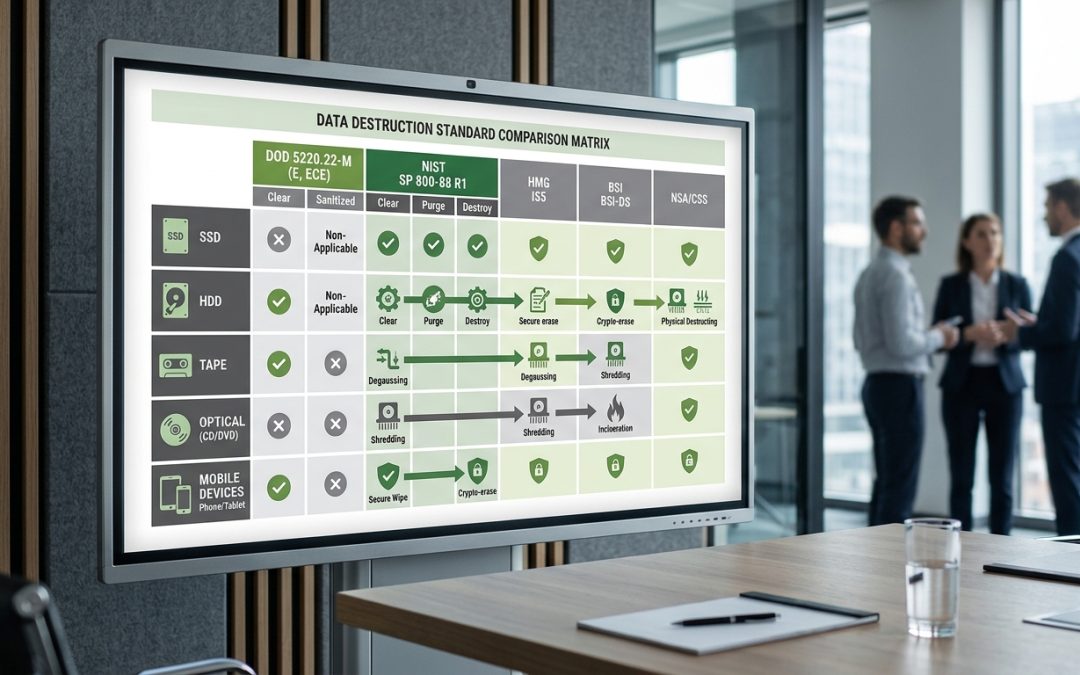
The belief that multiple overwrite passes are necessary traces back primarily to two sources. The U.S. Department of Defense Standard 5220.22-M prescribed a three-pass overwrite method for sanitising magnetic media. Peter Gutmann’s influential 1996 paper proposed a 35-pass method designed to defeat magnetic force microscopy attacks on the encoding technologies used by hard drives of that era.
Both of these sources addressed the storage technologies of their time. In the 1990s, hard drives used longitudinal magnetic recording at data densities that were orders of magnitude lower than modern drives. At those densities, the residual magnetic signal from an overwritten track was potentially detectable using specialised laboratory equipment. The multi-pass methods were designed to address this specific technical reality.
What Has Changed Since Then
Hard drive technology has changed dramatically since the multi-pass methods were developed. Modern drives use perpendicular magnetic recording (PMR) at areal densities exceeding 1 terabit per square inch. Track widths have shrunk from micrometres to nanometres. The magnetic write head generates a precisely focused field that is matched exactly to the track width.
At these densities, the relationship between the written data and the physical magnetic domain is so precise that the residual signal from a previous write is extremely weak, essentially indistinguishable from noise. The physical limitations of modern drive technology make multi-pass overwriting unnecessary for security purposes.
What the Research Shows
Multiple independent research studies have confirmed that a single overwrite pass is sufficient to prevent data recovery from modern hard drives.
A key study by the Centre for Magnetic Recording Research (CMRR) at the University of California, San Diego, examined the recoverability of data after overwriting on modern perpendicular recording media. The researchers found that the probability of correctly recovering a single overwritten bit was approximately 56%, barely better than random chance. The probability of recovering even a single byte (8 bits) drops to below 1%, and recovering any meaningful amount of data is effectively impossible.
Craig Wright and colleagues published research in 2008 that reached similar conclusions, finding no statistically significant difference in data recoverability between single-pass and multi-pass overwriting on modern drives. The study concluded that “for a modern hard drive, a single overwrite pass is sufficient to render data irrecoverable.”
These findings are reflected in the current edition of NIST 800-88, which considers a single-pass overwrite (Clear level) to be effective against non-invasive data recovery techniques for modern magnetic media.
What Peter Gutmann Actually Said
Peter Gutmann, whose 35-pass method became one of the most cited references in data destruction, has publicly clarified that his paper was widely misinterpreted. In a frequently referenced epilogue to his original paper, Gutmann stated that the 35-pass method was designed for drive technologies that used a wide range of encoding methods, many of which are no longer manufactured.
Gutmann explicitly noted that for a modern drive, “a few passes of random scrubbing is the best you can do.” He did not intend for the 35-pass method to become a universal standard applied to all drives regardless of technology. Organisations that still specify 35-pass wipes are following a misunderstanding of the original research, not the researcher’s actual recommendations.
The DoD Has Moved On
The U.S. Department of Defense, whose 5220.22-M standard was the other major source of multi-pass wiping requirements, has also moved away from overwriting as a primary sanitisation method. The current DoD guidance references NIST 800-88 for media sanitisation, effectively endorsing the single-pass approach for modern drives.
Organisations that still specify “DoD 5220.22-M three-pass wipe” in their policies are referencing a standard that its own originator no longer maintains as current guidance.
When Multi-Pass Might Still Be Justified
There are narrow circumstances where multi-pass overwriting may be justified. Very old hard drives using longitudinal recording at low areal densities may benefit from multiple passes, though these drives are extremely rare in current IT environments. Some compliance frameworks or contractual requirements may specifically mandate multi-pass overwriting, and these requirements must be followed regardless of the technical evidence. Some organisations apply multi-pass wiping as a precautionary measure for their most sensitive data, even though the evidence suggests it provides no meaningful additional security.
In these cases, the decision to use multi-pass wiping is driven by policy or contractual requirements rather than technical necessity.
The Cost of Unnecessary Passes
Multi-pass wiping is not free. Each additional pass takes time, with a full overwrite of a 1TB drive taking roughly 2-3 hours depending on the drive speed. A three-pass wipe triples this to 6-9 hours. A 35-pass Gutmann wipe takes approximately 3-4 days per drive.
For organisations wiping hundreds or thousands of drives, unnecessary passes translate directly into increased labour costs, longer turnaround times, higher electricity consumption, and delayed equipment redeployment or disposal. Switching from multi-pass to single-pass wiping can reduce processing time by 60-95% with no reduction in security.
The Modern Recommendation
The multi-pass vs single-pass debate is settled. The science is clear, the standards have been updated, and the original proponents of multi-pass methods have clarified their positions. Organisations that update their practices accordingly save time and money without compromising security.
EWV helps Victorian businesses manage e-waste and IT asset disposal compliantly and sustainably — including collection, certified data destruction, and recycling. Contact us for a free quote.