
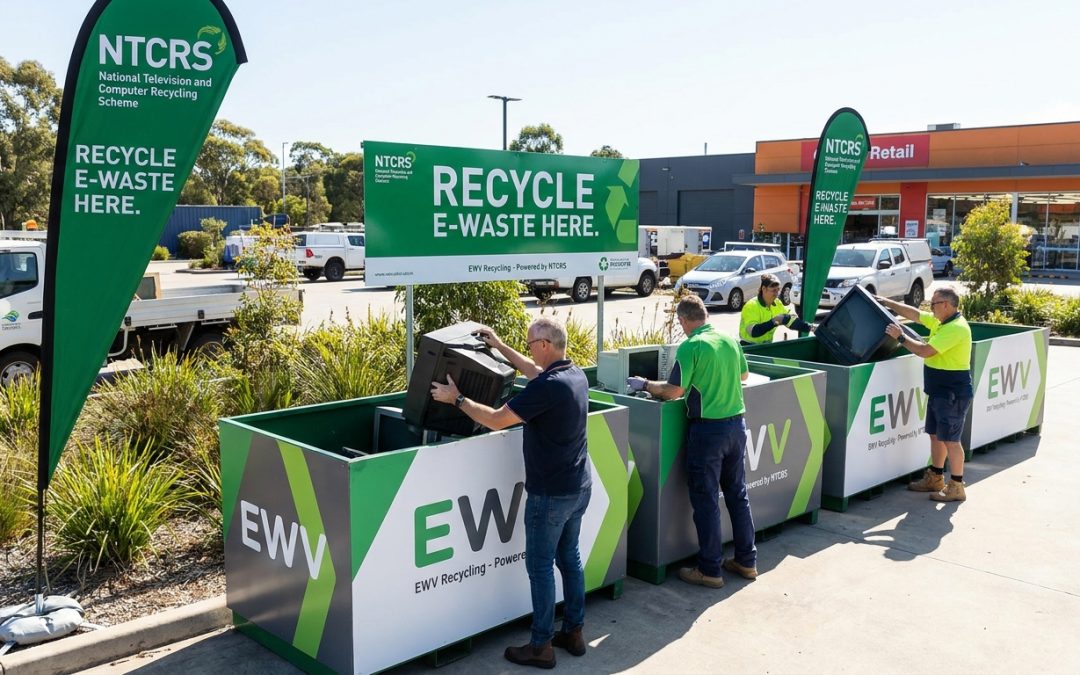
Australia’s Largest E-Waste Recycling Program
The National Television and Computer Recycling Scheme (NTCRS) is Australia’s primary government-mandated program for recycling electronic waste. Established under the Product Stewardship (Televisions and Computers) Regulations 2011, the scheme requires manufacturers and importers of televisions, computers, and printers to fund the collection and recycling of these products when they reach end of life. For consumers and businesses, this translates into free recycling services for covered products at collection points across the country.
The NTCRS was launched in 2012 and represents the federal government’s primary response to the growing challenge of electronic waste. It was the first co-regulatory product stewardship scheme established under the Product Stewardship Act 2011, and it remains the largest in terms of volumes processed and geographic coverage.
Since its inception, the scheme has collected and processed hundreds of thousands of tonnes of e-waste, diverting significant volumes of hazardous materials from landfill and recovering valuable materials for reuse in manufacturing. Understanding how the scheme works helps both consumers and businesses take advantage of the free services it provides.
How the NTCRS Works
The NTCRS operates through a co-regulatory model. This means the government sets the regulatory framework and targets, but the industry manages the operational delivery of the scheme through approved co-regulatory arrangements.
Here is how the different parts connect:
Liable parties are manufacturers and importers of covered products who exceed specified import thresholds. These companies must join an approved co-regulatory arrangement and contribute funding based on the volume and type of products they place on the Australian market. The funding calculation considers the weight and recycling difficulty of different product categories.
Co-regulatory arrangements (CRAs) are industry organisations approved by the government to deliver the scheme’s collection and recycling services. They use the funding contributed by liable parties to establish collection points, contract with recyclers, and manage logistics. Multiple CRAs operate in Australia, providing collection services under various brand names.
- Televisions: all types including CRT, LCD, LED, plasma, and OLED
- Computers: desktops, laptops, notebooks, and tablets
- Computer monitors: all types
- Printers: including multifunction devices (print, scan, copy, fax)
- Computer peripherals: keyboards, mice, external hard drives, and similar accessories
Collection points are established across Australia, including permanent sites and periodic collection events. These are where consumers and businesses can drop off covered products for free recycling. Collection points may be co-located with council transfer stations, operate at retail locations, or function as standalone facilities.
Recyclers contracted by the CRAs process the collected e-waste. They must meet environmental and occupational health standards, and they are required to report on recycling outcomes including material recovery rates. The scheme sets minimum standards for recycling to ensure genuine resource recovery rather than mere disposal.
What the NTCRS Means for Consumers
For households, the NTCRS provides free and convenient recycling for the most common types of consumer electronics. You can take your old television, computer, monitor, printer, or peripherals to a collection point at no charge. This is funded by the manufacturers and importers of these products, not by taxpayers or consumers at the point of disposal.
Finding a collection point is straightforward. The scheme operators maintain online tools that allow you to search for the nearest collection point by postcode. Most metropolitan areas have multiple collection points, and coverage extends to regional and rural areas, though with fewer locations.
There are typically no quantity limits for household drop-offs. Whether you have a single old laptop or a garage full of outdated electronics, the collection points will accept covered products. However, if you have very large quantities, calling ahead to confirm the site can accommodate your drop-off is courteous and practical.
What the NTCRS Means for Businesses
Businesses can also use NTCRS collection points to recycle covered products for free. This is particularly useful for small businesses that may only have a handful of old computers or a few monitors to dispose of. The free service removes cost as a barrier to responsible recycling.
However, businesses should be aware of some limitations. The NTCRS is a recycling scheme, not a data destruction service. Collection points accept equipment for material recovery, but they do not provide certified data destruction. For businesses with data security obligations under the Privacy Act 1988 or other regulations, simply dropping computers at an NTCRS collection point may not satisfy their data protection requirements.
Businesses needing certified data destruction should work with an ITAD (IT Asset Disposition) provider who can provide documented data sanitisation to NIST 800-88 standards before equipment enters the recycling stream. The ITAD provider can then ensure the equipment is recycled through appropriate channels after data has been addressed. See our guide to data destruction for more on this important distinction.
For larger volumes of business e-waste, commercial recycling services may be more practical than NTCRS collection points, which are primarily designed for consumer and small business use. Commercial services offer collection from your premises, bulk handling capability, and the documentation that businesses need for compliance records.
Recycling Targets and Performance
The NTCRS sets annual recycling targets that determine what proportion of covered products placed on the Australian market must be collected and recycled. These targets are expressed as a percentage of the estimated weight of products available for collection (essentially products reaching end of life based on historical sales data and average product lifespans).
The targets have been progressively increased since the scheme’s launch, reflecting the government’s intention to grow recycling rates over time. Meeting these targets requires the CRAs to continuously expand collection infrastructure and recycling capacity.
Performance data shows that the scheme has made significant progress in diverting televisions and computers from landfill. However, the scheme has also faced challenges, including the high cost of recycling certain products (particularly CRT televisions with lead-containing glass), fluctuating commodity prices for recovered materials, and the difficulty of providing services in remote areas.
Limitations and Criticisms
While the NTCRS has achieved considerable success, it has also faced criticism and challenges that are worth understanding.
The scope of coverage is limited. Many common electronic products, including mobile phones, household appliances, power tools, audio equipment, and gaming consoles, fall outside the scheme. This means that a significant portion of Australia’s e-waste stream has no mandatory producer-funded recycling program.
Geographic coverage in remote and regional areas remains a challenge. While the scheme has collection points across the country, the density of services in rural areas is lower than in metropolitan centres. This can make recycling inconvenient for people in remote locations.
The economics of recycling some covered products, particularly CRT televisions, have been challenging. The cost of safely processing CRT glass, which contains lead, exceeds the value of the recovered materials. This has put financial pressure on the scheme and contributed to some processing difficulties.
Despite these limitations, the NTCRS represents a significant step forward in managing electronic waste in Australia. For a broader view of how it fits within the regulatory landscape, see our overview of e-waste laws and regulations across Australia.
Using the NTCRS Effectively
To make the most of the free recycling services provided through the NTCRS:
Check what is covered. The scheme accepts televisions, computers, monitors, printers, and peripherals. Other items may not be accepted at NTCRS-specific collection points, though many sites also accept other e-waste through council or other programs.
Find your nearest collection point using the search tools provided by the scheme operators. Plan your drop-off for when the site is open and you can transport items safely.
Remove personal data from devices before dropping them off if you can do so yourself. For businesses or anyone with sensitive data, use a professional ITAD provider rather than relying on the NTCRS for data security.
The NTCRS exists because the electronics industry recognises its responsibility to help manage the end-of-life phase of its products. Taking advantage of the free services it provides is a practical way to ensure your old electronics are recycled responsibly rather than ending up in landfill. For more on the full recycling process, see our complete guide to e-waste recycling in Australia.
EWV helps Victorian businesses manage e-waste and IT asset disposal compliantly and sustainably — including collection, certified data destruction, and recycling. Contact us for a free quote.