
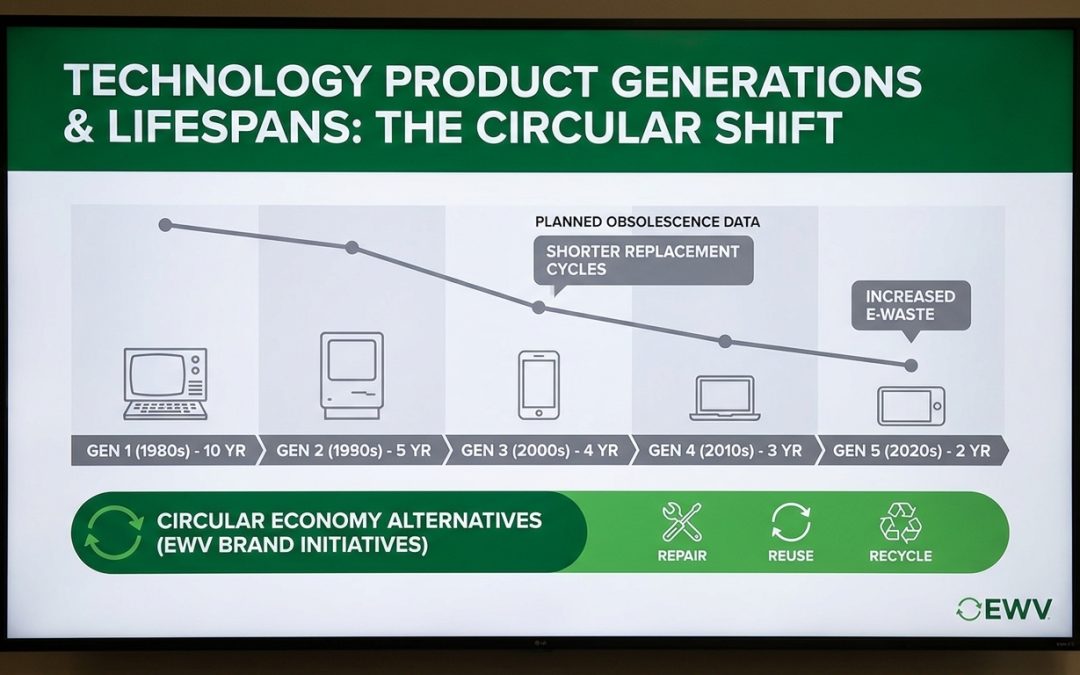
What Is Planned Obsolescence?
Planned obsolescence is the practice of designing products with an intentionally limited lifespan, so that consumers are compelled to purchase replacements sooner than would otherwise be necessary. In the technology sector, this takes several forms, some obvious and some subtle, and it plays a significant role in the volume of electronic waste generated globally.
The concept isn’t new. It was formally described in the 1950s, but its roots stretch back to the 1920s when light bulb manufacturers allegedly conspired to limit bulb lifespans. In modern electronics, planned obsolescence has become sophisticated, operating through hardware design choices, software strategies, and marketing psychology that collectively drive replacement cycles far shorter than technical necessity would dictate.
Types of Planned Obsolescence in Electronics
Physical obsolescence occurs when a device is designed to fail or degrade after a predictable period. This might involve using components rated for a specific number of charge cycles, soldering parts that could be socketed (preventing upgrade), or using adhesive instead of screws (preventing repair). When a $1,200 laptop’s battery is glued into the chassis and costs $500 to replace professionally, the entire device becomes economically obsolete when the battery degrades, even though the rest of the hardware is perfectly functional.
Software obsolescence is increasingly the primary mechanism driving premature device replacement. When an operating system update requires hardware capabilities that older devices don’t support, those devices become obsolete regardless of their physical condition. This is particularly visible with smartphone operating systems, where manufacturer support for older models is typically limited to 3-5 years for Android devices and 5-7 years for Apple devices.
The security implications are significant. Once a device stops receiving security patches, it becomes a liability on any network, effectively forcing replacement for security compliance reasons rather than hardware failure. This creates a form of obsolescence where the manufacturer’s software support decision, not the hardware’s physical condition, determines lifespan.
Psychological obsolescence is driven by marketing and social dynamics rather than technical limitations. Annual product launches, incremental feature updates, and marketing that positions last year’s model as outdated all contribute to a culture of replacement. While this form of obsolescence is less tangible than physical or software-driven obsolescence, its impact on consumption patterns and e-waste generation is enormous.
How Planned Obsolescence Drives E-Waste
The connection between planned obsolescence and e-waste is direct and measurable. When devices are designed to last three years instead of seven, the world produces roughly twice as many devices to deliver the same amount of computing service. That means twice the raw material extraction, twice the manufacturing emissions, and twice the end-of-life waste.
Globally, approximately 62 million tonnes of e-waste was generated in 2022 according to the Global E-waste Monitor, and less than 25% was formally collected and recycled. The remaining 75% was either landfilled, incinerated, or informally processed with minimal environmental controls. Products designed for longer lifespans would significantly reduce this volume.
For businesses, planned obsolescence translates directly into higher total cost of ownership and larger environmental footprints. An organisation replacing 500 laptops every three years instead of every five years will purchase roughly 67% more laptops over a 15-year period, with corresponding increases in procurement costs, setup labour, data migration effort, and disposal logistics.
Legislative Responses
Governments are beginning to address planned obsolescence through legislation. France has been the most aggressive, making planned obsolescence a criminal offence in 2015 with penalties of up to two years imprisonment and 300,000 euros in fines. The law defines planned obsolescence as deliberately shortening a product’s lifespan to increase replacement rate.
The European Union is implementing a suite of regulations that collectively combat planned obsolescence, including mandatory repairability scoring, requirements for spare parts availability, software update obligations, and the Ecodesign for Sustainable Products Regulation that sets minimum durability standards for electronics.
In Australia, the Productivity Commission’s Right to Repair inquiry examined planned obsolescence as part of its review, though it stopped short of recommending specific anti-obsolescence legislation. Australian Consumer Law’s consumer guarantee provisions offer some protection by requiring products to last a “reasonable” time, but enforcement is inconsistent and the definition of “reasonable” remains subjective.
What Businesses Can Do
While individual businesses can’t change manufacturer design practices, they can make procurement and management decisions that mitigate the impact of planned obsolescence on their operations and environmental footprint.
Prioritise repairability in procurement. Choose equipment that can be maintained and upgraded. Laptops with socketed RAM, replaceable batteries, and standard SSD slots will last longer than sealed, glued alternatives. The initial purchase price may be slightly higher, but the total cost of ownership will be lower.
Evaluate software support commitments. Before purchasing, check how long the manufacturer commits to providing operating system support and security updates. A device with a seven-year support commitment is worth more than a cheaper alternative with three years of support, even if the hardware specifications are identical.
Implement lifecycle management. Active IT asset lifecycle management extends equipment life through timely maintenance, component upgrades, and condition-based replacement rather than calendar-based refresh cycles. This approach directly counters the planned obsolescence model by keeping functional equipment in productive use.
Support the secondary market. When equipment does reach end of life for your organisation, proper ITAD processes ensure it enters the refurbishment and resale market rather than becoming waste. A laptop that’s obsolete for your power-user developer may have years of productive life ahead as a general-purpose office machine for another organisation.
Planned obsolescence is a systemic challenge that requires both regulatory and market-based responses. As a business, every decision to extend equipment life, choose repairable products, and properly manage end-of-life assets chips away at the disposability model and supports a more circular approach to electronics.
EWV helps Victorian businesses manage e-waste and IT asset disposal compliantly and sustainably — including collection, certified data destruction, and recycling. Contact us for a free quote.