
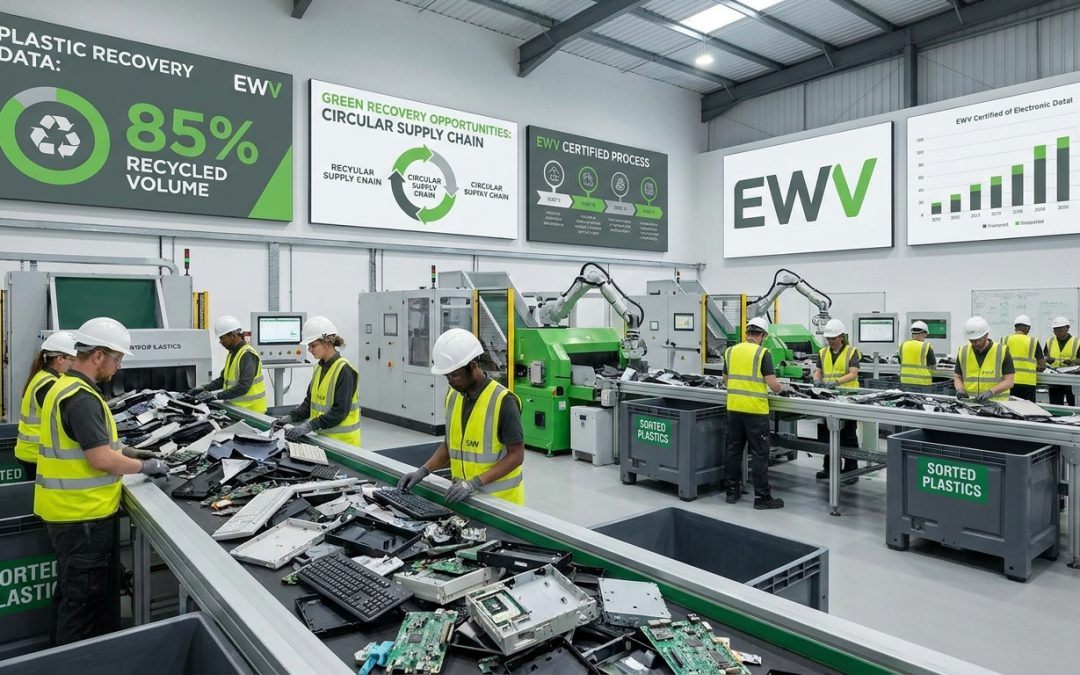
The Plastic Problem in Electronic Waste
When most people think about recycling electronics, they picture metals being recovered from circuit boards or batteries being safely handled. But there’s another material hiding in plain sight that represents one of the biggest challenges in e-waste processing: plastic. Electronic devices contain significant amounts of plastic, from laptop casings and monitor housings to printer components and cable insulation. And recycling this plastic is far more complicated than tossing it in your kerbside bin.
Electronics plastics differ fundamentally from packaging plastics. They’re engineered for durability, heat resistance, and structural integrity, which means they contain a complex mix of polymer types and chemical additives. This complexity makes them both valuable and difficult to process through conventional recycling streams.
What Types of Plastic Are in Electronics?
Electronic devices typically contain several different plastic types, each with distinct properties and recycling challenges. ABS (acrylonitrile butadiene styrene) is one of the most common, used in keyboard keys, monitor housings, and printer casings. Polycarbonate appears in phone cases and laptop shells where transparency or impact resistance is needed. PVC (polyvinyl chloride) is widely used in cable insulation and connectors.
Other plastics found in electronics include polypropylene, polyethylene, and various engineering plastics like nylon and polyphenylene oxide. Many components use blends of multiple plastic types, which complicates sorting and recycling further. A single laptop might contain five or more different plastic formulations.
The Flame Retardant Challenge
One of the biggest obstacles to recycling electronics plastics is the presence of brominated flame retardants (BFRs). These chemicals are added to plastics in electronics to meet fire safety standards, particularly in devices that generate heat. While they serve an important safety function during the product’s life, they create serious problems at end of life.
BFRs are persistent organic pollutants that can leach into the environment if not handled properly. Under the Stockholm Convention, certain BFRs are restricted or banned, which means plastics containing them cannot simply be recycled into new products. They need to be identified, separated, and either treated or disposed of through controlled high-temperature processes.
Modern electronics increasingly use halogen-free flame retardants, but the installed base of older equipment still contains significant quantities of BFRs. This means recyclers must test and sort plastics carefully, adding cost and complexity to the process.
How Electronics Plastics Are Recycled
The recycling process for electronics plastics begins with manual or mechanical disassembly to separate plastic components from metals, glass, and other materials. Once isolated, the plastics go through several stages:
Sorting is the critical first step. Different plastic types must be separated because mixing them produces low-quality recyclate with poor mechanical properties. Advanced sorting technologies include near-infrared spectroscopy, X-ray fluorescence (for detecting BFRs), and density separation in float-sink tanks.
Mechanical recycling involves shredding, washing, and re-pelletising the sorted plastics. The resulting pellets can be used to manufacture new products, though typically not for the same high-performance applications as the original material. This “downcycling” is common because repeated processing degrades polymer chains.
Chemical recycling is an emerging alternative that breaks plastics down to their molecular building blocks. Processes like pyrolysis and depolymerisation can theoretically produce virgin-quality feedstock, though commercial-scale operations are still developing for electronics plastics specifically.
Economic Realities of Plastic Recovery
Unlike metals recovery from e-waste, where gold, copper, and palladium provide strong economic incentives, plastics recovery often operates at marginal economics. The value of recycled engineering plastics is relatively low compared to the cost of sorting, testing for contaminants, and processing them to usable quality.
Several factors affect the economics. Virgin plastic prices fluctuate with oil prices, and when crude oil is cheap, recycled plastics struggle to compete on price alone. The need for BFR testing adds analytical costs. Colour sorting is another consideration, as mixed-colour batches fetch lower prices than uniform streams. Black plastics, which are extremely common in electronics, are particularly problematic because carbon black pigment interferes with infrared sorting systems.
Despite these challenges, regulatory pressure and corporate sustainability commitments are shifting the economics. Recycled content mandates in the EU and growing demand for post-consumer recycled plastics from electronics manufacturers are creating new market opportunities for high-quality electronics plastic recyclate.
Innovation in Electronics Plastic Recycling
The industry is seeing promising developments that could transform how electronics plastics are handled. Solvent-based purification processes can dissolve specific plastic types while leaving contaminants behind, producing high-purity recyclate suitable for demanding applications. Companies in Europe and Asia are piloting these technologies at commercial scale.
Design for recycling is gaining traction among manufacturers. This includes reducing the number of plastic types used in a single product, making components easier to separate, marking plastic parts with resin identification codes, and avoiding dark pigments that complicate sorting. Some manufacturers are already incorporating recycled electronics plastics into new devices.
Digital watermarking and tracer-based sorting technologies are also being developed. These embed invisible markers in plastic parts during manufacturing that can be read by sorting equipment at end of life, enabling precise identification of both polymer type and chemical composition.
What This Means for the Circular Economy
Closing the loop on electronics plastics is essential for achieving genuine circular economy goals in the electronics sector. Currently, a significant proportion of electronics plastics either end up in landfill, are exported for processing in countries with lower environmental standards, or are incinerated for energy recovery rather than being recycled back into useful materials.
For Australian businesses disposing of IT equipment, choosing processors who properly handle plastics, not just metals, makes a meaningful difference. Ask your recycler what happens to the plastic fraction. A responsible processor will have clear pathways for plastic recycling and will be transparent about what percentage actually gets recycled versus sent to energy recovery or landfill.
As the environmental cost of electronics comes under increasing scrutiny, plastics recycling from e-waste is set to become a much bigger part of the sustainability conversation. The technology is advancing, regulations are tightening, and market demand for recycled content is growing. The challenge now is scaling these solutions to match the volume of electronics plastic entering the waste stream.
EWV helps Victorian businesses manage e-waste and IT asset disposal compliantly and sustainably — including collection, certified data destruction, and recycling. Contact us for a free quote.