
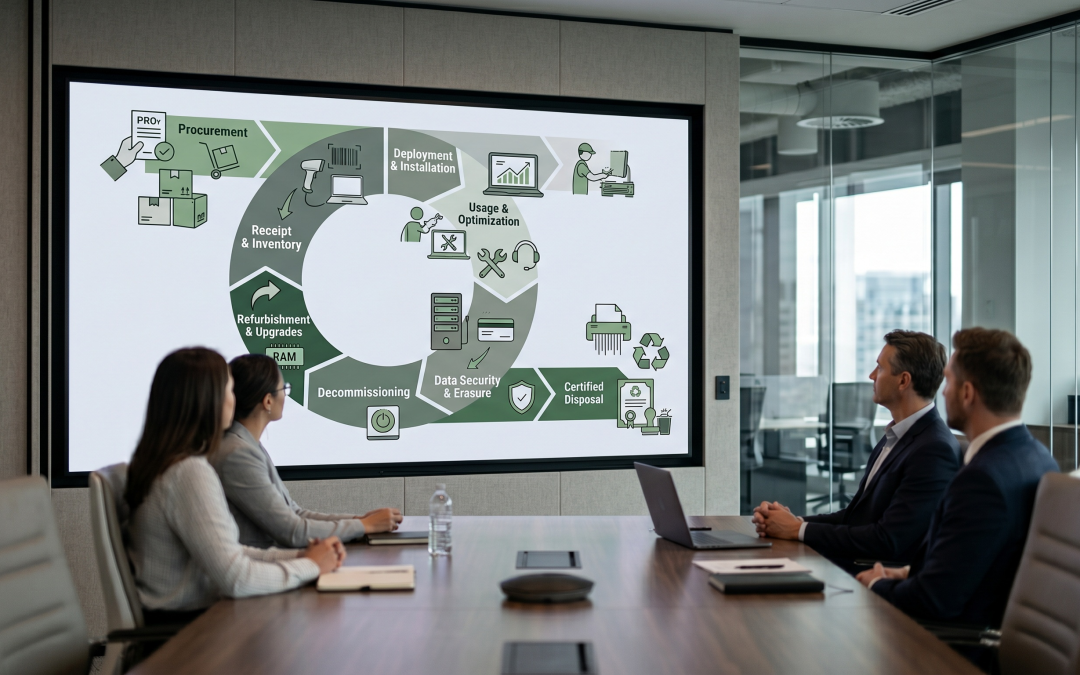
IT procurement and IT disposal are typically managed by different teams with different budgets, different priorities, and little communication between them. This separation is inefficient and costly. What you buy directly affects what you will eventually need to dispose of, and how you plan for disposal should inform what you buy. Connecting these two functions creates a more cost-effective, sustainable, and manageable IT operation.
How Procurement Decisions Affect Disposal
Every procurement decision sets the parameters for a future disposal challenge. The brand and model you choose determines the resale value at end of life. Business-grade equipment from major manufacturers holds value significantly better than consumer-grade or less established brands. Standardisation decisions affect disposal efficiency. Disposing of 200 identical laptops is far simpler and more cost-effective than processing 200 devices across 15 different models.
Storage type and encryption affect data destruction costs. Devices with self-encrypting drives simplify sanitisation. Devices with non-standard storage configurations may require more complex or expensive destruction methods. Build quality and repairability determine how much useful life can be extracted through refurbishment. Equipment that is designed to be repaired and upgraded retains value and functionality longer than sealed, non-repairable devices.
Lease versus purchase decisions change the entire disposal dynamic. Leased equipment must be returned in acceptable condition rather than remarketed or recycled, which creates different obligations and cost structures.
How Disposal Experience Should Inform Procurement
Your disposal experience generates valuable data that should feed back into procurement decisions. If certain brands or models consistently achieve strong resale values, that information should influence future purchasing. If specific devices are problematic to sanitise or frequently fail testing during refurbishment, procurement should consider alternatives.
If your ITAD provider reports that a particular model has high demand in secondary markets, that suggests strong buyer confidence in the product, which is a positive signal for your own use as well. If certain accessories (docking stations, chargers) are frequently missing at disposal because they were not tracked during the asset’s life, procurement should implement better accessory management from day one.
This feedback loop between disposal and procurement requires communication between the teams involved, which starts with recognising that these functions are connected.
Designing for End of Life
Forward-thinking procurement teams include end-of-life considerations in their evaluation criteria. When assessing new equipment purchases, consider the expected resale value at the planned refresh point, the ease of data sanitisation for the device’s storage configuration, the availability and cost of replacement parts for refurbishment, the manufacturer’s track record on product support lifecycles, the device’s recyclability at true end of life, and any take-back or recycling programs offered by the manufacturer.
Some procurement frameworks now include a “disposal cost index” alongside traditional criteria like performance, price, and reliability. This index estimates the net disposal cost (or revenue) for each option, providing a more complete total cost comparison.
Standardisation Benefits
Standardising your IT fleet on fewer models delivers benefits at every lifecycle stage, but the disposal benefits are particularly significant. Standard equipment can be processed in bulk, reducing per-device costs. Consistent batches of the same model attract better remarketing prices. Spare parts are more readily available for refurbishment. Testing and grading is faster and more consistent. And documentation and compliance management is simpler when dealing with fewer variables.
The procurement team controls standardisation decisions. By understanding how these decisions affect disposal, they can make choices that optimise the entire lifecycle rather than just the procurement phase.
Vendor Engagement
Engage equipment vendors on end-of-life topics during the procurement process. Ask about trade-in programs that provide credit toward new purchases when returning old equipment. Enquire about manufacturer recycling programs that may simplify disposal. Discuss product lifecycle commitments including how long models will be supported and when parts become available for refurbishment. And explore whether the vendor offers any certified data destruction tools or services for their products.
Vendors who consider the full product lifecycle in their offerings are increasingly differentiated from those who focus solely on the sale.
Organisational Alignment
Connecting procurement and disposal requires organisational alignment that goes beyond good intentions. Practical steps include holding regular meetings between procurement, IT operations, and the ITAD program manager. Sharing disposal performance data (value recovery, processing costs, remarketing results) with the procurement team. Including disposal cost estimates in procurement business cases and total cost of ownership calculations. Establishing shared KPIs that span the full lifecycle, such as total cost per device per year of use. And creating a feedback mechanism where disposal insights are formally communicated to procurement teams.
When procurement and disposal teams work together rather than in isolation, the benefits compound across the entire IT asset management program.
EWV helps Victorian businesses manage e-waste and IT asset disposal compliantly and sustainably — including collection, certified data destruction, and recycling. Contact us for a free quote.